
Stakeholders urge probate modernization, legal aid and preservation funding at heirs-property hearing
Get AI-powered insights, summaries, and transcripts
Subscribe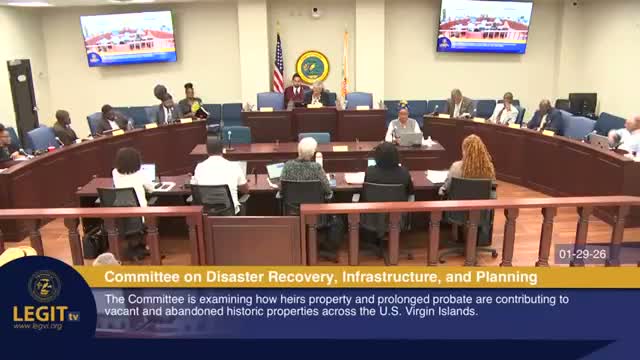
Summary
A multi-stakeholder hearing on heirs property and prolonged probate produced calls for probate modernization (triage case management, temporary preservation authority), improved transfer-on-death deed processing, legal aid and title-clearance funding, and targeted preservation financing for historic towns where hundreds of properties sit vacant or deteriorating.
The Committee on Disaster Recovery, Infrastructure and Planning convened a lengthy multi-stakeholder hearing on heirs property, prolonged probate, and vacant and abandoned historic properties across the U.S. Virgin Islands.
National and local experts, judges, government officials and nonprofit leaders testified that heirs property — land held by multiple family members as undivided fractional interests after a death without estate planning — has produced long-term title fragmentation that blocks repairs, insurance, permitting and financing. Lance George of the Housing Assistance Council called heirs property “structurally rooted” and urged cross-sector solutions, while attorney Karabo Malloy described how probate-generated tenancy-in-common arrangements multiply fractional shares across generations and can lead to predatory partition-by-sale.
Judge Jessica Gallivan told the committee the Superior Court handled roughly 802 active probate matters as of the close of fiscal year 2025 and acknowledged cases dating to the 1980s in the docket. The judge and clerk of court described capacity limits and said delays are driven by a mix of missing records, dispersed heirs, contested matters and administrative burdens. The court asked for funding to retain and train clerical and legal staff and for more streamlined, practical processes to prevent treatable matters from becoming irretrievable losses.
Attorneys who specialize in title work urged several practical fixes the committee could pursue: a standard diligence/‘heir search’ affidavit, statutory safe harbors to speed cadastral attestation and recording for transfer-on-death deeds, a limited temporary preservation authority (a 60–90 day custodial power) to allow stabilization work while probate proceeds, standard forms and default inventory valuations (for example, tax-assessed value subject to objection) to reduce appraisal delays, and modernization of nonresident administrator rules so off-island heirs can serve with reasonable safeguards.
The State Historic Preservation Office and nonprofit stewards described preservation-specific tools. SHPO director Sean Krueger recommended adopting a conservatorship/receivership model (as used in Pennsylvania and Baltimore) to compel rehabilitation of truly abandoned historic buildings while preserving owner equity. Nonprofits including the Saint Croix Foundation, Our Town Fredericksted and the Virgin Islands Architecture Center emphasized the need for funded technical assessments, workforce training for heritage trades, and sustainable public-philanthropic financing to support long-term stewardship.
Several witnesses noted administrative chokepoints that undercut otherwise promising statutory tools. Attorneys told the committee they sometimes discourage clients from using transfer-on-death deeds because recording can be delayed by cadastral attestation steps; the recorder and lieutenant governor's office urged public education to ensure recording of death certificates and change-of-address updates so tax and deed records reflect current owners. Testimony also flagged a recent license suspension in the cadastral office as a governance concern that the lieutenant governor’s office is investigating.
Next steps: committee members praised the breadth of testimony and asked agencies and nonprofits for inventories and documents — including WAPA master plans from the first block and lists of government-owned vacant properties in historic towns — and proposed forming working groups and follow-up hearings. Witnesses and senators agreed the work will require statutory fixes, administrative improvements, sustained funding and expanded legal and technical capacity across agencies and nonprofits to preserve historic properties and unblock title for families.
What matters to owners: witnesses repeatedly stressed that legal fixes alone are not enough—successful strategies will pair statutory change with legal assistance, funding for stabilization/assessments, and community-driven approaches that protect native ownership and minimize displacement.