
Lawmakers press DMH on privatization RFPs, staffing shortfalls and Title 19 true‑ups
Get AI-powered insights, summaries, and transcripts
Subscribe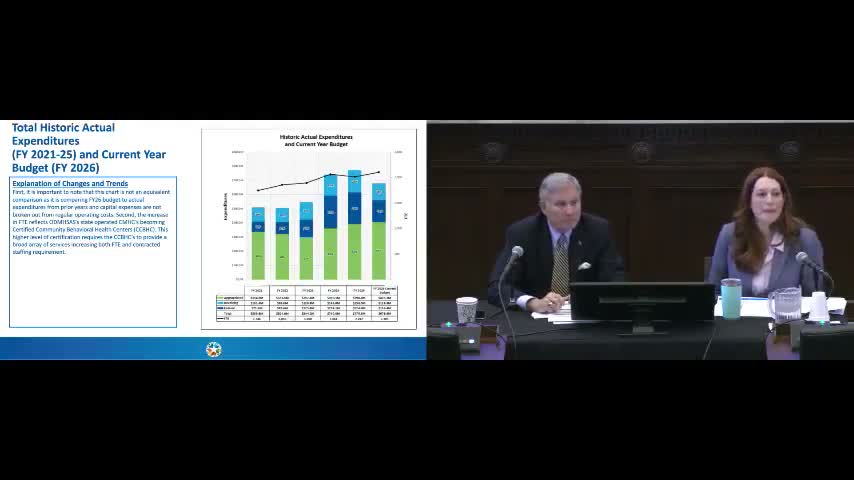
Summary
Legislators questioned DMH officials about an RFP to privatize four state‑run CCBHCs (potentially affecting ~600 FTEs), rapid FTE growth since 2021, and a Title 19 Medicaid true‑up estimated at roughly $20M; the agency said only certified CCBHCs could bid to enable fair cost comparisons.
Lawmakers on the appropriations panel focused extended questioning on the Department of Mental Health and Substance Abuse Services' procurement approach and workforce risks tied to possible privatization of state‑run Community Care Behavioral Health Clinics (CCBHCs).
The RFP and potential staff impacts: Committee members asked whether the department's open request for proposals could force large numbers of state employees out of their roles. Kathy Menefee said the RFP would be open only to currently certified CCBHCs because those providers have completed cost reporting and certified PPS rates that allow a valid cost comparison to state operations. She said if all four state‑run facilities were transferred, the total FTE impact could be "somewhere around 600," depending on location and the contractor's staffing plans.
Why the limit to current CCBHCs? Rep. Coleman and others argued that restricting bidders to existing CCBHCs may exclude capable local providers. Menefee replied the department needs certified rates to compare costs and that expanding eligibility later is possible once the market matures; she said bidders must submit plans to protect consumer transitions and interview existing employees as part of the award criteria.
Staffing, pay and contract labor: Lawmakers described a "hemorrhaging" of staff at some facilities and worried about the effects on patient care. Slovonic said DMH currently uses substantial contract labor—"more than 25% of the staff at the forensic center is contract labor"—and cannot always convert those contractors to FTEs given staffing ratios. He also noted market competition: forensic psychiatrists command high pay and the agency is building clinical residency pipelines with state universities to broaden recruitment.
Title 19 and ETPS payments: Financially, Menefee told the panel the department needs a Title 19 Medicaid true‑up (presented as about $20 million in the budget slides) and a FY25 close‑out request to address roughly $25.6 million in outstanding payments to the Health Care Authority; she said the close‑out ask would be around $19.6 million pending final reconciliations. Members sought assurance that ETPS back payments and enhanced tier payments would be covered; Menefee said the FY25 ask includes two quarters of ETPS for both private and state‑run CCBHCs.
Oversight and employee protections: Representatives emphasized transparency and communication after earlier news leaks about Griffin relocation. Multiple lawmakers urged the department to share data and allow more legislative review; DMH leadership said it would provide additional breakdowns and make staff available for follow‑up briefings. Menefee emphasized that the RFP includes consumer transition requirements and that Medicaid and indigent patients must continue to be served under the CCBHC model.
Ending: The committee did not make procurement decisions at the hearing. Members said they will continue to press for detailed cost reports, clear plans for employee transitions, and documentation showing the Title 19 and ETPS requests cover contractor back‑payments and are sufficient to stabilize provider cash flow.