
Brevard County staff outline 2026 budget constraints and warn proposed homestead exemption could cut services
Get AI-powered insights, summaries, and transcripts
Subscribe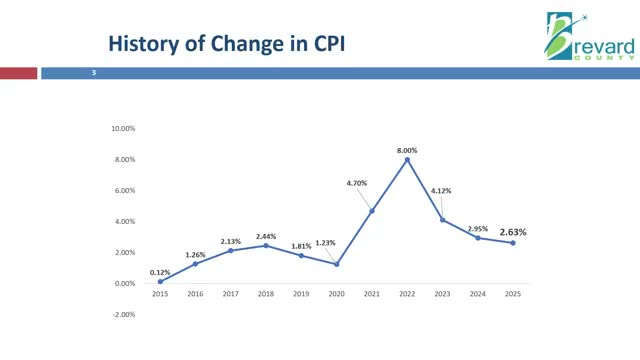
Summary
County budget staff told commissioners that CPI of 2.63% will constrain ad valorem growth under the charter cap, that operating revenue totals about $1.19 billion in 2026, and warned a proposed state homestead-exemption change (identified in staff materials as "House Resolution 203") could sharply reduce non‑school revenues and force cuts unless alternate local revenues are adopted.
Keith Netter, interim director of the Budget Office, told the Brevard County Board of County Commissioners that staff will use a 2.63% CPI figure for fiscal-year 2027 charter-cap calculations and reviewed the county’s revenue mix and legal limits.
“For fiscal year 2027, we’ll be using a CPI of 2.63%,” Netter said, explaining that the charter cap limits the amount of ad valorem revenue the county may collect to the lower of 3% or CPI. He showed staff estimates that operating revenue in 2026 is about $1,190,000,000 and that total county expenses are roughly $2,500,000,000, with the difference driven largely by multiyear capital projects carried forward in enterprise funds.
Netter outlined key general-fund allocations and constraints: charter‑officer support in 2026 totals about $177,000,000 in general-fund support, reserves are set at 10% of operating revenues (about $30,300,000), and many operating programs rely on ad valorem taxes that are constrained by the charter cap and rollback rules under Florida law.
County manager Jim (staff speaker) told commissioners staff’s usable discretionary budget is much smaller than headline totals once multiyear obligations are stripped out. He also flagged potential state action: staff materials referenced a state measure described in the briefing as "House Resolution 203," which would phase in larger homestead exemptions over 10 years and — while holding school and public‑safety levies harmless in some drafts — could significantly reduce county revenues available for other services.
“I don’t see how this bill does not reduce services unless you raise taxes double on the non‑homestead folks,” Jim said, summarizing staff analysis that, depending on how the legislature acts and how voters respond, the county could see large reductions in revenue for parks, roads, libraries and other services in later fiscal years.
Commissioners asked staff for follow‑up details on ambulance-billing recoveries and the final CRA payment to Rockledge; staff said they would supply updated figures. Commissioners and staff agreed to hold further budget workshops in March and to consider revenue options and ballot timing if they decide to pursue county-level surtaxes or fee changes.
The board took no formal votes at the workshop; staff said statutory deadlines and an abbreviated timetable would apply if the board wants changes to take effect next fiscal year, including ordinance advertisement and mailer schedules.