
Building Code Council flags risks in several bills, agrees to send testimony on energy-code language
Get AI-powered insights, summaries, and transcripts
Subscribe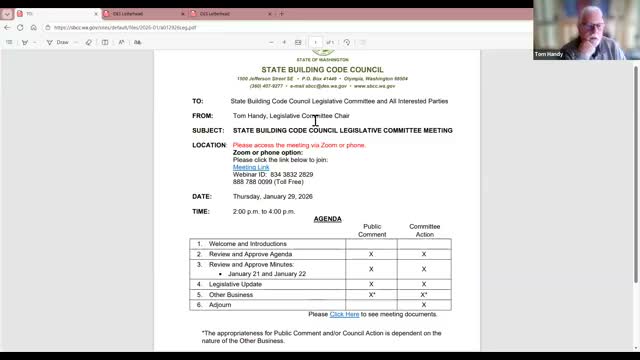
Summary
At its Jan. 29 legislative committee meeting, the State Building Code Council reviewed bills on embodied carbon, kit homes, wildfire risk maps and an energy-cost bill (2486) that members said could undercut the state's energy goals; the council agreed to provide targeted written and oral comments to the Legislature.
OLYMPIA — The State Building Code Council legislative committee spent much of its Jan. 29 meeting reviewing proposed legislation that members said could conflict with current code-development timelines and limit the council’s ability to meet state energy-performance targets.
Staff opened the session with a walkthrough of the tracking spreadsheet and highlighted several bills of interest, including an embodied carbon measure (2273), a low-rise residential/performance-code bill (2381), a Kit Homes bill (5552) and a wildland-urban interface measure (6279). Dustin, the council’s staff lead, explained the sheet’s highlighting and where members should look for new or changed language.
Why it matters: Members said several bills, if enacted as written, could remove the flexibility the council now has to refine standards through rulemaking and could force the council to adopt prescriptive standards or dates that do not align with the 2024/2027 code-development cycle. That mismatch, they said, could hinder the council’s ability to meet the state’s glide path for energy reductions.
Micah, a council member, raised sharp concerns about the proposed embodied-carbon approach, saying the bill ‘‘removes flexibility’’ and ties the state to prescriptive references. ‘‘Again, I almost wish this one would die,’’ Micah said, urging legislators to consider a modified approach that preserves rulemaking discretion.
Multiple members also cautioned about bill 2381, which they said reads broadly and could unintentionally sweep in buildings the council did not intend to regulate under that pathway. Ted and others warned amendments to place energy-performance or rating-system requirements into 19.27 could be overbroad, potentially affecting large facilities beyond the 1–24‑unit, up-to-six‑story buildings the sponsors intended.
The committee devoted significant time to bill 2486, described by several members as confusing first costs with lifecycle costs and, in its current language, potentially limiting the council’s ability to pursue measures necessary to meet the state’s 70% energy‑use reduction target. Kjell (council member) said the bill ‘‘confuses first cost and operational cost’’ and warned that giving permit officials broad discretion to waive provisions could invite inconsistent local results.
What the council decided: The committee moved 2486 into its high-priority category and agreed to provide clarifying comments to the Legislature. Kjell volunteered to prepare testimony and to send an outline to staff in advance; Dustin said he would prepare technical comments and accept written inputs from other members. The committee did not take a formal recorded roll-call vote on legislative positions during the meeting.
Other items: Staff summarized monitoring items including factory-built-structure bills (2151/6158), insurance-rating bills (2277/5928), a schools/renewable-energy exemption bill (5941) and an AI rules-analysis bill that would require agencies to use AI for initial rule reviews and respond to those analyses within short deadlines; members flagged fiscal and human-review concerns for the AI proposal.
What’s next: Staff will draft technical comments on the dates and statutory references flagged by the committee and circulate Kjell’s testimony outline to members for review before submitting materials to the appropriate House committee. The council adjourned after completing the legislative update and routine business.