Georgia forestry director urges market development, highlights wildfire readiness after Helene
Loading...
Summary
Georgia Forestry Commission Director Johnny Sabo told the Natural Resources & Environment committee the state has kept wildfire acreage low through aggressive response, faces market losses after mill closures, and is pursuing equipment, AI detection pilots and market innovation to address fuel loads and salvageable wood.
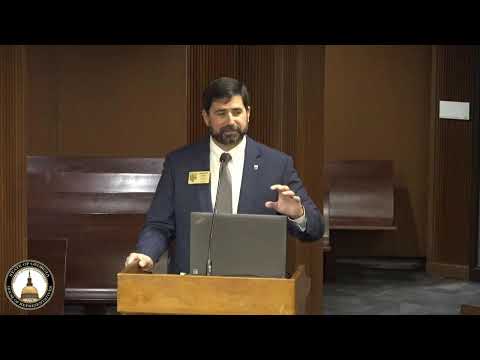
Johnny Sabo, director of the Georgia Forestry Commission, told the Natural Resources & Environment committee on Jan. 31 that the agency has limited the acreage lost to wildfires through rapid suppression but still faces long‑term market and fuel‑loading challenges after Hurricane Helene.
Sabo cited agency fire statistics and said the state recorded roughly 2,100 wildfires with an average of about 5.1 acres per fire; he also noted an earlier 2025 season of more than 4,000 wildfires but said the acreage burned represented less than a tenth of a percent of Georgia’s forested acres. "We kept it to less than a tenth of a percent of our forested acres in the state," he said, calling the suppression record an accomplishment for agency crews.
The commission is balancing immediate wildfire response with recovery and economic work. Sabo described post‑Helene problems: standing and fallen timber that has become fuel, reduced markets after recent mill closures and an estimated 100–120 logging crews potentially exiting the business. He urged expanded markets for small‑diameter wood, noting state efforts such as the Georgia Grown wood project and the Georgia Forestry Innovation Initiative to scale laboratory research into industrial products.
On equipment and readiness, Sabo said the agency has received new firefighting tractors and that a new, larger helicopter funded last year was arriving; he said the newer aircraft can carry about 360 gallons compared with about 180 gallons for the existing helicopter and that pilots will complete manufacturer and in‑house training before deploying. He described rapid response times—about 26 minutes from notification to equipment on scene at nights and weekends—and said one constraint remains how quickly fires are reported to the agency.
To improve detection, Sabo said the commission is testing a Pano AI camera system that stitches multiple views for 360° monitoring and uses automated smoke detection with a human monitor. He said staff will evaluate whether the system can reliably distinguish prescribed burns from wildfires and avoid excessive false positives.
Sabo also highlighted prevention and mitigation: the agency reported a high voluntary adoption rate for water‑quality best management practices (96.7% implementation, as he described it), the addition of four foresters to field positions to reduce caseloads, and a fuel mitigation program he characterized as totaling about $135 million (he said roughly $132 million was allocated and "just under $8 million" paid to landowners during his remarks). The commission has pre‑identified more than 3,700 miles of firebreaks and forest roads in impact areas, he added.
On public outreach, Sabo noted near‑term education efforts—Smokey Bear programs reached nearly 100,000 people and about 41,000 students last year—and a new communications tagline that calls GFC rangers "the first responders for the forest." He also described unified command operations during Winter Storm Firm that worked with state and federal partners to clear 28 counties and remove debris from hundreds of miles of roads.
Committee members asked about pilot training, prescribed fire acreage trends and task force composition. Sabo said prescribed burning acreage has generally increased in recent years (with a dip after Helene) and estimated the commission usually conducts on the order of 150,000 acres of burns statewide on private land annually; he estimated market development for small‑diameter uses could take two to five years to come online. Asked how many acres were lost to clear cutting after Helene, Sabo said he would need to provide a follow‑up figure.
Madam Chair closed the session, noting the committee’s recent visit to a mass timber building near Ponce City Market and announcing upcoming subcommittee meetings and bills.