Lifetime Citizen Portal Access — AI Briefings, Alerts & Unlimited Follows
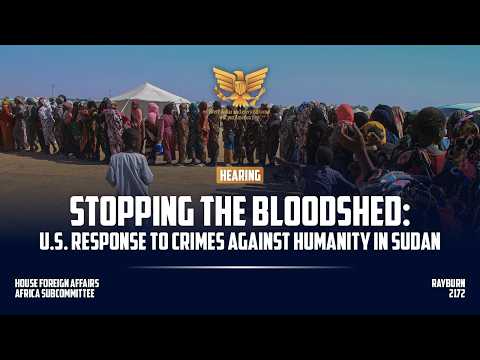
House Foreign Affairs hearing: witnesses and lawmakers urge immediate action to halt Sudan atrocities and restore humanitarian aid
Loading...
Summary
At a House Foreign Affairs subcommittee hearing, State Department and human‑rights witnesses described mass atrocities in Sudan, urged a 90‑day humanitarian truce, stronger sanctions on external backers (including naming RSF an FTO), and restoration of U.S. humanitarian funding to community emergency response networks.
A House Foreign Affairs subcommittee hearing on the conflict in Sudan brought bipartisan urgency and detailed policy proposals on how the United States can press for an immediate cessation of mass atrocities and restore lifesaving aid.
Chairman Smith opened the hearing by framing the session as an examination of “the current state of conflict in Sudan, including very pervasive reports of atrocities against civilians and to evaluate U.S. policy options to bring the fighting to an end.” He and several members blamed external backers — frequently naming the United Arab Emirates, Russia and Iran among others — for fueling the fighting, and raised the possibility of designating the Rapid Support Forces (RSF) as a foreign terrorist organization.
Deputy Assistant Secretary Vincent Spera, who leads Sudan work at the State Department's Bureau of African Affairs, testified that the administration has sanctioned more than 40 individuals and entities connected to the conflict and has provided roughly $405,000,000 in assistance this year. Spera described a three‑pillar U.S. approach under a Quad (U.S., UAE, Saudi Arabia, Egypt) road map that prioritizes (1) pressing the belligerents to accept a 90‑day humanitarian truce, (2) using diplomacy to cut off external financing and arms flows, and (3) building conditions for a future civilian‑led political transition.
“We have put forward a strong text for a humanitarian truce and urge the parties to accept it without any preconditions,” Spera said. He added that much of the immediate challenge is operational: “the central part of the challenge right now are access issues and obstruction issues on part of both parties.”
Members repeatedly asked why the administration could not more quickly use leverage with the UAE to halt support for the RSF, and pressed whether U.S. arms sales to the UAE risked enabling transfers into Sudan. Spera said the State Department is engaging at the highest levels and working through the Quad, but deferred some questions on specific arms‑sale decisions to offices responsible for military sales.
Witnesses from the second panel described verified evidence of systematic abuses and offered concrete recommendations. Nicole Witterschein of Human Rights Watch summarized geospatial and video documentation of mass killings and sexual violence and called for a 10‑point U.S. response that included reestablishing a presidential special envoy for Sudan, restoring U.S. support for local emergency response rooms (ERRs), using Global Magnitsky and targeted sanctions against enabling entities, and supporting the International Criminal Court's investigations.
Ken Isaacs of Samaritan's Purse described famine conditions on the ground and argued an enforceable ceasefire overseen by credible international monitors is a necessary first step to allow humanitarian access. ‘‘You cannot solve a political problem with a humanitarian solution,’’ Isaacs said, adding that aid corridors must be guaranteed and monitored as part of any ceasefire.
Tony Perkins of the Family Research Council recommended reimposing a "country of particular concern" (CPC) designation under the International Religious Freedom Act and urged decentralization and civilian governance as long‑term reforms.
Several members highlighted funding decisions that have constrained relief efforts. Ranking Member Jacobs said earlier cuts to U.S. foreign assistance and the dismantling of USAID capacities forced nearly 80% of community emergency response room activities to stop, affecting more than 1,460 community kitchens; witnesses said that those local networks deliver aid more efficiently to hard‑to‑reach communities and urged Congress to restore funding. Jacobs also referenced pending legislation (the Stand Up for Sudan Act and the U.S. Engagement and Sudanese Peace Act) intended to cut off arms to countries supplying the belligerents.
On accountability and investigations, members and witnesses discussed recent Treasury sanctions on Colombian mercenaries fighting for the RSF, the role of the International Criminal Court (ICC) in Darfur investigations, and the chilling effect of prior sanctions on ICC staff. Witterschein asked Congress to support the UN fact‑finding mission and the ICC's work to document crimes.
The committee sought concrete follow‑up from the administration. Members asked the State Department to clarify who is the senior lead on Sudan policy inside the administration, to identify staffing and readiness for disaster response (a DART), and to provide written answers to outstanding questions. Chairman Smith said he would press the White House on designations and diplomatic outreach to external backers.
The hearing ended with Republican and Democratic members urging more immediate, coordinated action: a credible ceasefire that ensures humanitarian access, further targeted sanctions on those funding or arming belligerents, restoration of U.S. humanitarian funding to community networks, and stronger multilateral pressure through the Quad and the African Union. The committee requested written responses from witnesses and adjourned.
Next steps: witnesses were asked to provide additional written answers within five days; the committee indicated it would continue oversight and follow up with the executive branch on possible designations, sanctions, funding, and diplomatic measures.