Get Full Government Meeting Transcripts, Videos, & Alerts Forever!
Get email alerts on the War Powers Hconres61 topic
No spam. Unsubscribe anytime.
House debate over H.Con.Res.61 centers on strikes in Western Hemisphere and whether cartels are 'terrorists'
Summary
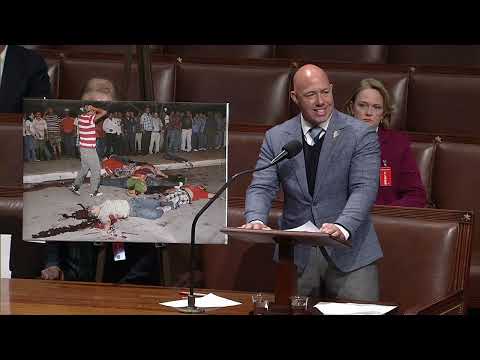
On the House floor Dec. 16, Representative Mr. Mast (the gentleman from Florida) called up H.Con.Res.61 and used his allotted time to argue that transnational cartels operating in the Western Hemisphere constitute terrorist networks and that the president has Article II authority to order limited strikes; debate was opened and 30 minutes each was allocated to Mr. Mast and Mr. Meeks.
The gentleman from Florida, Mr. Mast, called up House Concurrent Resolution 61 on Dec. 16 under the House order of 12/16/2025 and used his time to argue that transnational drug cartels in the Western Hemisphere constitute an imminent threat that may warrant limited executive military action.
Mr. Mast told the chamber, "Right now, we have cartels operating in our backyard. They are kidnapping Americans, extorting families, trafficking women and children, and flooding our towns with fentanyl to maximize death and addiction on American soil." He said those networks were "highly organized, militarized" and compared their tactics to those of Al Qaeda and ISIS.
Why it matters: The concurrent resolution, as read on the floor, would direct the president pursuant to section 5(c) of the War Powers Resolution to remove U.S. Armed Forces from hostilities against presidentially designated terrorist organizations in the Western Hemisphere. Supporters and opponents frame the measure as a test of how far Congress will constrain executive uses of force in the region.
In floor remarks, Mr. Mast named several criminal organizations he said operate as narcoterrorist networks, including the Sinaloa and Jalisco cartels, MS‑13, Tren de Aragua (transcribed in the record as "Trende Aragua"), and what he called the "Cartel of the Suns." He presented personnel estimates and drug‑flow figures as evidence: he said Sinaloa and Jalisco together have "nearly 45,000 members," the Gulf cartel "50,000," and MS‑13 "another 30,000," and he attributed to the Coast Guard a figure of "510,000 pounds of cocaine" interdicted in the Eastern Pacific and Caribbean since the start of 2025. Those statistics were offered by Mr. Mast to support his contention that strikes and interdictions reduce the flow of drugs and save American lives.
Mr. Mast also criticized the resolution's scope on procedural and legal grounds, calling it "reckless and poorly written" because, he said, it could bar the president from acting against foreign terrorist organizations that operate or transit into the Western Hemisphere. He invoked Article II authority and compared the proposed restriction to prior, largely undisputed limited operations in places such as Yemen, Libya and Syria.
The procedural outcome on the floor: the clerk read the title of H.Con.Res.61 and the Speaker announced the resolution would be debated for one hour, equally divided and controlled by the chair and ranking minority member of the Committee on Foreign Affairs; the gentleman from Florida, Mr. Mast, and the gentleman from New York, Mr. Meeks, were each allocated 30 minutes. Mr. Mast also asked unanimous consent to give members five legislative days to revise and extend their remarks; the request was granted "Without objection, so ordered."
The transcript records Mr. Mast reserving the balance of his time and the gentleman from New York being recognized to respond; the record here truncates Mr. Meeks's remarks. The resolution and subsequent debate raise questions about how Congress defines the military/counterterrorism role in the Western Hemisphere and how far it will limit presidential flexibility.
Next steps: Floor debate was opened; Mr. Meeks was recognized to respond after Mr. Mast reserved time. No formal floor vote on the merits of H.Con.Res.61 is recorded in the provided transcript excerpt.