Get Full Government Meeting Transcripts, Videos, & Alerts Forever!
Get email alerts on the Hconres64 Venezuela topic
No spam. Unsubscribe anytime.
Rep. Mass calls H.Con.Res.64 "weak, unnecessary and dangerous," says it would tie the president's hands on Venezuela
Summary
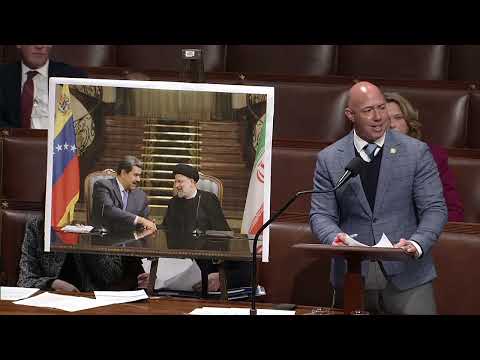
Rep. Mass of Florida opposed House Concurrent Resolution 64 on the House floor Dec. 16, 2025, saying the measure would prevent the president from responding to threats from Venezuela and describing Nicolás Maduro as a "designated narcoterrorist;" the House set one hour of debate equally divided among Rep. Mass, Rep. Meeks and Rep. McGovern.
Representative Mass of Florida opened debate on House Concurrent Resolution 64 on Dec. 16, 2025, calling the measure "weak, unnecessary and dangerous" and arguing it would limit the president's ability to respond to threats from Venezuela.
"This resolution is weak. Unnecessary and it's dangerous," Mass said after the clerk read the resolution directing the removal of United States Armed Forces from hostilities within or against Venezuela that have not been authorized by Congress. The presiding officer announced the resolution would be debated for one hour, "equally divided among" Representative Mass, Representative Meeks of New York and Representative McGovern of Massachusetts, with each controlling 20 minutes.
Mass said the resolution was not about oversight or the Constitution but about "tying the president's hands, specifically, in Venezuela," and characterized the measure as a "preemptive surrender." He argued that the United States is not currently "in hostilities inside Venezuela" and invoked Congress's authorized-use-of-force process, saying the resolution would operate as a blanket restriction on presidential action.
Mass made repeated allegations about Venezuela's government under Nicolás Maduro, calling Maduro "not a legitimate head of state" and "a designated narcoterrorist who is poisoning Americans." He described Venezuela as a "state-run criminal enterprise" and said it moves "more than 250 metric tons of Colombian cocaine through their country every year." Mass also referred to an intercepted "ghost ship" smuggling Venezuelan oil and asked, "How do you enforce sanctions if you're not allowed to stop the shipments?" He added, "Interdicting Venezuelan oil shipmentsthat's not war. It's sanctions enforcement. It's law and order."
Earlier on the floor, a clerk read the resolution's title: "House concurrent resolution 64, concurrent resolution to direct the removal of United States Armed Forces from hostilities within or against Venezuela that have not been authorized by Congress." Representative Mass asked unanimous consent to allow members five legislative days to revise and extend their remarks; the request was granted "without objection." After his remarks Mass "reserved the balance of his time," the clerk said.
The floor debate will proceed under the announced one-hour limit, equally divided among the three named control holders. No formal vote on the resolution is recorded in the transcript segments provided.