
Madison officials outline plan for 10‑megawatt digital‑currency mining site next to Southeast Substation
Get AI-powered insights, summaries, and transcripts
Subscribe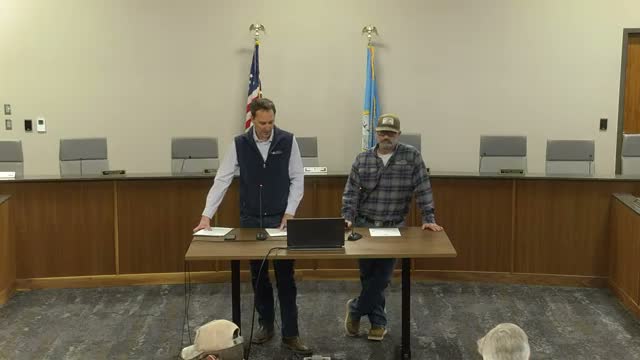
Summary
City officials described a proposed 3.75‑acre Giga Energy bitcoin‑mining facility adjacent to the Southeast Substation, explained the rezoning and conditional‑use steps, and said the project could bring an estimated $425,000 a year to the electric fund while operating under an interruptible rate program.
City Administrator Jameson Berth and Utilities Director Mike Pluster on Thursday described a proposal to host a 10‑megawatt digital‑currency mining facility on 3.75 acres of city property adjacent to Madison’s Southeast Substation.
Berth said the site comprises two parcels (a 3.25‑acre south parcel and a 0.5‑acre north parcel) and that the city and Heartland Energy have signed a letter of intent with Giga Energy to pursue detailed, proprietary discussions. "The data program is an interruptible load," Berth said, adding that the program includes a pass‑through energy charge plus a 1¢ per kilowatt‑hour adder intended to share benefits with the community.
Why it matters: the city would rezone the parcels from Highway Business and Agriculture to Light Manufacturing and then require a conditional use permit (CUP) from the Planning Commission before the facility could operate. Berth told residents the rezoning requires two city commission readings as an ordinance and that the first reading was scheduled for the coming Monday.
What officials said about operations and reliability: Pluster said the mining operation would likely use four to six prefabricated, container‑style buildings and be placed on its own circuit with protective devices so problems at the facility would not automatically cause outages for city residents. He described the interruptible arrangement: "we can interrupt their load, bringing them from a 100% down to 3%," he said, which the city would use in emergencies or to protect resident service during substation issues.
Power and infrastructure: city officials said interconnection studies requested through Heartland and East River and work by the city’s engineering firm DGR showed that to reach 10 MW the system would not require major transmission upgrades beyond some cable and switch replacements to be paid by the operator. Pluster said substation upgrades to accommodate a 115 kV East River loop are already planned and estimated Southeast Substation energization in August–September 2026.
Projected local revenue and rate impacts: Pluster gave an electric‑fund estimate of about $425,000 per year in additional revenue—roughly 3.5% of metered sales—and estimated general‑fund sales tax at about $66,000 annually; lease or sale revenue would be negotiated. "When you have an annual new revenue source such as this ... it pushes downward pressure on rates," Berth said, but he cautioned that precise rate impacts depend on future commission decisions.
Environmental and community concerns: officials addressed EMF and noise. Pluster said EMF levels from containerized equipment "will be about the same as if you're in an office building" and that nearby transmission lines or substations show higher field levels; he did not give numeric EMF values. On sound, the presenters shared decibel readings near the generation plant (90–98 dB while running; 73 dB when not running) and at site edges (east side ~89 dB running, ~66 dB not running) and estimated the proposed facility could be roughly 85 dB in the middle of those measurements. Pluster agreed a third‑party noise study and CUP conditions (screening, fencing, setbacks, landscaping) are appropriate steps.
Ownership, contracts and protections: presenters said Heartland supplies power but does not own the facility; ownership of the site and equipment would be determined in later negotiations with Giga. The city would own medium‑voltage lines up to transformers, they said, and the contract would include protections such as a decommissioning reserve and a reserve deposit to ensure site restoration and to cover large unpaid electric bills if an operator left.
Public questions and next steps: residents asked about nearby examples, line ownership, whether contract protections would survive a sale to a third party, and whether additional right‑of‑way would be needed. Berth said the site has existing dedicated right‑of‑way access and that any additional access needs would be addressed in contract negotiations. The next formal steps are the city commission rezoning readings and the Planning Commission CUP review; no final lease or sale has been executed.
What remains unresolved: ownership structure of the operating entity, final lease versus sale terms, exact noise and EMF measurements for the installed equipment, and the final contract provisions. City staff said those issues are to be defined in negotiations and CUP conditions and that they will continue community engagement as those technical analyses proceed.
The city repeated the presentation at 6:15 p.m. and staff remained afterward to take additional questions.