Madison officials outline plan for 10‑megawatt crypto‑mining site as rezoning, permit steps begin
Loading...
Summary
City officials presented details of a proposed digital currency mining facility on roughly 3.75 acres of city‑owned land, explained rezoning and conditional‑use steps, and described financial protections (decommissioning reserve, billing deposit) and estimated revenue from a 1¢/kWh adder.
Madison city officials on Monday described a proposal to host a digital currency mining facility on about 3.75 acres of city‑owned land and laid out the zoning, permitting and infrastructure steps that would be required before the site could operate.
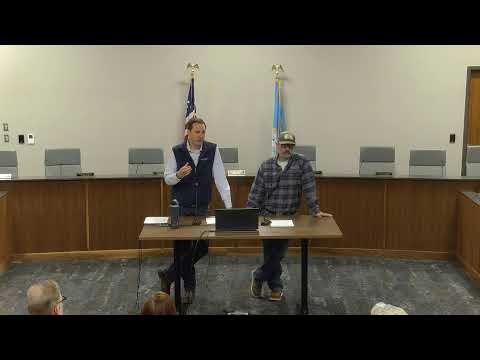
City Administrator Jamieson Berreth said the site under consideration consists of two parcels — a larger southern parcel of about 3.25 acres currently zoned “highway business” and a smaller northern parcel of roughly 0.5 acre in agricultural zoning — and that the administration plans to ask the city commission to rezone both parcels to a light‑manufacturing district. "We are looking at a digital currency mining facility," Berreth said in the presentation, adding that rezoning to light manufacturing would allow the use but would not obligate the city to host a data center.
The project sponsor, identified in the presentation materials as Giga Energy, envisions a relatively small installation of about four to six prefabricated shipping containers or modular buildings operating 24 hours a day. "They mainly look for property that's close to substations," Utilities Director Mike Pluster said. The company would be expected to place its load on a separate circuit with its own protective devices so facility faults would not affect Madison customers.
Officials emphasized the distinction between a mining facility and large artificial‑intelligence data centers: Pluster said the mining operation the city is considering is a scalable load of roughly 10 megawatts initially (possible 10–15 MW range discussed), uses air or closed‑loop cooling with minimal water needs, and requires a small onsite workforce. By contrast, he said, AI data centers use hundreds of megawatts and far greater water and physical footprint, and that Madison lacks capacity and appetite for such facilities.
Process and permits
Berreth outlined the next steps: the planning commission has already heard the rezone application and recommended approval; the city commission will hold a first reading of the rezoning ordinance at its next meeting, with a second reading required at a later meeting. If rezoning succeeds, the applicant — Giga Energy — would then apply for a conditional‑use permit (CUP) before the planning commission, which may impose conditions such as screening, setbacks, landscaping, and noise‑mitigation measures to address gateway‑district standards.
Berreth also described a non‑binding letter of intent (LOI) the city has signed with Giga Energy and Heartland Energy to allow further, proprietary discussions. "This letter of intent...allows the city, Giga, and Heartland to move forward with our discussions," Pluster said, and he stressed the LOI is not the same as an electrical service contract.
Infrastructure and timing
Separately, the city is already planning an upgrade to the Southeast Substation to meet voltage and reliability needs; Pluster said those projects are in Madison's improvement plan and will proceed whether or not the mining facility is built. The Southeast Substation upgrade has an estimated completion in about August 2026, and officials said synchronizing the facility’s energization with substation commissioning would simplify work.
Financial protections and estimates
Officials described contractual protections the city would seek in any final agreement: a decommissioning reserve (cash, bond or escrow) to restore the property if the company departs, and a deposit or reserve to secure initial high electric bills. Pluster said Giga would pay required upgrade costs, professional fees and studies.
Berreth and Pluster explained a proposed 1¢ per kilowatt‑hour adder associated with the data‑rate program; they said roughly half of that adder would flow to the city electric fund and half to Heartland Energy. Pluster presented an electric‑fund estimate of about $425,000 and an estimated general‑fund sales‑tax benefit of about $66,000, noting those figures are estimates and could offset borrowing costs for infrastructure improvements. "I can't make any promises" about future customer rate changes, Berreth said, adding the revenue could reduce upward pressure on rates but exact impacts are uncertain.
Environmental, safety and community concerns
Pluster addressed electromagnetic field (EMF) and noise questions: he said enclosed steel containers would contain EMF levels and that local transmission and substation infrastructure already produces higher EMF levels than the proposed facility. He also presented onsite decibel readings around 85 dB inside the facility during gen‑plant operation and invited attendees to review detailed graphics. Pluster and Berreth both encouraged continued public input via email, phone or in‑person conversations as the process moves forward.
What happens next
If the rezoning ordinance clears two required readings and a CUP is approved by the planning commission with any conditions the commission adopts, the city and Giga would negotiate a final lease or sale agreement and prescribe technical and financial terms before the facility could be built and energized. Officials said the city leans toward leasing the land to retain control but that final disposition would be determined in negotiations. The presentation closed with a brief Q&A and an invitation for further one‑on‑one discussion.
Sources quoted in this story are from the public presentation and question‑and‑answer session: Jamieson Berreth, City Administrator; Mike Pluster, Utilities Director.