
National ESA executive briefs Senate Finance on governance models, funding and shared services
Get AI-powered insights, summaries, and transcripts
Subscribe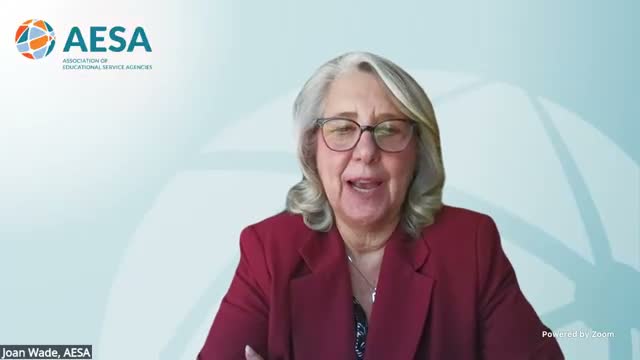
Summary
Joan Wade of the Association of Educational Service Agencies told the Senate Finance committee that regional ESAs provide shared special-education services, cooperative purchasing and technical support; she described governance options and three common funding models.
Joan Wade, executive director of the Association of Educational Service Agencies (AESA), told the Senate Finance committee that educational service agencies — sometimes called CESAs, AEAs, intermediate units or ESCs — are regional organizations that help school districts share specialized services and reduce costs.
"Educational service agencies serve a region of public schools in each state and they have a diverse portfolio of services," Wade said in her Jan. 29 presentation. She told senators ESAs commonly handle special education placements, Medicaid reimbursement programs, professional development, cybersecurity and cooperative purchasing.
Wade described four governance models used across the U.S.: superintendent-led boards, local school-board representation, mixed boards and publicly elected boards. She warned that elected boards can bring public accountability but also electoral costs and the potential for politicization.
On funding, Wade outlined three common models: state baseline funding, fee-for-service (districts buy services), and hybrid approaches that mix state funding for core work with fees for additional services. She said a small number of states (Michigan was cited) give ESAs taxing authority; most ESAs rely on hybrid or fee models.
Wade also highlighted startup approaches for new ESAs, noting many can begin modestly by co-locating in existing district or higher-education facilities and repurposing staff. She offered to provide committee staff a state-by-state report that catalogs ESA governance and funding structures.
Senators thanked Wade for practical examples from Wisconsin, Iowa, Pennsylvania and Texas and signaled interest in follow-up data about documented savings and implementation strategies. Wade said she would share additional resources and offered direct follow-up with committee members.