Get Full Government Meeting Transcripts, Videos, & Alerts Forever!
Get email alerts on the Nvra Hava Reform topic
No spam. Unsubscribe anytime.
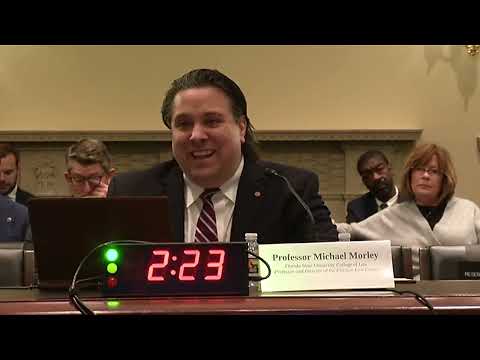
Witness urges House Administration committee to amend NVRA, clarify voter‑roll removal rules
Summary
A testifier before the House Administration: House Committee recommended amending the National Voter Registration Act and Help America Vote Act to relax NVRA's strict "necessary" information standard, allow removal of records of people ineligible at registration with due process, and define terms such as "removal" and the 90‑day quiet period.
At a House Administration: House Committee hearing, an unidentified witness recommended statutory changes to the National Voter Registration Act (NVRA) and the Help America Vote Act (HAVA) to give election officials clearer authority to confirm eligibility and to remove registrations that were invalid from the start.
The witness said the law should balance three core principles: that eligible voters have a reasonable opportunity to vote; that the system produce accurate results by minimizing mistakes, irregularity or fraud; and that election rules sustain public confidence. "A sound electoral system is based on 3 principles," the witness said.
Why it matters: The witness argued that some provisions of NVRA and HAVA are ambiguous or too restrictive, creating obstacles for state officials seeking to verify eligibility or correct erroneous registrations. That, the witness warned, leaves administrators and courts to fill gaps through litigation rather than clear statutory direction.
Most important recommendations
The witness recommended three primary changes. First, revise NVRA's "necessary to" information standard so states may request information "reasonably related to confirming an applicant's eligibility," rather than being limited to a narrower necessity test. The witness argued courts have held that because applicants attest under penalty of perjury that they are citizens, additional documentary requirements are generally unnecessary and therefore impermissible in some cases.
Second, the witness urged the committee to permit election officials to remove records of people who were ineligible at the time they were added to voter rolls, provided officials afford notice and an opportunity to submit evidence. "The NVRA does not expressly provide for the removal of records of people who were ineligible at the outset and should not have been registered in the first place," the witness said, and recommended amending the statute to allow such removals as part of list‑maintenance programs.
Third, the witness asked the committee to clarify several statutory terms that affect how list maintenance is carried out. He proposed defining "removal" to exclude shifting a voter to an inactive list (a voter on the inactive list, the witness noted, "may still vote in an impending election so long as they confirm their identity, address, citizenship, or eligibility"). The witness also urged clarifying that "systematically" (as used in the NVRA's prohibition on systematic removals during the 90‑day quiet period) does not bar measures taken in response to information suggesting particular voters might be ineligible.
Context and supporting points
The witness acknowledged that incidents of noncitizen registration are rare in relative terms—investigations "invariably involve a fraction of 1% of all voter registrations in the jurisdiction"—but said that, in a country with an estimated 28,000,000 noncitizen residents, the public reasonably expects safeguards at registration sites such as motor vehicle agencies to address errors from language barriers, scrivener's mistakes, or automatic registration errors. The testimony also noted that HAVA permits an individual to register even if they lack both a Social Security number and a driver's license.
The witness pointed to judicial interpretations as part of the problem, saying courts have defined terms such as "uniform" and "nondiscriminatory" in varying ways; he suggested statutory definitions would reduce uncertainty and litigation.
Attribution
Quotes and specific formulations in this article are taken from the unidentified witness who began speaking at SEG 001 and concluded at SEG 098.
Next steps
The witness closed by offering to help the committee draft or refine statutory language. The hearing record does not show a committee vote or formal motion on the recommendations; the witness instead asked the committee to consider statutory amendments and clarifications.