Cal Poly Humboldt presents childcare needs assessment, urges employer partnerships and subsidy changes

Eureka City Council · June 4, 2025

Loading...

AI-Generated Content: All content on this page was generated by AI to highlight key points from the meeting. For complete details and context, we recommend watching the full video. so we can fix them.

Summary

Researchers presenting the Humboldt County Childcare Needs Assessment told the Eureka City Council that local childcare supply meets roughly 41% of estimated demand and recommended employer partnerships, higher reimbursement ceilings and streamlined subsidies backed by ARPA-funded stabilization dollars.

Cal Poly Humboldt researchers on Thursday presented a Humboldt County Childcare Needs Assessment to the Eureka City Council, saying the county’s licensed childcare supply meets only around 41% of potential demand and urging a mix of employer partnerships, targeted grants and subsidy reforms.

Nino Di, senior research analyst with the California Center for Rural Policy at Cal Poly Humboldt, told the council the assessment draws on 459 parent survey responses, interviews with licensed providers and secondary data. “Forty-one percent of potential childcare demand, only 41% is met,” Di said, adding that infant care is especially limited in rural southern Humboldt and that 55% of surveyed families want nontraditional hours such as evenings or weekends.

The study, funded through American Rescue Plan Act dollars awarded to Humboldt County and administered as the Humboldt County Childcare Stabilization Fund, lists six policy recommendations: expand availability and accessibility, engage employers as partners, enhance affordability, strengthen the childcare workforce, expand access for children with special needs, and simplify subsidy access and renewals.

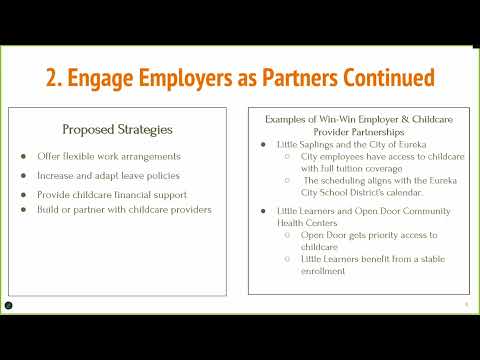
Di emphasized employer engagement as a priority. The report documents circumstances in which employer-sponsored childcare and flexible leave reduce absenteeism and turnover; citing external research, Di said employer-provided childcare benefits can yield substantial returns, noting a 2024 Boston Consulting Group analysis the presentation cited that found a return on investment of up to 425% in studied companies.

On affordability, Di said childcare can consume far larger shares of household income locally than state or national averages. “Child care costs take up to 43% of median income in household” in Humboldt County, he said, compared with about 30% for California and 27% nationally. He also cited a U.S. Department of Health and Human Services guideline that childcare spending ‘‘should not exceed 7% of family income.’’ The presentation called for raising reimbursement ceilings and widening financial-assistance eligibility to include families just above current cutoffs.

Other recommendations address the workforce (higher pay and benefits, professional-development supports), accessibility for children with disabilities (training and facility improvements) and simplifying the subsidy application and renewal processes, which the presenters said are underutilized due to complexity.

Council members asked whether the recommendations were targeted at local governments, businesses or state and federal policymakers. Di and a colleague said many recommendations are aimed at businesses and regional partners, and staff noted the report has been shared with the county Board of Supervisors and state legislative representatives to support broader policy action.

The presentation and report (posted at humboldtchildcare.org, under local advocacy links, according to staff) will be available to council and the public; staff and the researchers said they are open to follow-up questions and partnership discussions.

The council did not take formal action on the report but thanked the presenters and discussed potential next steps for advocacy and local pilot programs.