Get Full Government Meeting Transcripts, Videos, & Alerts Forever!
Get email alerts on the North Spokane Corridor topic
No spam. Unsubscribe anytime.
WSDOT: North Spokane Corridor progressing with major phases; Legislature added $276 million to close cost escalation
Summary
WSDOT Eastern Region Administrator Shar Kay told the Senate Transportation Committee the North Spokane Corridor has seven of eight highway miles open, about $650 million in construction completed to date, and recent legislative funding of $276 million to address cost escalation; major segments advertise in 2026–2027 with completion windows into 2030.
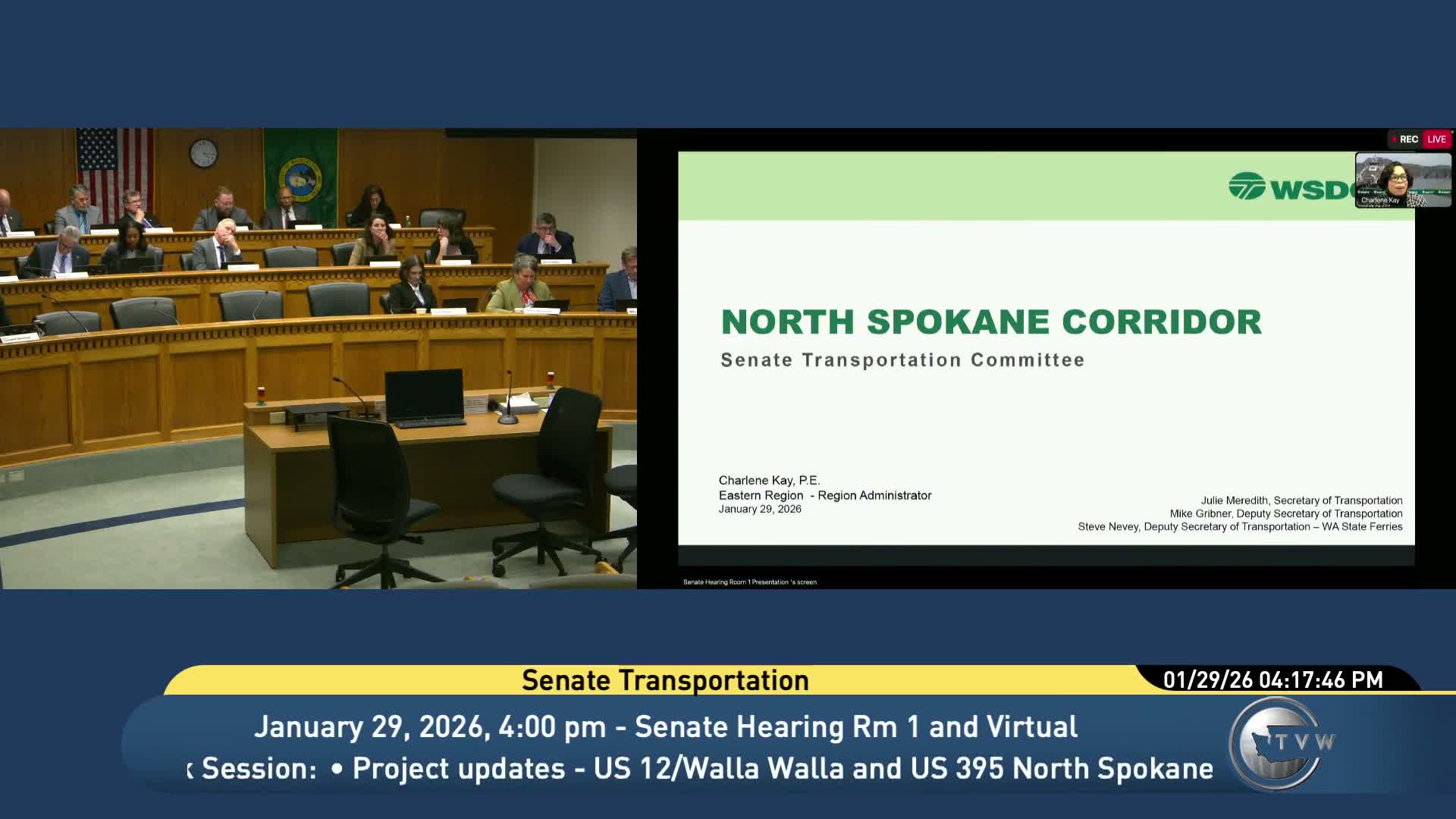
Shar Kay, WSDOT Eastern Region administrator, presented a multi‑slide status report to the Senate Transportation Committee outlining progress and remaining work on the North Spokane Corridor (NSC).
Kay said the NSC will be a 10½‑mile principal north‑south multimodal corridor in Spokane County connecting I‑90 to US 395. “When it is finished, the North Spokane corridor will provide eastern Washington a 10 and a half mile principal north south multimodal corridor,” she said, listing seven of eight highway miles already completed and open to travelers.
Expenditures and recent funding: Kay told the committee the project has completed roughly $650 million in construction and about $345 million in right‑of‑way purchases; she also thanked the Legislature for a recent $276 million appropriation to address projected cost escalation identified through WSDOT’s cost validation process.
Scope and schedule: Kay walked through projects under construction and in advertisement, including the Spokane River Crossing (completion now expected early to mid‑2026 because of a labor strike delay), Stage 2 (Sprague Avenue to Alki Avenue; advertised January 12, bids opening February 25, 2026) and the large I‑90 connection projects planned as three sequential segments with final completion dates for some segments in the 2028–2030 window. She described the Stage 2 estimated bid range as roughly $200–$225 million.
Risks and community impacts: Kay highlighted interdependence of project segments, limited laydown/contractor space, potential contractor resource constraints, new project labor agreement requirements, unknown utility conflicts in built urban environments and the legacy of displacement in the corridor. She said WSDOT is coordinating neighborhood engagement and design elements to reduce visual impacts and to add multimodal connections, including a separated shared‑use path. Kay noted the agency will run another cost validation process in April 2026.
What this means: The presentation framed the NSC as a multi‑decade legacy project with both transportation and community impacts and with near‑term construction milestones that require continued resourcing and close coordination among contractors, local governments and federal reviewers.
Closing: Kay closed by thanking committee members for support and community engagement. The committee responded with recognition of the project’s scale and partnership work.
Reporting note: Transcript contains multiple numeric summaries from Kay’s slides; direct quotes and numerical figures are taken from her presentation to the committee.