Get Full Government Meeting Transcripts, Videos, & Alerts Forever!
Get email alerts on the Luxury Aircraft Tax topic
No spam. Unsubscribe anytime.
Business aviation, airports urge repeal of luxury aircraft tax; port urges caution to protect SAF funding
Summary
Hundreds of aviation industry witnesses and airport officials told the committee HB 2347 should repeal the recently enacted 10% luxury aircraft tax on noncommercial aircraft above $500,000, citing aircraft relocations, job and revenue losses and practical enforcement problems; the Port of Seattle urged working toward a fix that preserves sustainable aviation fuel (SAF) funding.
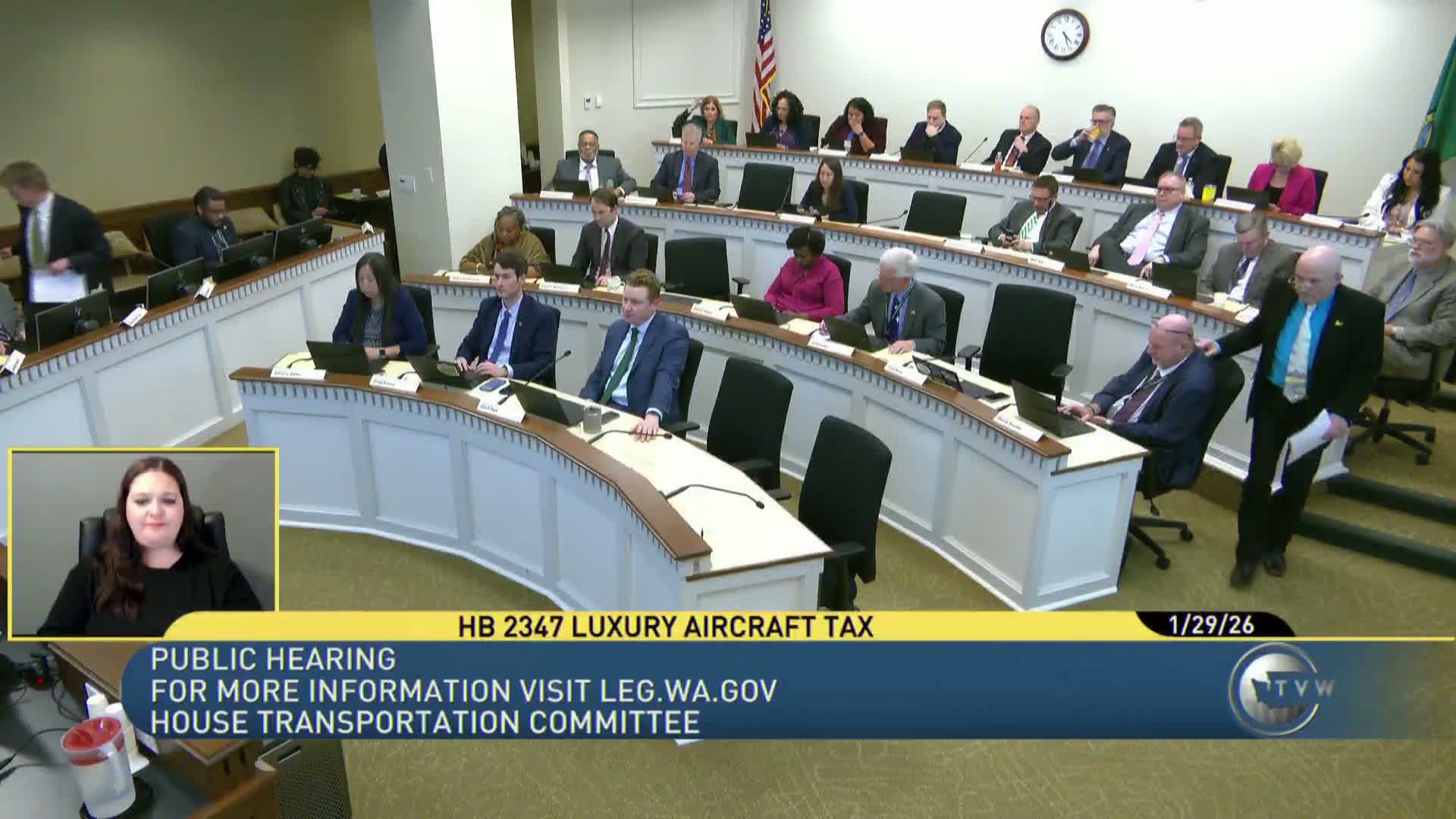
The House Transportation Committee heard extensive public testimony on House Bill 2347, a proposal to repeal the luxury aircraft tax enacted last year (referred to in testimony as Senate Bill 5801). Staff explained the existing tax imposes a 10% sales and use tax on noncommercial aircraft value above $500,000 and directs proceeds into a sustainable aviation fuel account for SAF research, development and infrastructure. The bill before the committee would repeal that tax and take effect immediately.
Lily Smith, committee staff, told the committee that the tax is scheduled to take effect on April 1 and described the fiscal note included in the bill packet: repealing the tax would reduce state receipts by an estimated $700,000 beginning in the current fiscal year (starting April 1) and by just over $4 million in fiscal 2027, with larger amounts projected in later years.
Representative Tom Dent, sponsor of HB 2347, said the tax unintentionally burdens business, agricultural and emergency operations that use aircraft as working tools rather than luxury items. “If we don’t, we’re gonna lose some of them and we will lose them,” Dent said, urging the committee to consider the tax’s effect on jobs, maintenance facilities and fuel sales.
Industry witnesses and airport officials gave detailed examples alleging real losses since the law passed. Eric Schneider of Modern Aviation told the committee some customers have already moved aircraft out of state; he said “To date, 5 aircraft have already left.” Brett Smith of Propeller Airports and other witnesses cited an AOPA survey and industry analyses they said show much larger downstream revenue losses; witnesses told the committee AOPA estimated roughly $90 million a year in lost revenue under scenarios they presented.
Speakers argued the tax is difficult to apply in practice because many aircraft have mixed personal and business use, and they said the tax could hollow out aviation-dependent businesses and airports in rural and urban areas alike. Representatives of Weyerhaeuser, Schweitzer Engineering Laboratories, regional airport managers and the National Business Aviation Association described cancelled investments, empty hangars and threats to local jobs.
Not all testimony pushed for a full repeal. John Flanagan of the Port of Seattle said ports and some stakeholders want to work with the sponsor and proponents to avoid a full repeal that would eliminate the SAF account without identifying replacement funding. He described the scale of potential infrastructure costs for SAF blending and storage (for example, testimony cited a $50 million estimate for a single blending facility and roughly $100 million for shared storage facilities) and urged a negotiated approach that preserves funding for SAF deployment.
Committee members asked witnesses for concrete numbers and survey details; some witnesses said they would follow up with additional data. The committee closed the public hearing on HB 2347; no vote was taken on the bill at the hearing.
Next steps: proponents said they will provide supporting documentation and survey details; staff and the sponsor may work to craft language that addresses definitional, enforcement and funding trade-offs.