Get Full Government Meeting Transcripts, Videos, & Alerts Forever!
Get email alerts on the Sb 5439 topic
No spam. Unsubscribe anytime.
Supporters tell Senate committee divestment from thermal coal is low‑cost, high‑impact; SIB warns of costs and limits
Summary
At a Ways and Means hearing, advocates urged passage of SB 5,439 to phase out SIB investments in thermal coal by 2030, citing about $2.6 billion in coal exposure (roughly 1% of holdings); SIB had earlier cautioned that exclusions can raise fees and reduce diversification.
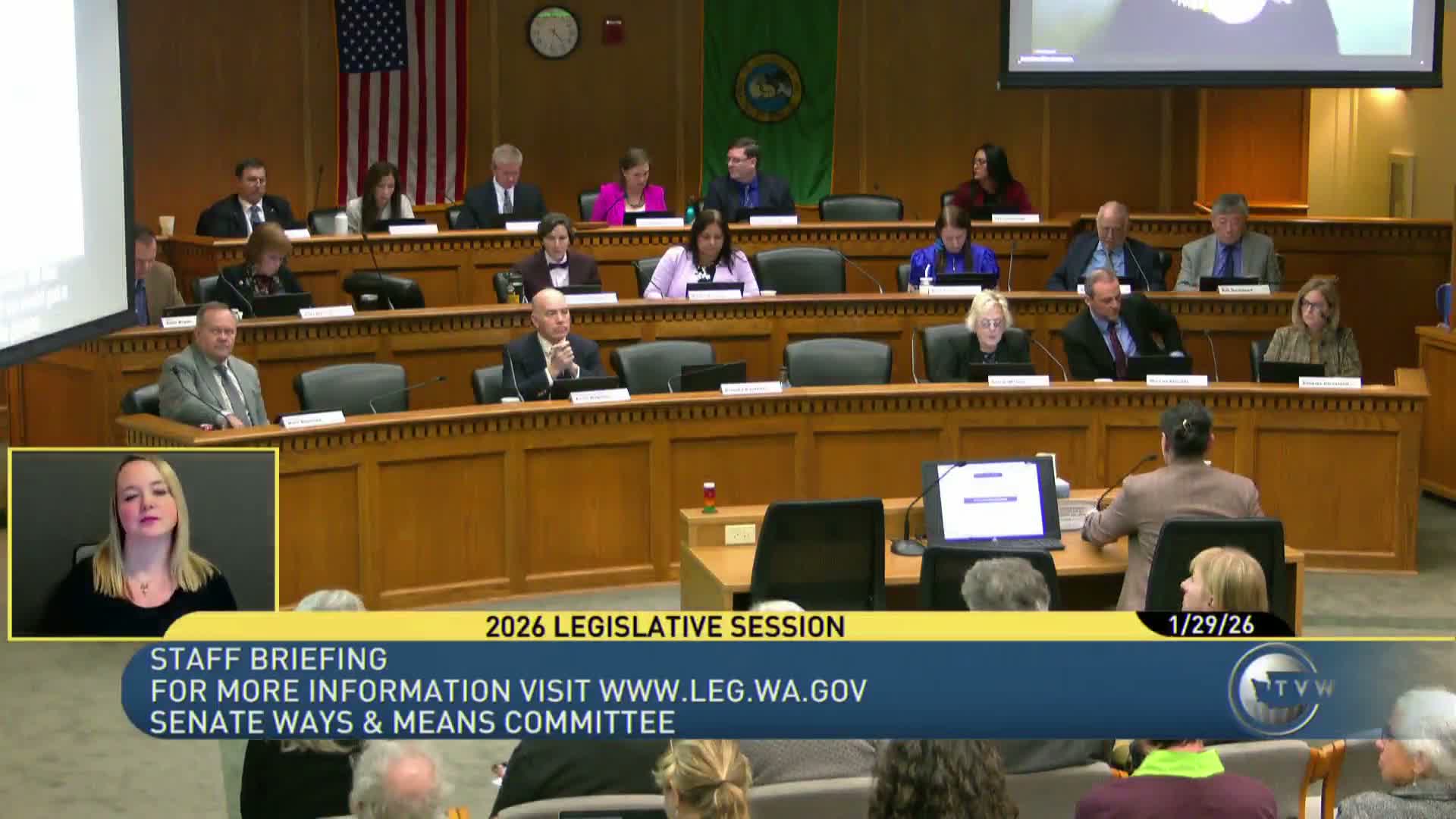
Proponents of Senate Bill 5,439 told the Washington Senate Ways and Means Committee on Jan. 29 that the State Investment Board should stop new investments in thermal coal beginning in 2026 and fully divest by Jan. 1, 2030. Amanda Cecil, committee staff, summarized the bill: SIB may use a non‑governmental Global Coal Exit List to identify thermal‑coal companies, consult peer funds and adopt transition timelines with limited exceptions; the Department of Ecology will annually review definitions and report differences to the legislature.
Multiple witnesses said SIB held about $2,600,000,000 in companies identified on the Global Coal Exit List in 2022 — roughly 1 percent of the portfolio — a figure cited repeatedly by advocates. Barb Carey, a PERS III retiree and divest Washington co‑lead, said the exposure “is only 1% of the portfolio, an amount readily rebalanced in everyday SIB business.” Kathrin Ganswind, who said she led research for a German NGO using the Global Coal Exit List, argued the list is more comprehensive for coal exposure than some vendor data and can be used for screening, engagement and phase‑out planning.
Environmental and public‑health speakers said coal investments pose long‑term financial and health risks. Andrew Echols of 350 Washington called coal “a violation of SIB’s fiduciary duty” because climate‑related damages could impose persistent inflationary and economic shocks that harm future beneficiaries. Adam Loe, speaking for Washington Physicians for Social Responsibility, connected coal burning to respiratory and cardiovascular disease and said the fund’s roughly $2.6 billion coal exposure is a public‑health concern even if it is a small share of assets.
SIB staff had earlier told the committee that public equity exposure is largely managed through passive index funds to keep costs low, and that mandating exclusions or custom vehicles could increase fees substantially. James Aber of WSIB said SIB evaluates ESG factors through a materiality lens and favors engagement and proxy voting where it can influence corporate transition plans; he cautioned that divestment removes ownership and the ability to influence change. “You do give up your voice and your ability to influence change if you don't own a stock or a company,” Aber said.
The fiscal note for SB 5,439 was requested but not yet available at the hearing. Advocates and experts argued that available low‑carbon index products and normal rebalancing make the transition feasible without harming long‑term returns; SIB staff repeated that any structural change should be evaluated for cost and implementation implications.