Get Full Government Meeting Transcripts, Videos, & Alerts Forever!
Get email alerts on the Scap Onbase Schools topic
No spam. Unsubscribe anytime.
Bill would change SCAP eligibility for schools on military bases; OSPI proposes compliance fix
Summary
House Bill 2470 would exclude instructional facilities located on military bases from a district's counted space when calculating SCAP eligibility, potentially increasing state construction assistance for districts like Clover Park; OSPI said federal law limits referencing federal funds and proposed amending the bill to boost the state's funding assistance percentage by 15%.
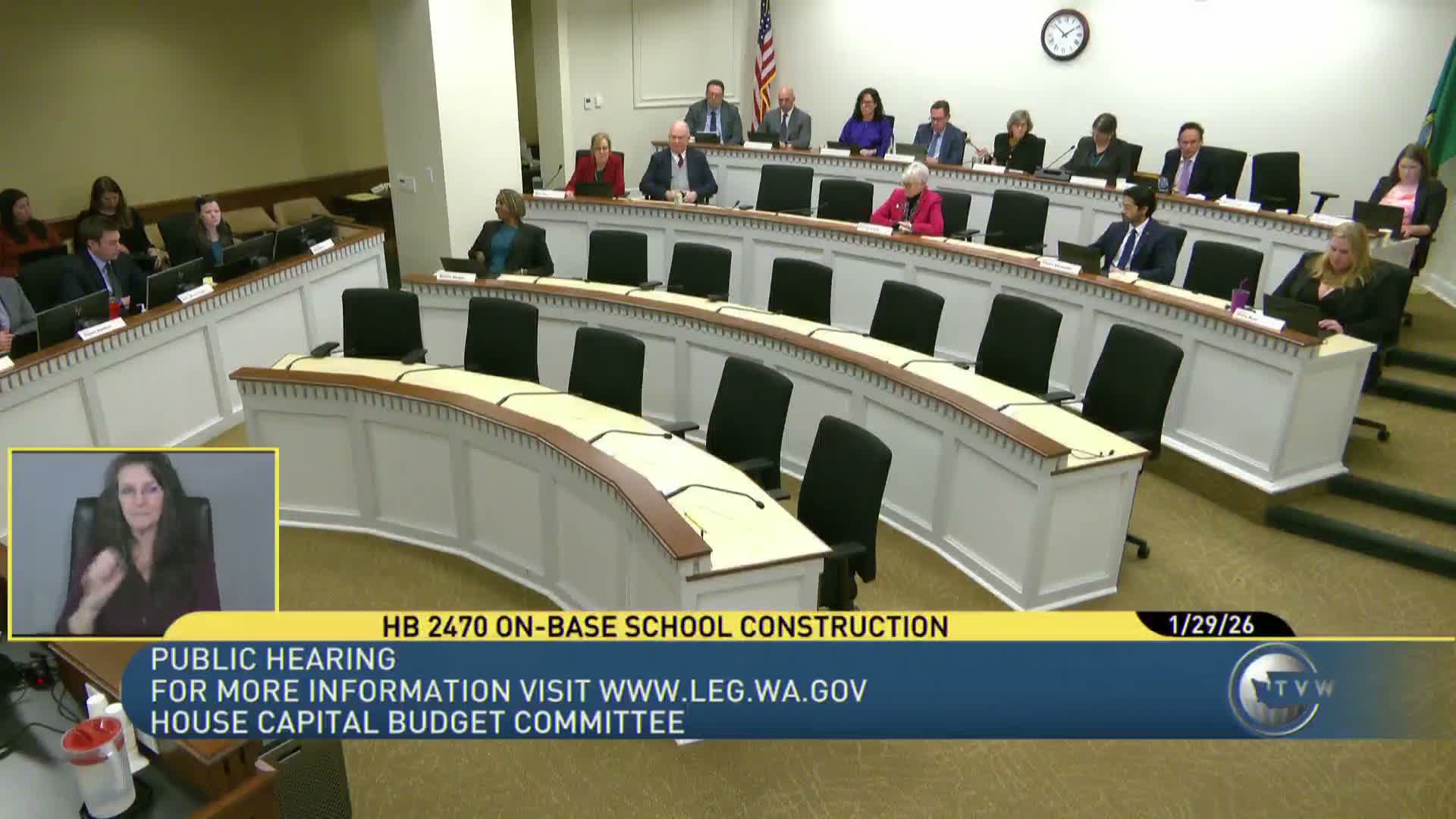
House Bill 2470, sponsored by Representative Levitt (introduced in committee by Representative Marie Lovett), would alter the School Construction Assistance Program (SCAP) by excluding instructional facilities located on military bases from a district's inventory of available instructional space when determining state assistance eligibility. Staff explained that excluding on‑base facilities would typically reduce counted space and therefore increase a district's eligibility for state support.
Representative Marie Lovett (28th Legislative District) said military families and school districts that host bases face special challenges and that counting on‑base facilities against a district's eligible space can disadvantage those districts. "Having some flexibility so those facilities and spaces aren't counted against the school district ... is essential," she said.
Tyler Munch, testifying for the Office of Superintendent of Public Instruction (OSPI), said federal law prohibits referencing federal funds in state policy and that OSPI is working with Representative Levitt to amend the bill to increase SCAP's funding assistance percentage by 15% rather than attempting a full backfill tied to federal impact aid. "Shifting from a full backfill to a 15% increase in the funding assistance percentage is necessary to maintain compliance with federal law while still addressing the underlying equity problem the bill was designed to solve," Munch said.
Charlie Brown, representing Clover Park School District, described Clover Park as having a high percentage of military families and relatively high poverty and said the proposed exception would mean a lot to local families. Committee members asked about coordination with the U.S. Department of Education; Brown offered to follow up with district contacts.
OSPI's fiscal note, summarized in the staff briefing, showed illustrative estimates for two districts (Clover Park and Medical Lake) and projected an uncertain annual cost in the range of approximately $17 million to $18 million under illustrative assumptions, which staff emphasized were uncertain. The committee closed the hearing after testimony; no committee vote was taken at this meeting.