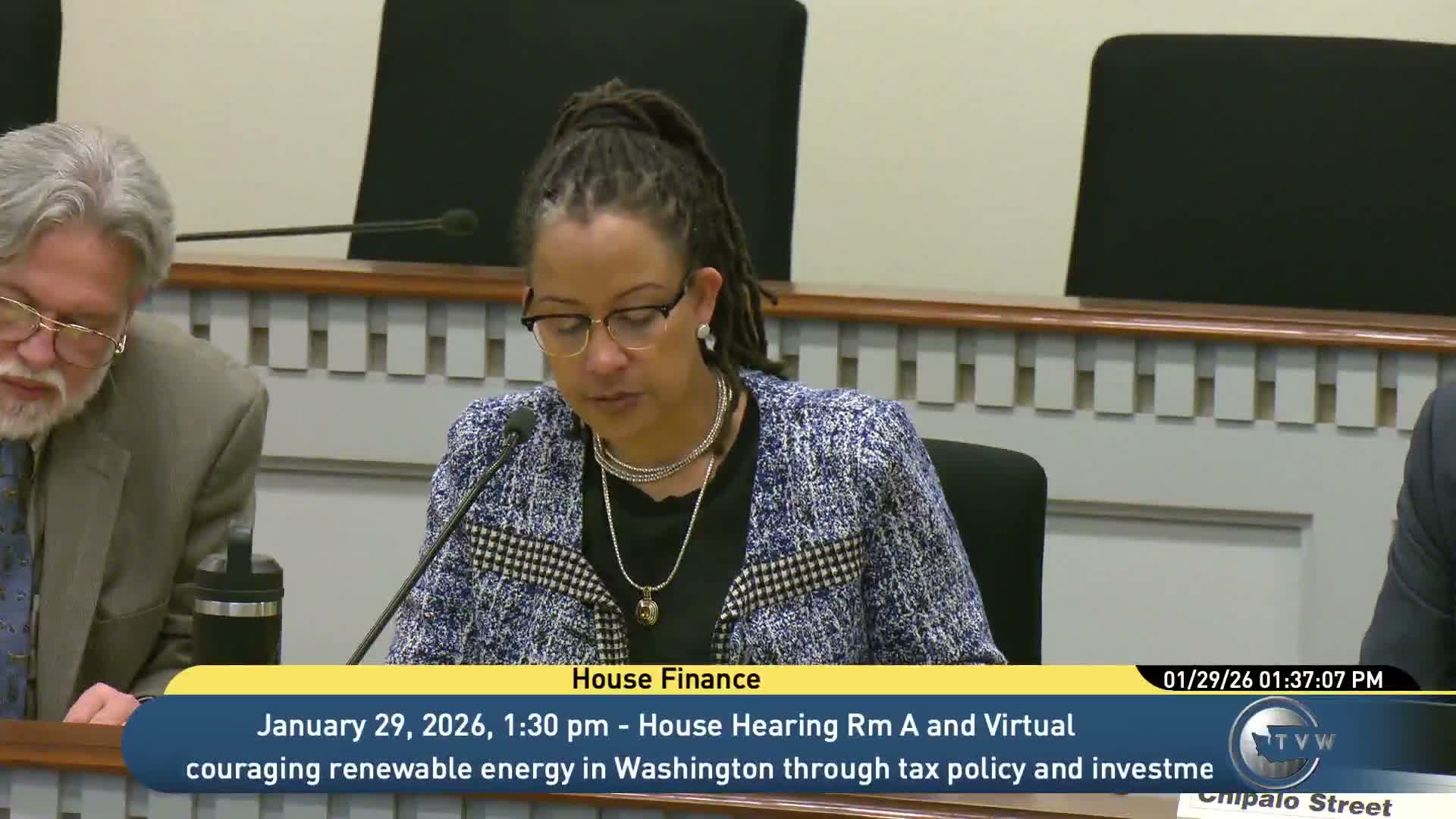
House Finance committee advances substitute to tax renewable-energy personal property after amendments
Loading...
Summary
After technical and policy amendments, the committee voted to report out a third substitute for HB 1960 that sets state and local excise taxes on personal property of new or opted‑in renewable energy and battery storage systems; roll call was 11 ayes, 4 nays.
The House Finance Committee on Jan. 29 approved a third substitute to House Bill 1960 that would permit state and local excise taxes on personal property associated with renewable-energy generating systems and battery-electric storage systems that become operational on or after Jan. 1, 2028, and for existing systems that opt in or meet the bill’s definition of repowered.
Sponsor Representative Rammell, in opening remarks, framed the bill as ensuring communities hosting renewable systems ‘‘realize a lasting economic benefit’’ and said he had worked with stakeholders and tribes to refine definitions and rates. "I really appreciate the committee's time and attention on this topic," Rammell said, adding that the bill still required work on rates and tribal language but was ready for further consideration.
Staff and members discussed several amendments. An adopted technical amendment (TAYT 5-15) clarified who is responsible for verifications, notification timing and that payments must be monthly rather than semiannually. Representative Orcutt supported an amendment to direct an adjustment to tax levies so revenue shifts would not disadvantage taxing districts and pressed for revenue-neutral designs that compensate districts for prior shifts. Representative Bramwell and others successfully moved an amendment to have the Joint Legislative Audit and Review Committee (JLARC) conduct an independent study and obtain necessary data from the Department of Revenue and county assessors.
Opponents raised concerns about potential long-term effects on taxing districts and the need to calibrate local-option rates. Representative Bridal argued that differing treatment of repowered systems could create unintended consequences; other members said the bill should not penalize repowering or reinvestment.
After amendment votes, staff conducted a roll call. The committee recorded 11 ayes and 4 nays; the motion to report the third substitute out of committee with a due-pass recommendation carried. Recorded votes were read aloud by staff; members voting aye included Berg, Street, Orcutt (aye without recommendation on one roll), Mena, Ramel, Santos, Scott, Springer, Wallen, Wiley and Zahn; members voting nay included Jacobson, Abel, Chase and Penner (notations varied by vote line). The committee’s action sends the bill, as amended, to the next stage of the legislative process.
The committee also adopted language clarifying eligible tribal recipients for one Ecology grant program referenced in the bill and added JLARC’s independent review requirement. The sponsor said those details and rate-setting remain subject to continued work in the short session.
The committee reported the substitute out with a due-pass recommendation; the bill’s proponents and critics signaled plans to continue negotiating technical language and rates before floor consideration.