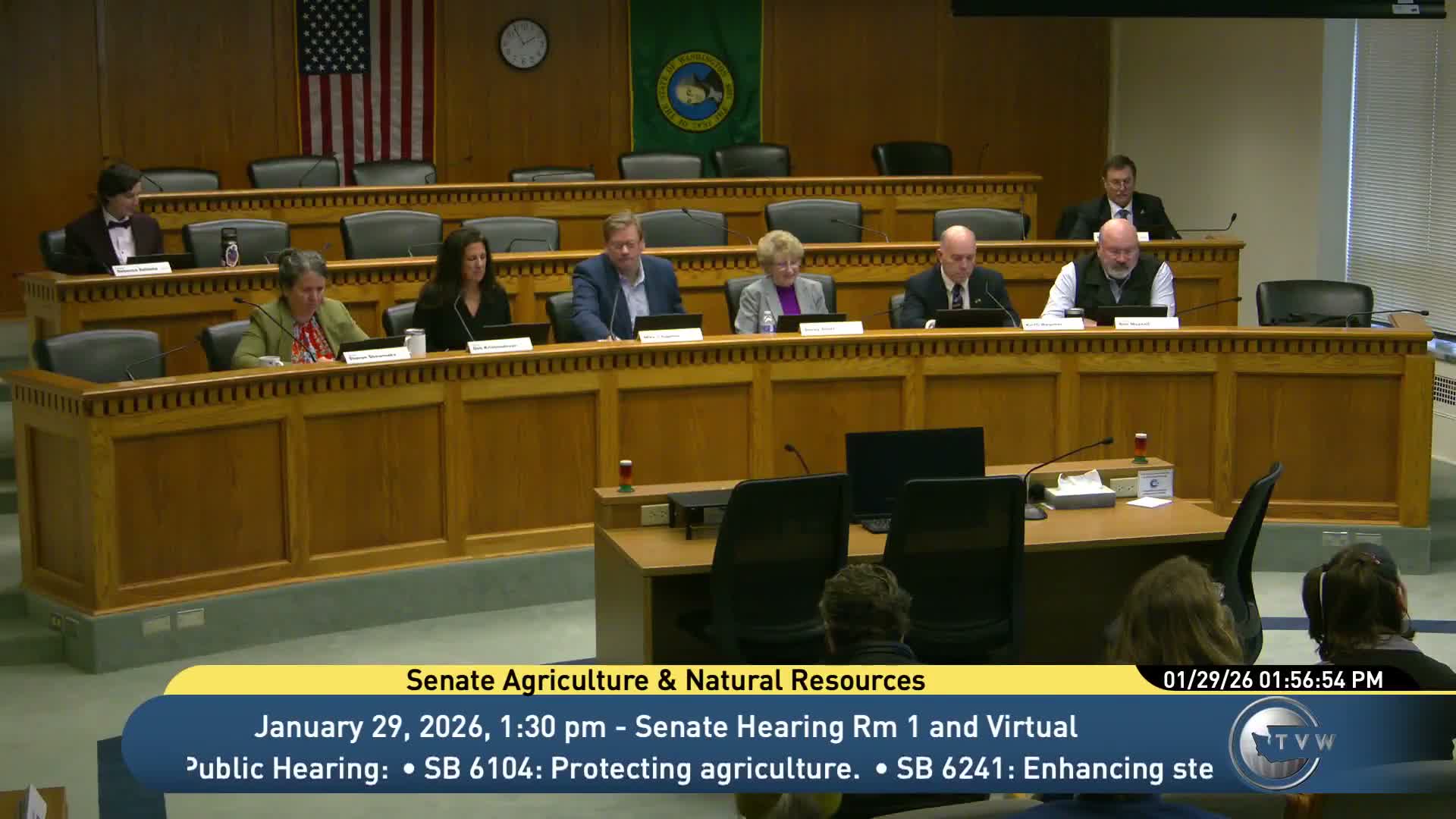
Committee hears competing views on bill to require agricultural impact statements and mitigation
Loading...
Summary
SB 6,104 would require agencies to include agricultural impact statements in major actions, set consultation requirements and mitigation sequencing, and enable conservation or compensation measures; farm groups supported the bill while small‑farm witnesses and conservation groups raised concerns about practicality and redirected funding from conservation accounts.
The committee received staff and public testimony on Senate Bill 6,104, legislation that would define required components of an agricultural impact statement, require agency consultation with WSDA and land‑grant economists, and establish mitigation sequencing and conservation ratios for land‑use changes.
Elena Becker, committee staff, outlined five major points: required components for agricultural impact statements, agency consultation requirements, mandated mitigation measures from technical assistance up to financial compensation, conservation/land mitigation ratios (1:1 for adjacent agricultural land; 3:1 when nonadjacent), and a requirement that Office of Financial Management develop an agricultural fiscal note process. Becker said a fiscal note for the bill was not yet available.
Senator Mazzall, sponsor, described Washington's agricultural pressures and said the state was losing farms rapidly; he urged legislative action to retain agricultural viability and culture.
Industry groups including the Washington Potato and Onion Association, Washington Association of Wheat Growers and Washington Cattlemen's Association supported the bill for its protections and the mitigation hierarchy. Mark Strehley said the bill's ag viability statement and hierarchy could prevent siloed agency decisions.
Several witnesses representing small farms and conservation organizations raised concerns. Kenton Gartell said SB 6,104 "does not actually help the small farmers it claims to protect, especially those of us operating on 50 acres or less," arguing the bill emphasizes agency procedure rather than practical financial or infrastructure assistance. Yvonne Krause of the Washington Wildlife and Recreation Coalition opposed the bill in its current form because it expands the allowable use of the WWRP Habitat Conservation Account to provide compensation, potentially undermining the account's conservation purpose.
The committee closed the public hearing and logged written support and opposition; members asked follow‑up questions and requested additional information on how much preserved acreage remains actively farmed.
Next steps: the bill will proceed to executive session for further consideration.