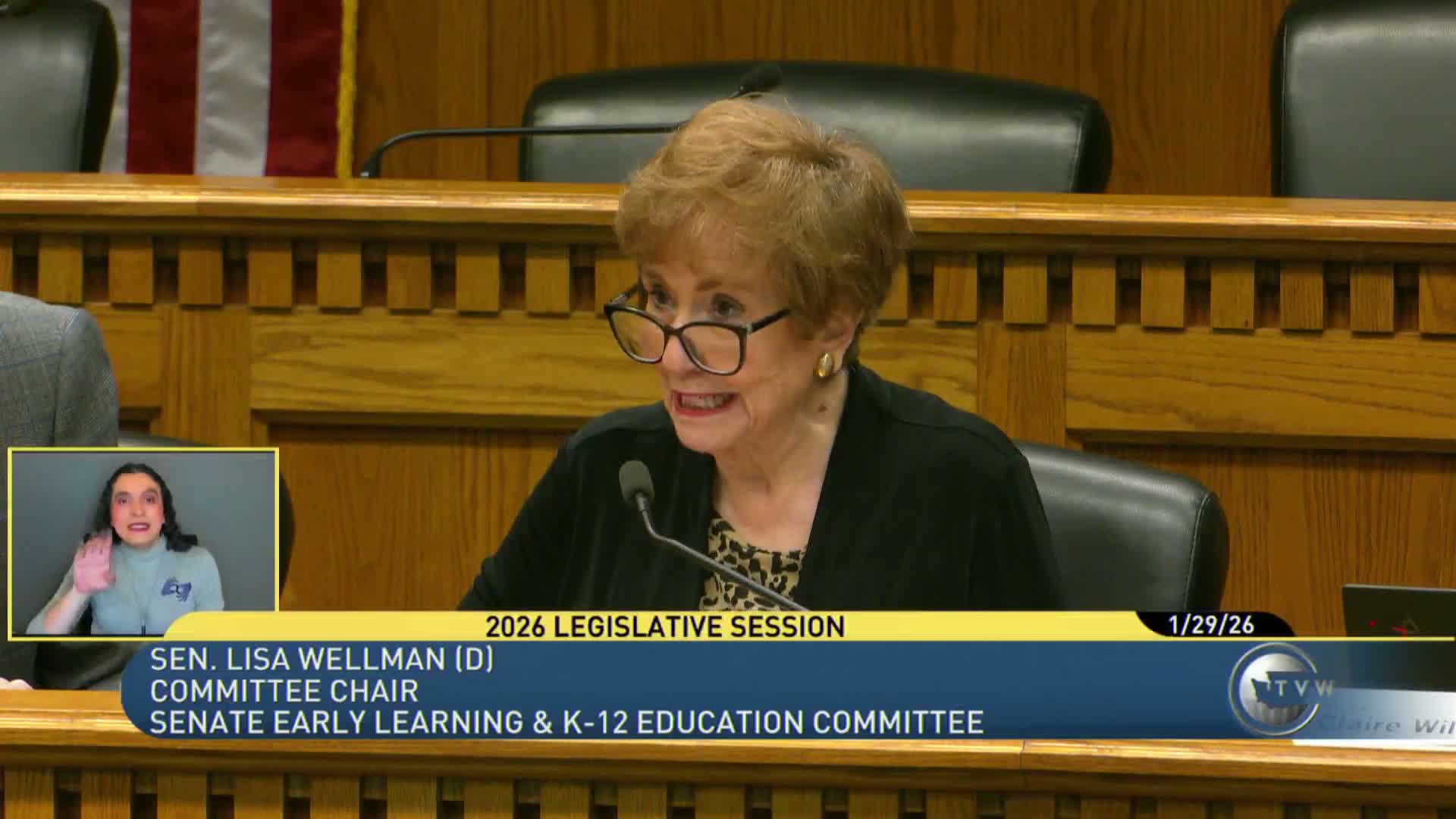
Committee hears competing views on SB 6,192 to tighten literacy and math interventions
Loading...
Summary
The Senate Early Learning and K-12 Education Committee heard testimony on SB 6,192, which would require structured literacy and numeracy programs by 2028–29, create regional ‘star teacher’ bonuses of $10,000–$20,000, and mandate interventions for third‑grade students scoring low on assessments; witnesses split over standardized methods, merit pay and program approvals.
The Senate Early Learning and K-12 Education Committee heard testimony on Senate Bill 6,192, which aims to strengthen instruction and interventions in third‑grade reading and mathematics.
Committee staff summarized five core parts of the bill: Educational Service Districts (ESDs) would annually select six high‑performing teachers (three math, three ELA) to receive ongoing bonuses of $10,000–$20,000; schools would implement a structured literacy program and a structured numeracy program by the 2028–29 school year with enumerated components; districts would be required to hold parent/guardian meetings and implement intensive improvement strategies for students who score or are projected to score a 1 or 2 on third‑grade assessments; schools where more than 40% of students score a 1 or 2 on the third‑grade math assessment must implement intensive strategies; and the Professional Educator Standards Board must revise endorsement standards for literacy by Sept. 1, 2027, to include phonemic awareness, among other changes (Elena Becker, committee staff).
Sponsor Senator John Braun (20th Legislative District) framed the proposal as modest guidance to refocus districts on core academics. "We could do ourselves a favor by providing a framework," Braun said, defending phonics for reading and a structured approach to numeracy while preserving local control. He described the incentive provision as a way to "reward the teachers who are doing it well."
State and regional education officials described both merits and implementation concerns. Mitra Trunisky (Office of Superintendent of Public Instruction) said OSPI supports the goal of improved literacy and numeracy but noted questions about how teacher recognition and incentives would be implemented. Flip Herndon (ESD superintendent) warned that section 1 requires ESDs to access and analyze student‑level assessment and growth data across districts, a capability some ESDs currently lack.
Public testimony split along methodological and policy lines. Supporters of the Read Write program, including Dee Tadlock (program originator) and several program alumni, credited the program with dramatic individual reading gains and asked that such programs not be excluded if they are not on state approval lists. "What is needed is a paradigm shift," Tadlock said of reading instruction. Parents and students delivered emotional accounts of successful outcomes in Read Write tutoring.
Opponents and some education groups raised practical and policy objections. Jennifer Denham, a Kitsap County parent, testified she opposes SB 6,192 because it "handcuffs our state's teachers and school districts to one specific reading method." The Washington Education Association told the committee it opposes merit pay and expressed concern about grade‑level retention policies implied by the bill.
Committee members probed the universe of approved curricula, the mechanics of selecting "star" teachers, and whether the bill could inadvertently encourage instruction geared toward improving test scores rather than deep learning. Staff and the sponsor repeatedly emphasized the bill sets criteria rather than mandating a single curriculum and that districts retain discretion.
The committee held the hearing and did not take a vote on SB 6,192. Chair Wellman closed public testimony and moved to other agenda items.