Get Full Government Meeting Transcripts, Videos, & Alerts Forever!
Get email alerts on the House Bill 1542 topic
No spam. Unsubscribe anytime.
Committee advances second substitute to set minimum rights for senior independent housing after amendment debate
Summary
On Jan. 29 the Housing Committee reported out a second-substitute House Bill 1542 (due-pass) that would establish minimum rights for senior independent housing residents; amendments to narrow coverage and remove Consumer Protection Act enforcement failed, while an amendment removing a Commerce reporting requirement passed. The final roll call was 10-7.
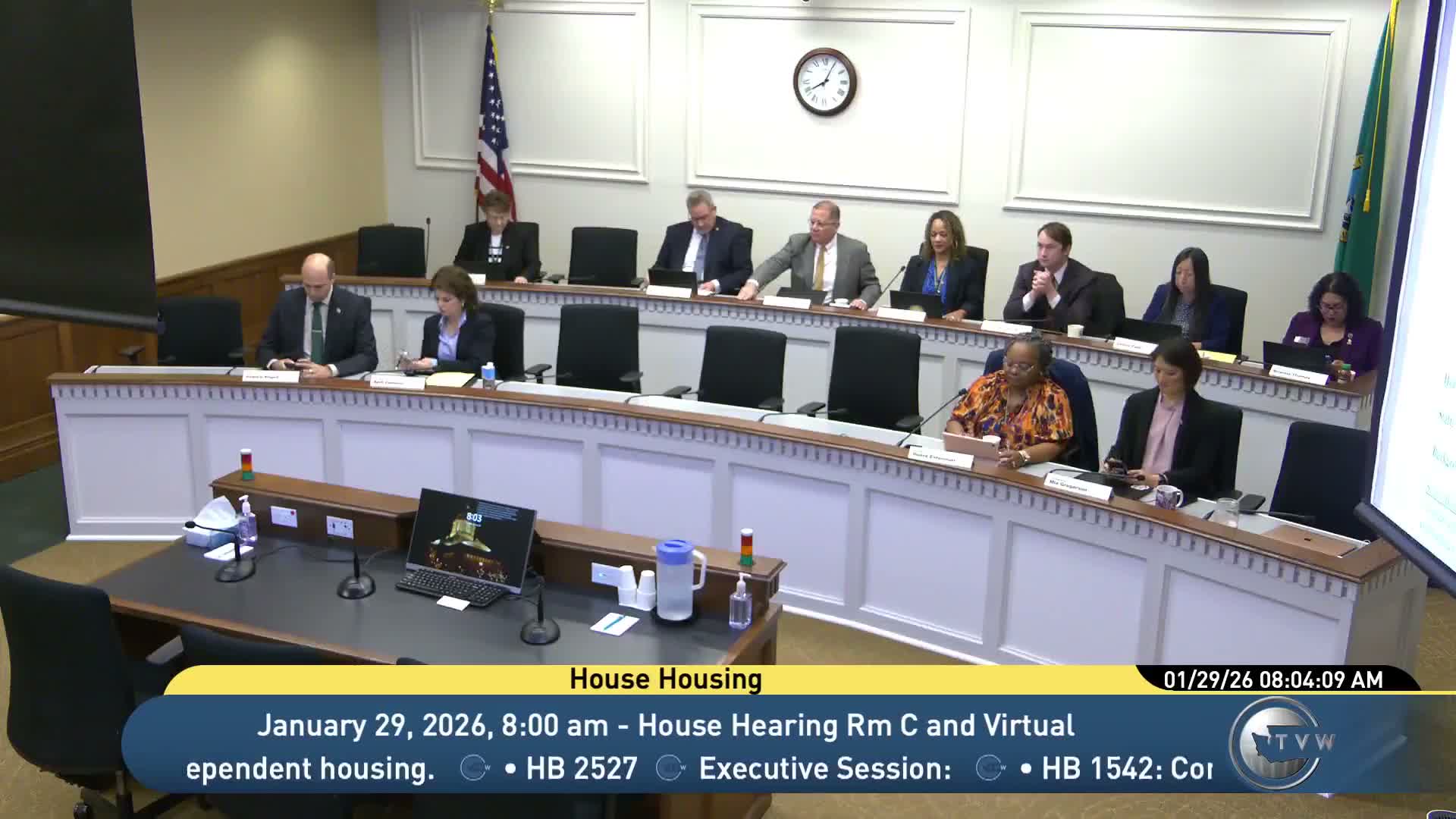
House Bill 1542, which would create statutory minimum rights for residents of senior independent housing, was reported out of the Housing Committee on Jan. 29 after lawmakers debated the bill’s scope and enforcement mechanisms.
Audrey Vacek, staff to the committee, told members the bill establishes minimum resident rights and initially included three amendments in the committee packet: an amendment from Representative Lowe narrowing the definition of senior independent housing to exclude standalone age-restricted developments and certain manufactured-mobile-home communities; an amendment from Representative Dufour to remove Consumer Protection Act enforcement and instead allow the attorney general to seek civil penalties ($500 for a first violation, $1,000 for subsequent violations); and an amendment from Representative Peterson removing a Department of Commerce reporting requirement.
Representative Lowe moved VAS 2-38 to narrow the bill’s coverage, arguing the change ‘‘clarifies housing providers that, you know, don't provide laundry, meals, etcetera’’ and would avoid discouraging 55-plus housing development. Chair Peterson said much of the amendment was ‘‘right’’ but expressed concern about excluding manufactured housing and asked members to consider further work on the floor; the amendment was defeated in a voice vote.
Representative Dufour moved VAS 2-36 to remove per se Consumer Protection Act enforcement and replace it with a civil penalty regime enforced by the attorney general. Dufour said CPA-style presumptions are ‘‘generally dangerous’’ because they can convert technical violations into significant liability, and described the alternate $500/$1,000 fine scheme as a clearer deterrent. The committee declined to adopt that amendment in a subsequent voice vote.
Vice Chair Hill moved VAS 2-39, a provision to remove the Department of Commerce reporting requirement and related fiscal implications. Members noted this mirrors committee action on the bill last year; the amendment was adopted by voice vote.
After incorporating adopted amendments into a second substitute, Vice Chair Hill moved that the substitute be reported out of committee with a due-pass recommendation. The clerk called the roll, and the committee recorded the following votes: Peterson — Aye; Hill — Aye; Richards — Aye; Lowe — No (no recommendation); Jacobson — No (no recommendation); Manjaras — No (no recommendation); Perez — No (no recommendation); Barkis — No (no recommendation); Connors — No (no recommendation); Dufo/Dufault — No (do not pass); Engel — No (no recommendation); Entenmann — Aye; Reid — Aye; Thomas — Aye; Timmons — Aye; Zahn — Aye; (final tally announced by the clerk: 10 ayes, 7 nays). The chair announced that the proposed second substitute House Bill 1542 was reported out of committee with a due-pass recommendation.
Next steps: the substitute bill will go to the full House for further consideration and potential floor amendments; committee members said they expect to continue refining definitions and enforcement language prior to floor debate.