Get Full Government Meeting Transcripts, Videos, & Alerts Forever!
Get email alerts on the Sustainable Aviation Fuel topic
No spam. Unsubscribe anytime.
Committee hears bill to accelerate sustainable aviation fuel incentives and clarify carbon accounting
Summary
Lawmakers heard testimony on HB 2322, which would change when Washington—s sustainable aviation fuel tax incentives kick in and clarify how alternative jet fuel production can claim low-carbon electricity. Supporters said the fixes are necessary for investment in Moses Lake; Ecology warned the bill could weaken incentives for new renewable generation.
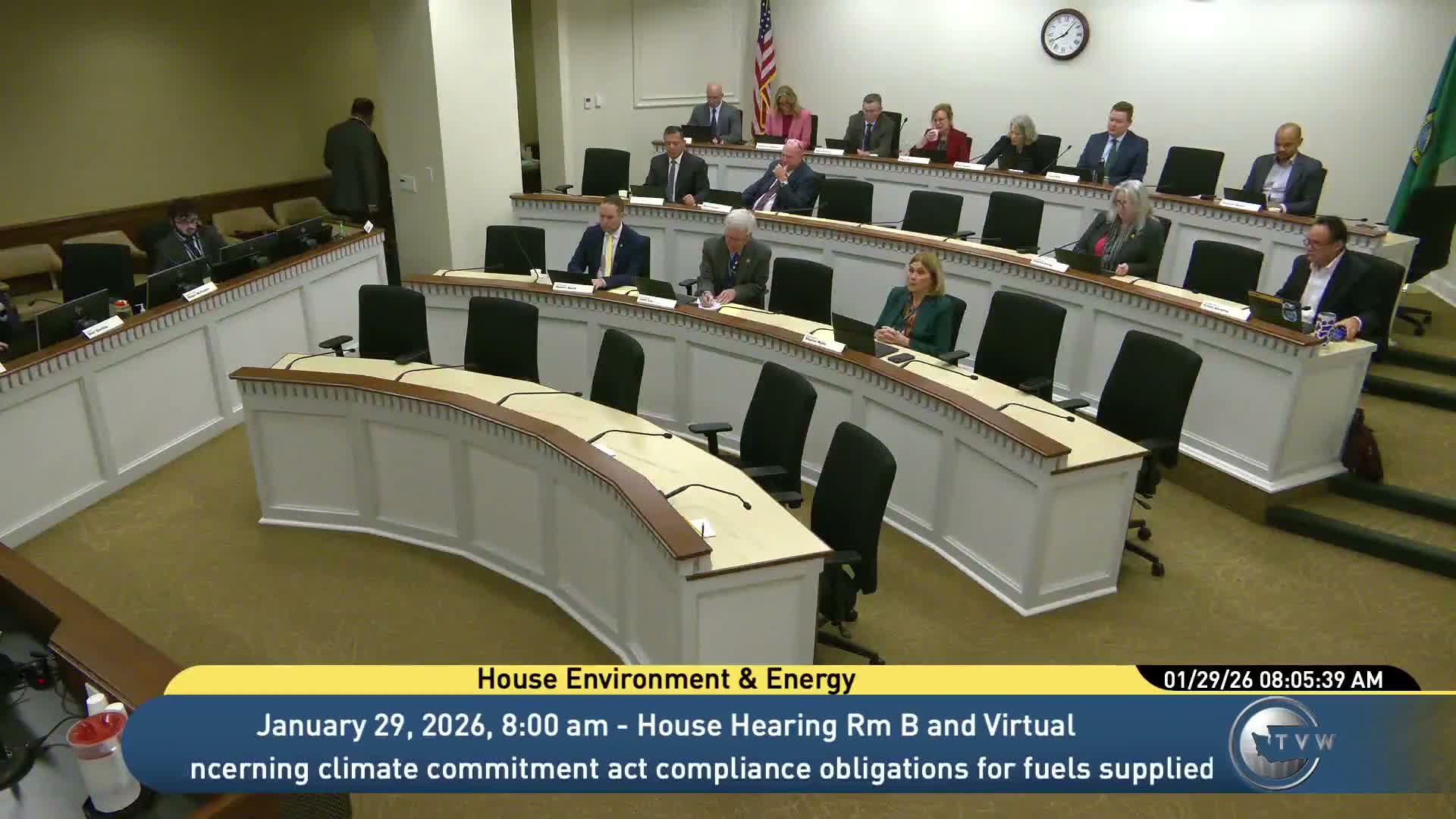
The House Environment and Energy Committee heard testimony on HB 2322 on Thursday, a bill that would change the timing of Washington—s sustainable aviation fuel (SAF) production tax incentives and specify how carbon intensity is calculated for alternative jet fuels.
Jacob Lipson, staff to the committee, told members the bill "changes the effective date of those tax incentives" so they trigger on the earlier of a 20,000,000-gallon cumulative production threshold or July 1, 2031, and directs the Department of Ecology—clean fuels carbon-intensity calculations to treat certain renewable electricity as zero carbon intensity for SAF manufacturers.
Sponsor Representative Tom Dent (13th Legislative District) said the Moses Lake proof-of-concept plant needs clarity to secure investment. "This company is looking at $1,000,000,000 investment to bring this thing in here and to make it happen," Dent said, and urged the committee to support tweaks to the incentives to keep the project in Washington.
Company witnesses and local officials described the economic stakes. Derek Phelps of Twelve said the proof-of-concept plant in Moses Lake is "substantially complete" and expects production to begin soon, but warned that without the bill—s fixes the company is "in all likelihood, realistically not able to consider expanding our plant here in Moses Lake to commercial scale." Phelps also said, "We have more than $3,000,000,000 in offtake contracts currently." Don Myers, deputy mayor of Moses Lake, urged the committee to support the legislation to preserve jobs and future private investment in the community.
The Department of Ecology signaled concern. Joel Creswell, manager of Ecology—s Climate Pollution Reduction Program, testified that "HB 2,322 weakens the Clean Fuel Standard's ability to incentivize new renewable electricity generation," saying the agency has suggested sponsor amendments to support startups without undermining the program—s additionality requirements. Creswell and others explained the rule allows SAF manufacturers to claim a zero-carbon electricity pathway through 2037, but after that time the rule requires additionality (new clean generation) to avoid shifting existing renewable electricity away from other customers.
Industry witnesses generally supported clarifying how the carbon intensity of electricity is calculated but differed on the bill—s timing mechanism. Marty Lesch of Sky Energy said clarifying Section 2 is important but asked that an automatic trigger date be removed because the 10-year incentive period is essential to finance full-scale facilities.
The hearing closed after extensive questioning about grid capacity and how much firm megawatts the Moses Lake facility requires; witnesses said the demonstration plant has a firm commitment of about 13 megawatts and that going to commercial scale would need roughly four to five times that capacity and likely infrastructure upgrades.
Next steps: the committee closed testimony on HB 2322 and did not take a final vote during the session. The bill will proceed according to the committee—s internal schedule.