Lifetime Citizen Portal Access — AI Briefings, Alerts & Unlimited Follows
Committee hears hours of testimony on bill to reshape first-time felony relief
Loading...
Summary
The House Community Safety Committee received extensive expert, judicial, defense, prosecution and victim-advocate testimony on HB 2217, which would replace Washington’s first-time offender waiver with new pretrial deferral and suspended-sentence pathways intended to increase rehabilitation but raise prosecutor and victims’ concerns about scope and consent.
Representative Daria Farovar, prime sponsor of House Bill 22 17, told the House Community Safety Committee on Jan. 29 that the bill is intended to give people charged with a first felony an opportunity to comply with conditions and avoid a conviction without pleading guilty up front. Farovar said the change would better align incentives for supervision and rehabilitation and that stakeholders are still working on exclusions and technical details.
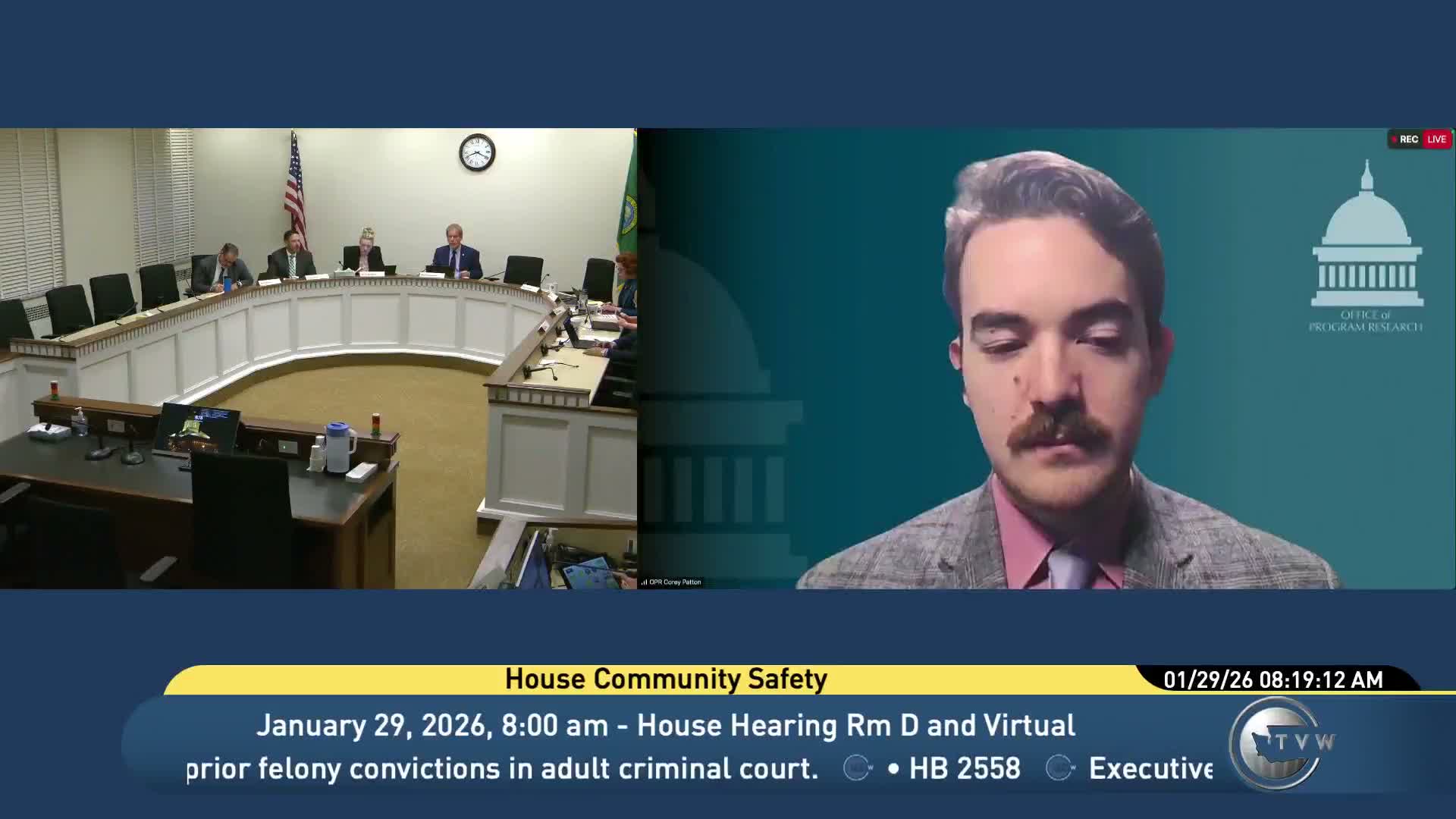
Corey Patton, counsel to the committee, summarized the bill’s mechanics: the measure would replace the existing first-time offender waiver with two pathways — a pretrial deferral and a suspended sentence — both available only once to an eligible defendant. Under current law, FTOW may result in up to 90 days confinement and up to one year of community custody; HB 2217 would allow up to six months of community custody under some paths and up to one year when treatment is ordered. The bill contains procedural rules for motions, revocation and successful-completion outcomes (dismissal for a deferral; termination of a suspended sentence on success) and creates a statutory “strong presumption” that courts should grant relief to eligible defendants (a presumption the sponsor said could be modified).
Defense and academic witnesses urged enactment as evidence-based reform. Katie Hurley of the King County Department of Public Defense told the committee the current waiver is underused (she estimated only about 25% of eligible people go on supervised custody) and said the proposed pathways would increase supervised rehabilitation opportunities and reduce long-term employment and collateral harm. Economists and policy researchers, including Kevin Schnepple and Jennifer Dolyak, cited studies from jurisdictions such as Harris County, Texas, finding deferred-adjudication approaches halved reoffending and materially improved employment over a decade.
Judges and some court-affiliated groups supported more options but voiced caution about statutory presumption and scope. Judge Melinda Young (King County) said judges should have the off‑ramp tools but opposed a strong presumption that would push judges to impose the option. Andre Penalver, testifying for the Washington State Minority and Justice Commission, said the current waiver is often unused and that deferral until successful completion, with dismissal, promotes equity and public safety.
Prosecutors and law‑enforcement associations urged significant revision. John Toonheim (Thurston County) and Russell Brown (Washington Association of Prosecuting Attorneys) warned the bill appears to allow judges to order diversion-like outcomes without prosecutor consent, raising constitutional and practical concerns. WAPA and other prosecutors recommended preserving prosecutor consent for diversion-like mechanisms and sought narrower definitions and guardrails to prevent dismissal of serious or repeat offenses.
Victims’ advocates opposed expansion to include certain offenses. Michelle Bart of the National Women’s Coalition Against Violence and Exploitation urged the committee not to make offenses such as second‑degree assault (including strangulation) eligible, saying those harms are predictive of later lethality and that survivors’ safety must be considered.
Stakeholder concerns the committee flagged for follow-up included: whether prosecutor consent should be required for deferred pathways; which specific offenses to exclude (sponsors said they plan to add exclusions such as hit-and-run causing death, human trafficking, child endangerment and financial exploitation of vulnerable adults); and how the proposal would interact with existing pretrial diversion and therapeutic-court models.
The committee concluded public testimony after broad stakeholder discussion and signaled additional drafting and cross‑branch consultation to address prosecutorial consent, offense lists and supervision standards. No formal votes were taken during the hearing.
The bill’s next steps were not set in the hearing; the committee chair closed public testimony and indicated executive sessions on a slate of bills would be scheduled the following week.