Sponsor and UW clash over bill to shift university endowment investing to state board
Loading...
Summary
Representative Stokesberry introduced HB 2,565 to require the University of Washington to place certain gifts and funds with the Washington State Investment Board for investment; UW witnesses opposed, citing donor restrictions, portfolio differences and fee-accounting details.
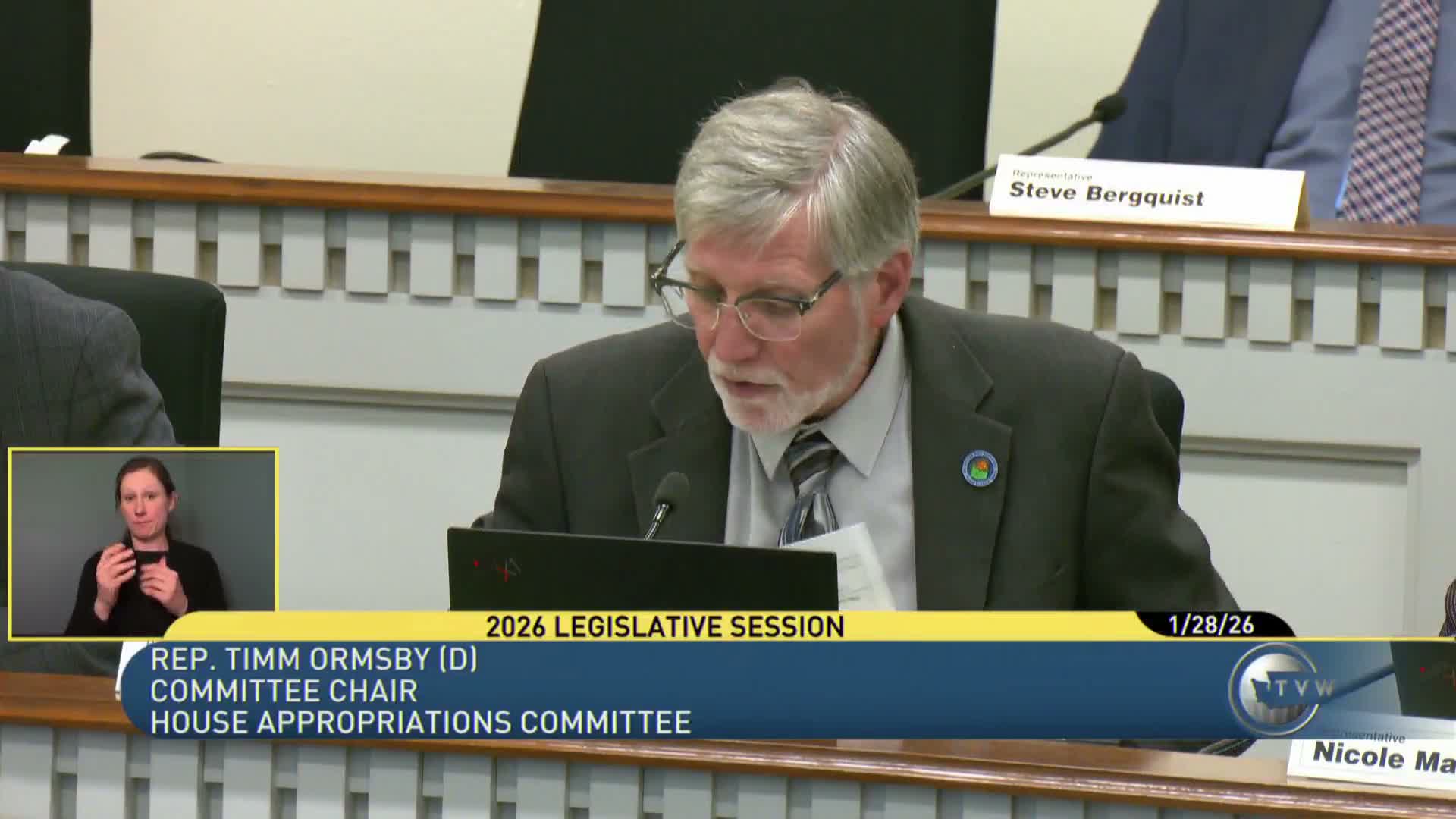
Representative Stokesberry introduced House Bill 2,565 on the House Appropriations Committee floor, saying the measure would require the University of Washington to invest gifts, grants, conveyances and other amounts through the Washington State Investment Board (WSIB) rather than manage them internally. Stokesberry argued WSIB can achieve higher returns and lower internal expense fees than the university’s investment organization, and framed the change as a way to save money and boost resources for UW’s core mission.
David Pringle, committee staff, told members WSIB manages roughly $230,000,000,000 and highlighted the board’s constitutional mandate and its range of portfolios, including pension funds and newer placements such as WA Cares. Pringle said the combined pension fund established under WSIB has delivered about a 9% annualized return over time and noted fee differences cited in the staff materials.
Morgan Hickel, representing the University of Washington, testified in opposition. Hickel said UW’s investment company (UNCO/UWIMCO) was formed after a years‑long planning process, that UW has long managed its endowment in-house, and that UNCO is self‑sustaining (not supported by taxpayers or students). Hickel warned of “significant legal and fiscal concerns” tied to nearly 6,000 individual endowed funds with donor‑specified terms and said transfers could raise legal issues with gift agreements.
Scott Davies, also testifying for UW/UNCO, challenged the bill’s fee comparisons. He said the cited 0.9% total internal fee for the Consolidated Endowment Fund (CEF) is not fully attributable to UWIMCO; only about 0.18% goes to the internal investment office while the remainder supports advancement, fundraising and stewardship. Davies added that portfolio objectives and liquidity constraints differ between WSIB and UW endowments and cautioned against direct performance comparisons using mismatched time horizons.
Stokesberry said donors would welcome lower administrative costs and defended the policy by analogy to earlier decisions to centralize investment of WA Cares funds; he also argued many private investment fund agreements permit transfers to affiliates and that WSIB could manage illiquid allocations. The committee took no formal action on HB 2,565 during the hearing; staff indicated subsequent executive-session briefing and amendment work would follow.
The committee did not vote on HB 2,565 during the hearing. The next procedural step will be whatever executive‑session action the Appropriations Committee schedules after briefings and any amendments are prepared.