
Bill would expand tuition‑recovery and teach‑out rules after program or school closures
Get AI-powered insights, summaries, and transcripts
Subscribe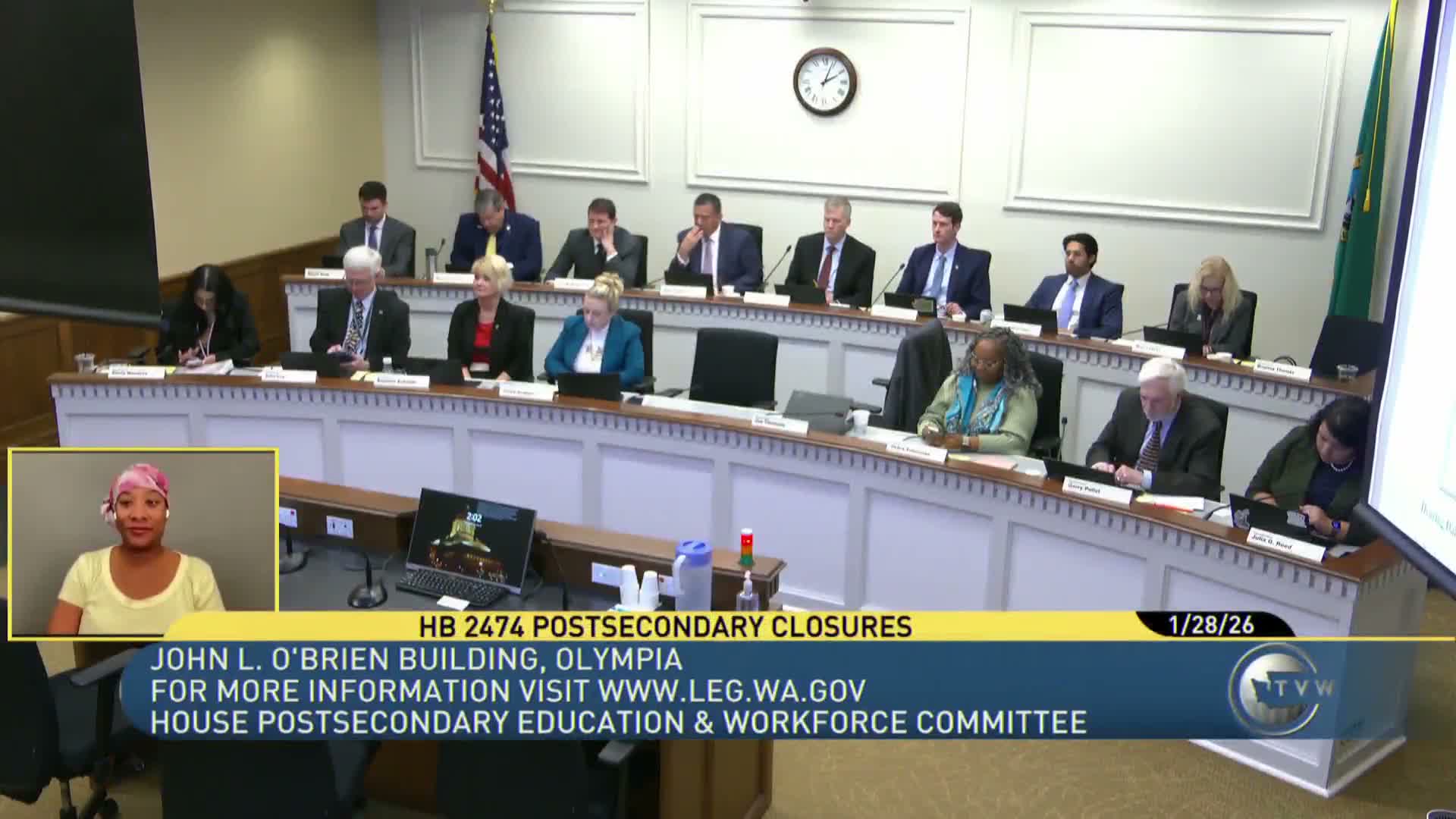
Summary
House Bill 2,474 would broaden the Student Achievement Council Tuition Recovery Trust Fund and require teach‑out or transfer agreements that do not increase cost to students; witnesses debated whether the bill should apply to public institutions and raised concerns about operational impact on smaller independent colleges.
The committee considered House Bill 2,474 on Jan. 28, a proposal to expand state consumer protections for students affected by institutional or program closures.
Staff counsel Elizabeth Wren described the bill as updating the Washington Student Achievement Council's Tuition Recovery Trust Fund and related rules so funds may be used to reimburse students for closures, secure and administer student records, and support teach‑outs or approved transfer agreements. The bill would require teach‑outs to preserve "the same material conditions" acceptable to WASAC and prohibit transfer agreements that increase costs to students; institutions that violate the provisions would be required to refund tuition and could not collect or enforce institutional debt owed by affected students.
Rep. Mike Pollet, the prime sponsor, said the legislation responds to evolving risks — including recent program closures — and seeks to preserve pathways for students when programs change or close. "What happens when the school says we've closed a program in Bremerton and you can go to school in Everett? Not really available," Pollet said, arguing the bill expands protection beyond outright school closures.
Testimony included support from the Washington Student Achievement Council (Joel Anderson), student representatives who urged protections for public institutions as well, and sector representatives. Joel Anderson said reduced federal oversight increases the need for state protections. Christopher Medeo of the Institute for College Access and Success supported refund and debt provisions, citing past state examples where students were left with institutional debt after a closure.
Independent Colleges of Washington warned the bill as written could have "unintended consequences" for small private campuses, potentially forcing them to maintain programs or face penalties when modifying curricula; they urged definitional changes or carve‑outs to avoid stifling innovation. Committee members questioned whether the bill should also apply to public colleges and how to define 'discontinue' vs. 'modify.'
No vote was taken; the committee closed the public hearing and may consider amendments to clarify scope and definitions.