Panel backs expanding Washington College Grant to short nondegree credentials
Loading...
Summary
Lawmakers and multiple industry and education witnesses urged the committee to expand the Washington College Grant to eligible short nondegree credential programs, saying it would improve access to family‑wage jobs; witnesses also pressed for guardrails on program quality and questioned long‑term effectiveness of micro‑credentials.
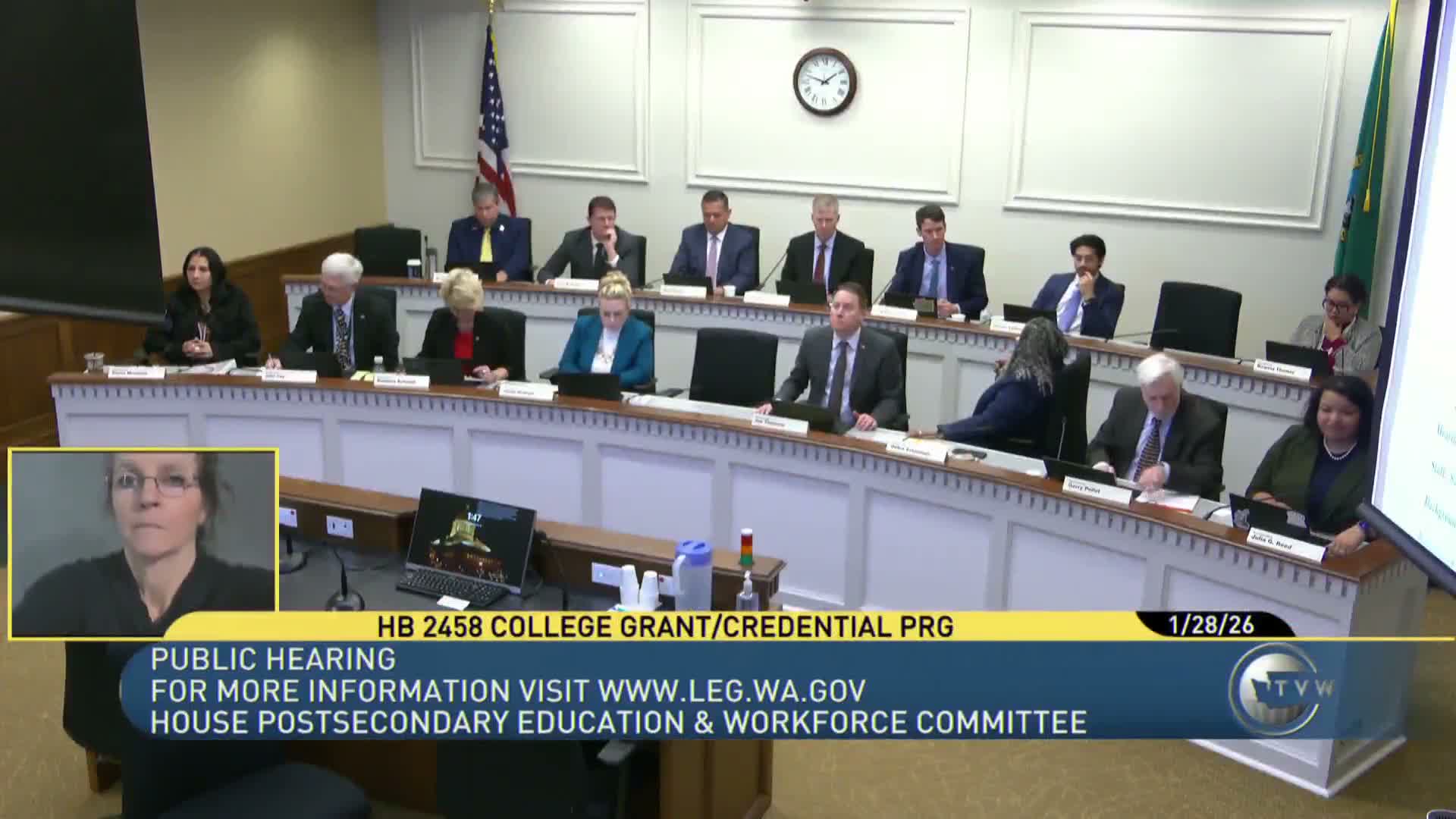
The Postsecondary Education and Workforce Committee heard testimony Jan. 28 on House Bill 2,458, which would expand eligibility for the Washington College Grant to students enrolled in eligible postsecondary nondegree credential programs.
Miranda Ross, counsel to the committee, said the Washington College Grant is the state's largest financial aid program and that the State Board for Community and Technical Colleges must consult with the Student Achievement Council to determine qualifying nondegree credential programs.
Rep. Entenmann, the bill's prime sponsor, framed the measure as a way to recognize that postsecondary education includes short certificates and career‑aligned credentials. "Just because a student is not receiving a degree, that does not mean that they are not participating in higher education," she said, and cited examples such as commercial CDL and cybersecurity certificates.
Testimony from community and technical colleges and industry groups emphasized workforce demand. Arlen Harris of the State Board for Community and Technical Colleges told the committee that approved nondegree credentials increase access to workforce‑aligned training. Tim Stokes, president of South Puget Sound Community College, and local builders described a 10‑week residential construction program with high on‑completion hire rates and argued financial aid would remove barriers for low‑income participants.
United Way of Thurston County's Chris Wells cited ALICE research, saying 38% of Washington households fall below the ALICE threshold and argued aid for nondegree credentials would help lift people into higher earning trajectories.
Members asked whether short‑term or micro‑credentials demonstrate long‑term efficacy and how programs would be vetted. Supporters said many short credentials articulate into degrees or stack into higher credentials, and that local advisory boards and employer partnerships validate program quality.
No formal amendments or votes were recorded. The public record showed 326 sign‑ins (267 pro, 59 con). The committee concluded the public hearing and may consider amendments based on staff and sponsor discussions.