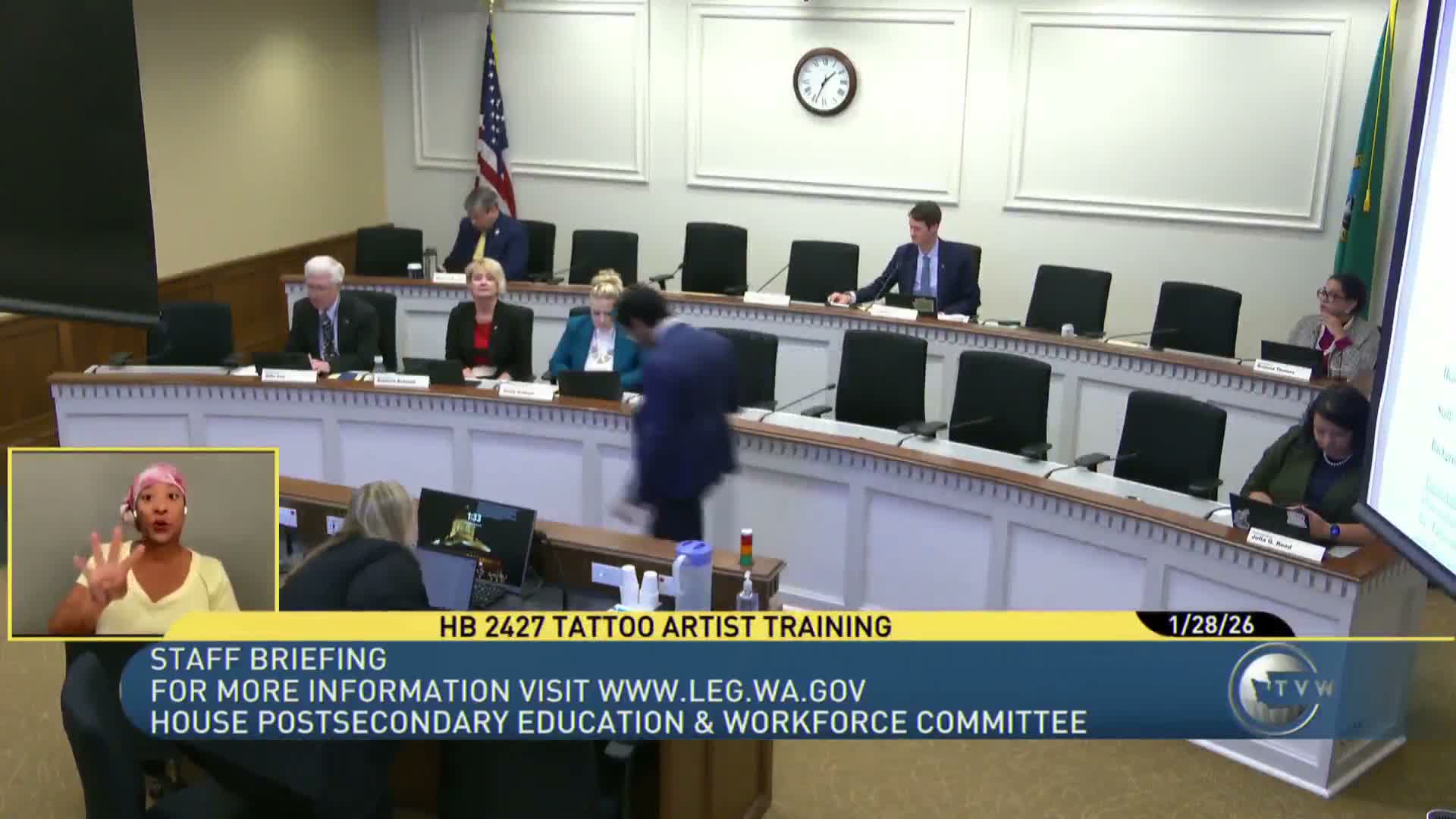
Committee hears bill to require trafficking‑recognition training for tattoo artists
Loading...
Summary
The Postsecondary Education and Workforce Committee heard House Bill 2,427, the "Ink of Hope" Act, which would require a one‑hour training (provided or contracted by the Department of Licensing) for licensed tattoo artists to recognize and refer potential human‑trafficking victims; supporters called it a low‑cost prevention step while opponents raised constitutional and oversight concerns.
The Postsecondary Education and Workforce Committee heard testimony Jan. 28 on House Bill 2,427, the "Ink of Hope" Act, which would require the Washington State Department of Licensing to provide up to one hour of training for licensed tattoo artists on how to recognize and respond to signs of human trafficking.
Sponsor Rep. Alicia Ruhl, a social worker, told the committee she introduced the bill after meeting trafficking survivors in her district. She said tattoos are often used by traffickers to "brand" victims and that tattoo artists can be among the few people to have recurring contact with survivors. "One of the things that was mentioned is that giving education to those who may have even just a brief interaction with that survivor is helpful," Ruhl said.
Saranda Ross, counsel to the committee, briefed members that the bill would require the Department of Licensing to develop or contract for up to one hour of online or in‑person training, make the training publicly available at no cost and in an accessible format, and require tattoo artists to complete the training annually beginning July 2027 as a condition of license issuance or reissuance.
Supporters included Noel Gomez of WACE Forward, who identified as a trafficking survivor and advocate. Gomez described being "branded" by a trafficker and said tattoo artists often do not know what to do when they suspect trafficking. "So I’m here in support of this, and I appreciate your time," Gomez said.
Opponents raised procedural and constitutional concerns. Sheema Cauley, founder of a private intelligence and research firm and spouse of a licensed tattoo artist, testified in formal opposition and argued the bill would impose an "annual compliance obligation" on small businesses without clear oversight of third‑party training content. Cauley said the delegation of curricular authority to undefined external organizations could raise First and Fourteenth Amendment and other legal concerns and asked the committee to reject the bill as drafted.
Committee members asked staff and the sponsor clarifying questions about who would provide the training and whether it is one‑time or recurring. The sponsor and staff confirmed the Department of Licensing would administer or contract the training and that the requirement aligns with license renewal timing.
No formal action or vote was recorded at the hearing. Staff noted a fiscal note is available in the legislative bill binder (EBB). The committee recorded 106 individuals signed in on the bill (102 pro, 4 con) and concluded the public hearing without adopting amendments.
Next steps: the bill remains under committee consideration pending any amendment requests and floor scheduling.