
Senate bill would require district cardiac emergency plans and AED protocols
Get AI-powered insights, summaries, and transcripts
Sign Up Free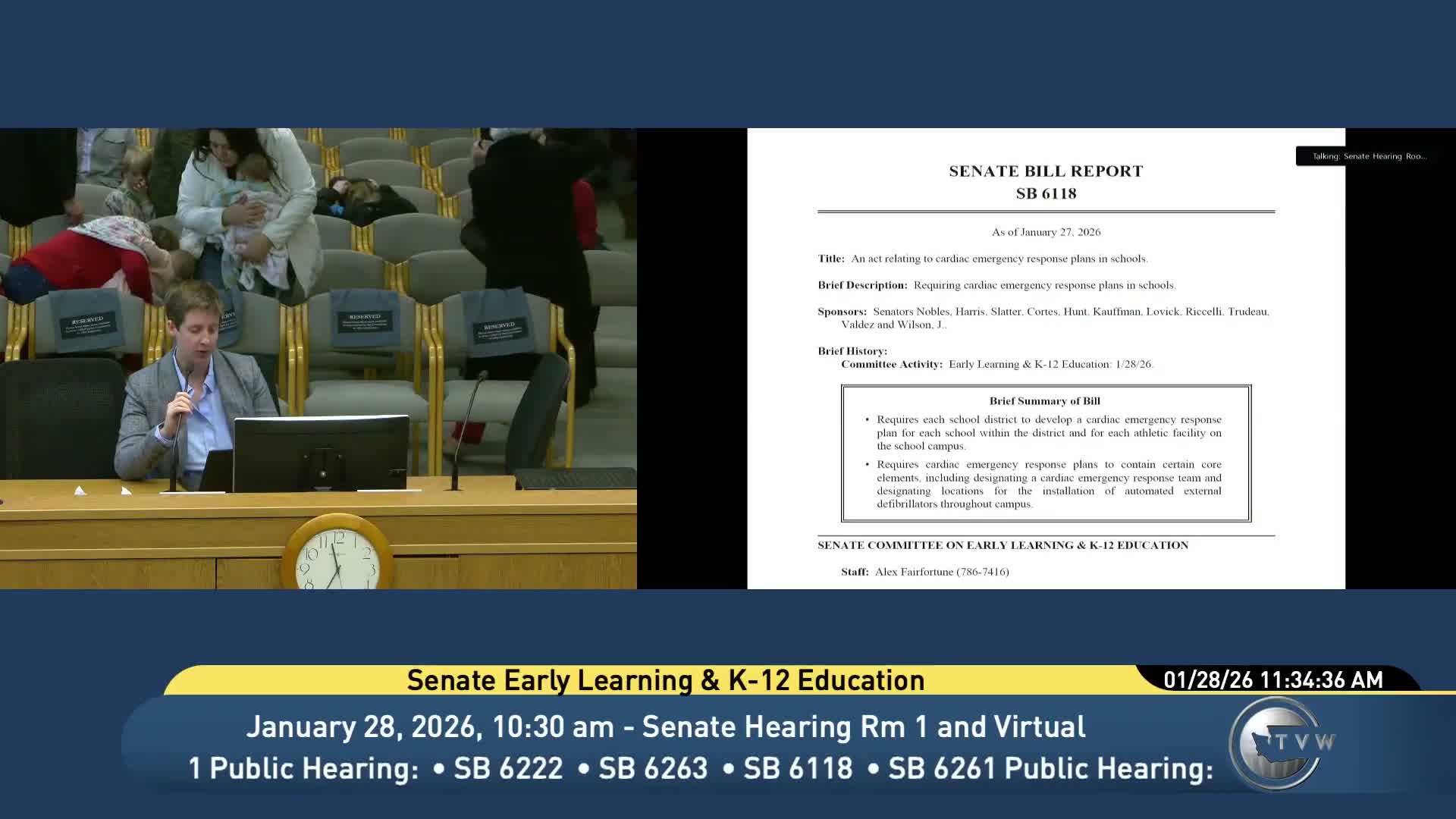
Summary
SB 6,118 would require school districts to adopt cardiac emergency response plans, designate response teams, and place AEDs to allow retrieval within three minutes. Witnesses told personal stories of cardiac emergencies to urge adoption and training; staff estimated potential implementation costs but the sponsor plans a substitute to reduce financial mandates.
Senate Bill 6,118 would require each school district to develop a cardiac emergency response plan for every school and athletic facility, designate response teams, establish rehearsal schedules and AED locations with the goal of retrieving a device within three minutes of recognizing cardiac arrest.
Committee staff identified core elements: designated response teams of school staff, activation and rehearsal procedures, AED placement and maintenance schedules, and integration with community emergency response protocols. Staff noted a fiscal note estimated indeterminate district costs and provided rough estimates including a one‑time cost of about $7.4 million to provide an additional AED per school and recurring training and maintenance costs every two years.
Senator Tawanna Nobles, sponsor of the bill, said the proposal is personal and life‑saving, referencing a family loss to heart failure. Witnesses from bereaved families, athletic trainers and student lifeguards described near‑misses and fatal events to highlight how practiced plans and prompt AED access can save lives. Melinda Truex recounted the collapse of her 16‑year‑old son during track and said delayed AED use contributed to a fatal outcome.
Supporters urged a substitute that aligns with existing district plans and removes strict financial mandates while preserving planning, training and equitable access for under‑resourced schools. Advocates emphasized that survival rates for out‑of‑hospital cardiac arrest can increase dramatically when bystanders recognize arrest, start CPR and use an AED promptly.
The committee heard multiple panels and closed the hearing without recording a committee vote.