Get email alerts on the Industrial Decarbonization topic
No spam. Unsubscribe anytime.
Washington committee hears industry, labor and environmental views on bill to require EITE decarbonization planning
Summary
The House Environment and Energy Committee held a hearing on HB 2537, which would require emissions-intensive, trade-exposed (EITE) facilities to file decarbonization plans and periodic reports to Ecology and would task Ecology with proposing methods to align allowance allocations with state emission limits. Testimony split between supporters urging planning and critics warning of costs, leakage and grid limits.
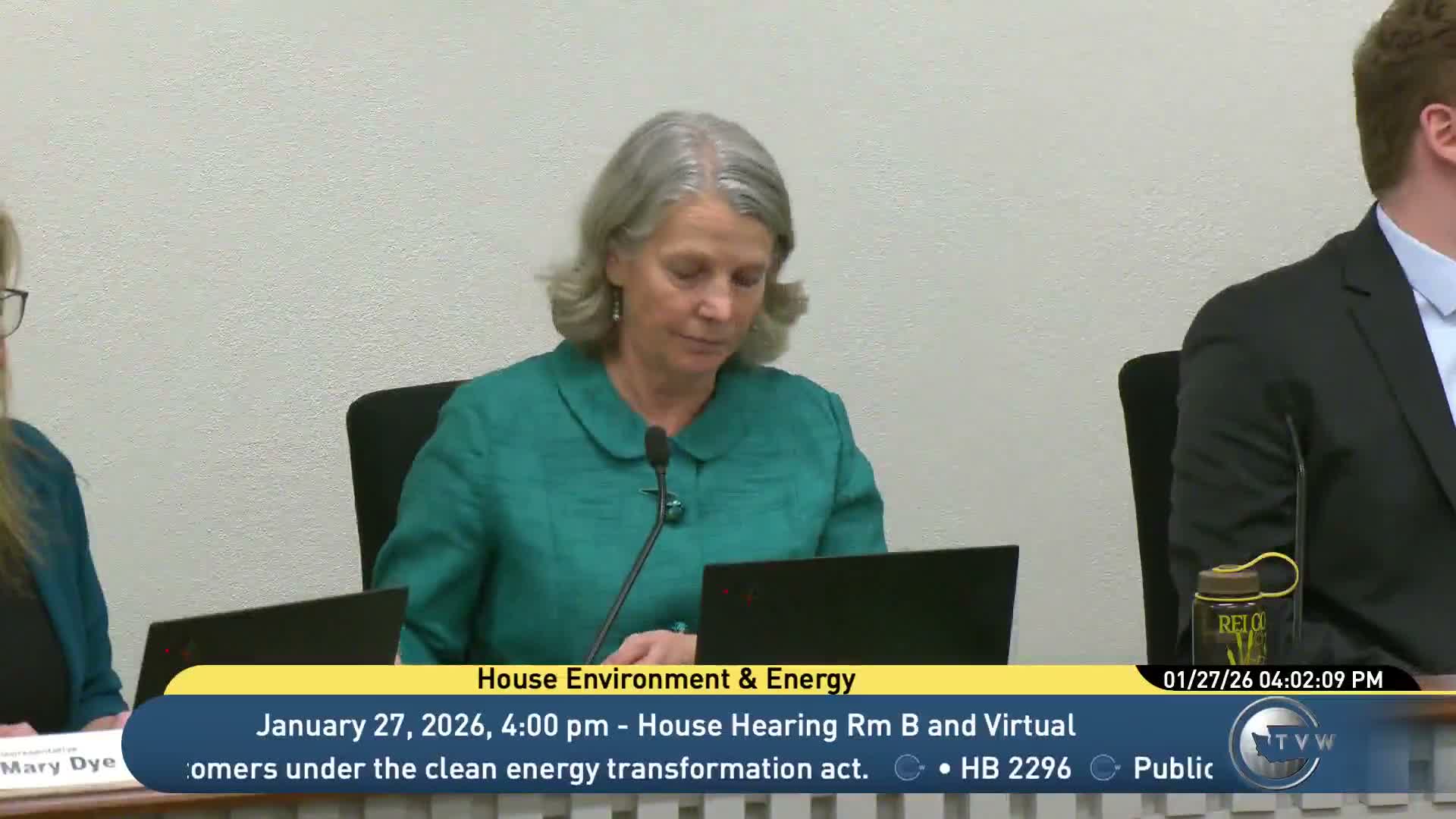
Madam Chair opened the Environment and Energy Committee hearing on House Bill 2537 on Jan. 27 and called for a staff report from committee staffer Jake Lipson, who summarized existing Climate Commitment Act (CCA) allowance allocations and how HB 2537 would change the post-2034 reporting and allocation framework.
Jake Lipson told the committee that EITE facilities currently receive no-cost allowances equal to baseline emissions in the first compliance period and that the statute schedules two 3% reductions in subsequent four‑year periods through 2034. He said HB 2537 would require Ecology’s legislatively directed report to include methods for annual reductions consistent with allowance budgets and state emission limits, methods to adjust allowances for leakage risk, and policy-design recommendations for consigning allowances and investing proceeds in facility emission‑reduction activities.
Representative Beth D'Alessio, the bill’s prime sponsor, said the measure is intended to gather better information from roughly 40 EITE facilities so the legislature and Ecology can tailor post‑2034 policy and avoid leakage while maintaining the state’s climate trajectory. “These plans will really help us tailor a policy that is specific to each of the EITEs,” she said.
Supporters told the committee that planning and consignment can spur decarbonization. David Mendoza, signing in support, said EITEs account for a substantial share of covered emissions and called the bill a tool for clarity and earlier legislative consideration. Kate White Tudor of the Natural Resources Defense Council said the bill would promote industrial innovation and pointed to examples of lower‑carbon cement formulations being developed elsewhere.
Industry trade groups, utilities and labor voiced concerns about costs, electric‑grid capacity and competitiveness. Peter Godlewski of the Association of Washington Business said HB 2537 focuses heavily on reporting but does not address prerequisites for major decarbonization—large amounts of reliable electricity, predictable permitting and financeable economics—and warned that without those the bill could increase compliance burden without accelerating real emissions reductions. Chris McCabe of the Northwest Pulp & Paper Association and other industry witnesses said some facilities lack commercially mature technology for certain decarbonization steps and cited recent plant closures as evidence of leakage risk.
Labor leaders urged caution and stronger leakage safeguards. Josh Estes of the Association of Western Pulp and Paperworkers said the union has lost more than 400 members in the last two years and called for rigorous economic and jobs‑impact analysis before conditioning no‑cost allowances on new planning requirements.
Joel Creswell of the Department of Ecology said Ecology generally supports the bill’s approach and that additional emissions data and third‑party‑verified plans would be useful, but he noted the agency will need resources to implement the new duties and recommended streamlining requirements that duplicate existing greenhouse‑gas reporting rules.
Several speakers urged that consigned allowance proceeds be structured to provide meaningful, multi‑year support for capital projects and that policy design preserve protections against leakage. Utilities and local‑impacted witnesses emphasized that some EITEs represent a large share of local load and tax bases and that grid and transmission limits are a practical bottleneck to electrification and large‑scale capital projects.
The hearing contained back‑and‑forth on specific points: whether free allowances constitute a subsidy and can be resold (witnesses said allowances have market value and can be sold), the magnitude of emissions associated with covered facilities (roughly 10 million metric tons of CO2 compared with roughly 100 million statewide was cited as an illustrative estimate), and whether Quebec and California models are comparable to Washington’s situation given different grid compositions and hydropower shares.
The committee recessed briefly to take up unrelated executive action and then resumed the HB 2537 hearing. No formal committee action was taken on HB 2537 at this meeting.
The committee chair closed the hearing and reminded members of upcoming hearings, staff deadlines for amendment requests and that committee work will continue on companion issues.
What happens next: HB 2537 moves to continued committee consideration. Witnesses on both sides asked for continued stakeholder engagement to refine the bill’s reporting, data‑protection, and funding design so it can support decarbonization while limiting leakage and preserving local jobs.
AI generated
The text on this page is AI generated. Summaries, highlights, analysis, and video transcripts are all produced from the original source material.
AI can make mistakes, so if you spot one, and we will fix it for everyone.
Note: the source content is unaltered by us. Any content source we link to, be it a video, an audio recording, or a document, is presented exactly as its publisher released it. That publisher is usually a government body, sometimes an individual official or another organisation.