Get Full Government Meeting Transcripts, Videos, & Alerts Forever!
Get email alerts on the Police Oversight topic
No spam. Unsubscribe anytime.
House committee hears bill to expand Office of Independent Investigations' jurisdiction and clarify records rules
Summary
Lawmakers and the Office of Independent Investigations told the House Community Safety Committee that House Bill 2508 would broaden OII's jurisdiction, require earlier agency notification for some uses of force and in-custody deaths, allow OII access to EMS/fire records with privacy limits, and exempt investigative files from public release until referral to a prosecutor; concerns focused on the scope of privacy exemptions and operational readiness.
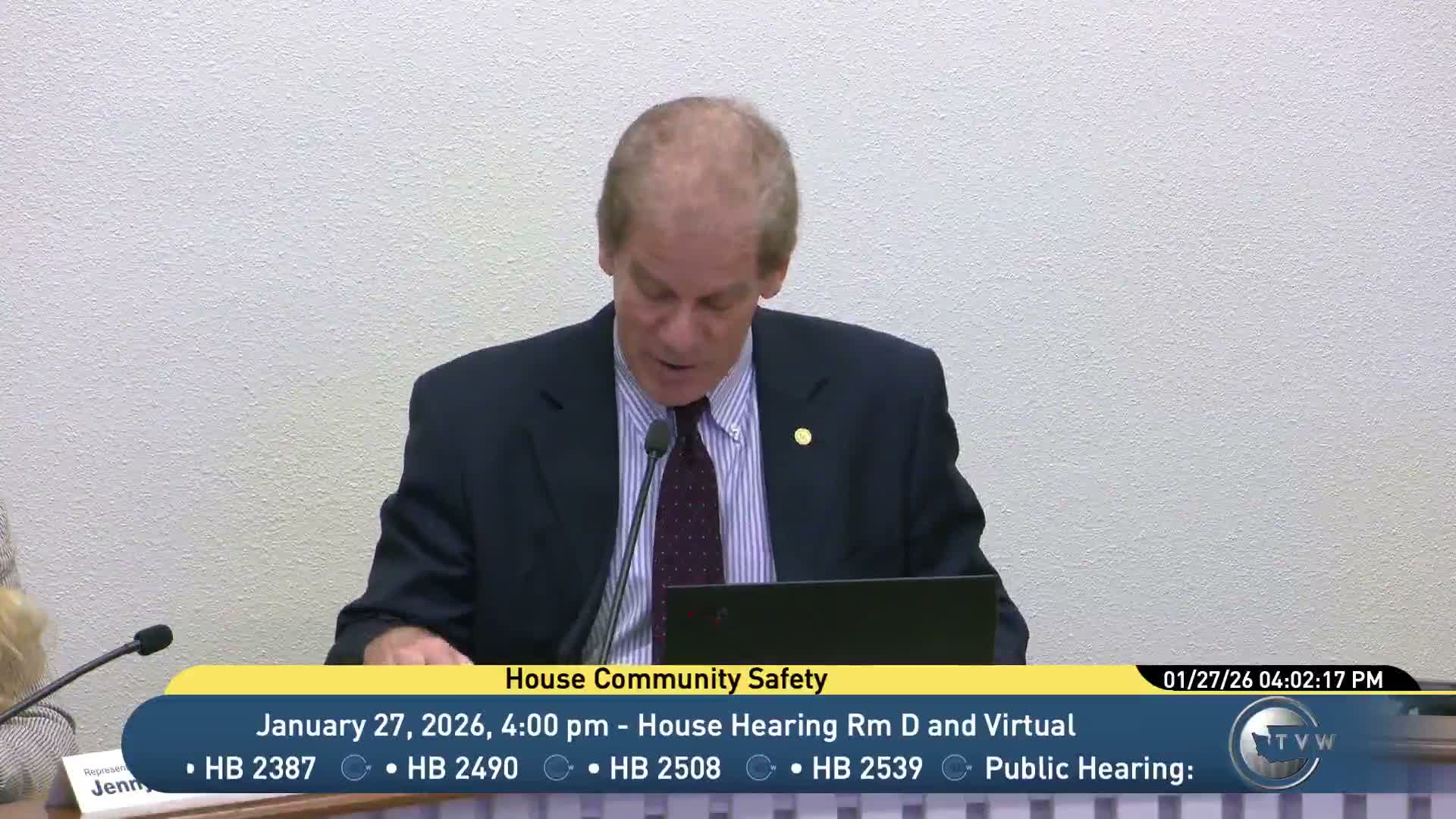
The Washington State House Community Safety Committee heard testimony Jan. 27 on House Bill 2508, a proposal to sharpen and expand the authority of the Office of Independent Investigations (OII) in use-of-force reviews.
Corey Patton, staff to the committee, summarized four principal changes in the bill: expanding OII’s jurisdiction to include prior deadly-force incidents and other uses of force that may have contributed to a death; requiring involved agencies to notify OII immediately about force that may have caused death or serious injury and about in-custody deaths; giving OII access to response records from fire, rescue and ambulance providers (with limited health-data exceptions); and exempting OII investigative records from public disclosure under the Public Records Act until a case is referred to a prosecutor.
Representative Deborah Entenmann, sponsor of amendments to the agency statute, said the bill is intended to produce “a fair and open and transparent investigation when police use deadly force,” and to align the office’s authority with legislative intent. Annette Taylor, legislative director for OII, and Jessica Berliner, the agency’s senior legal adviser, testified that the changes codify OII’s interpretation of its duties, clarify notification expectations for delayed deaths, and protect sensitive family communications while preserving public access to final case reports.
Committee members asked whether all cases that are ‘closed’ are referred to prosecutors and therefore exempt from public disclosure. Berliner said formal reviews and reinvestigations would be referred to prosecutors and thus follow existing PRA exemptions; administrative closures where no investigative materials are compiled would not be exempt. Taylor and Berliner said they will work with staff to tighten notification language and to ensure the PRA exemptions are appropriately limited.
Law enforcement organizations, including the Association of Sheriffs and Police Chiefs, generally supported the operational clarifications while raising implementation concerns: James McMahon, the association’s policy director, noted OII is currently operational in only one of ten regions and urged careful work on notification language for deaths that occur after a use of force.
Critics on the panel urged caution about broad non-investigative exemptions; several witnesses asked that the bill reference existing RCW privacy exemptions rather than creating a blanket new standard. The State Auditor’s Office, said OII, will audit use-of-force investigations as it does other independent investigation teams.
The committee intends to take action on HB 2508 on Monday, Feb. 2.
The hearing record shows the bill would change who investigates certain use-of-force and in-custody-death incidents, expand OII’s access to nonpolice records with restricted health-data disclosures, and add PRA exemption language the office says is necessary to protect highly personal communications until cases are referred to prosecutors.