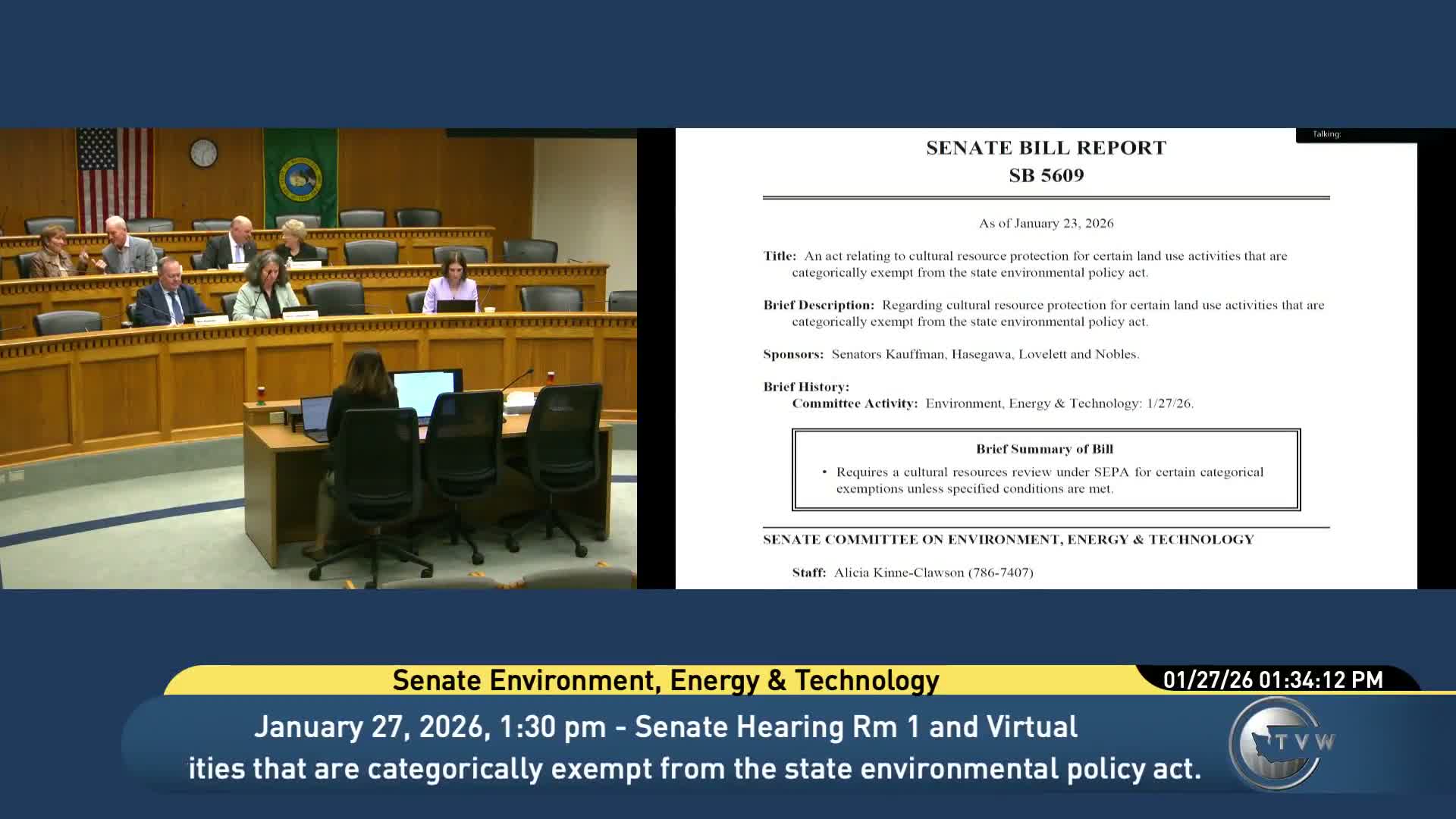
Senate committee hears competing views on SB 5,609 to require cultural‑resource review for SEPA categorical exemptions
Loading...
Summary
Supporters, including tribal leaders and local planners, praised SB 5,609 for protecting irreplaceable cultural sites and encouraging early consultation; builders, counties and developers warned it could delay housing, increase costs and create legal uncertainty without statutory guardrails and phased implementation.
A Washington State Senate committee heard public testimony Jan. 30 on Senate Bill 5,609, a proposed substitute that would require cultural‑resource review when projects proceed under certain SEPA categorical exemptions, committee staff said.
The measure, as described by Alicia Kinney Clawson, staff to the committee, would expand the role of the Department of Archaeology and Historic Preservation (DAHP) to develop minimum standards and would condition the use of certain categorical exemptions on adoption of local ordinances or cultural resource management plans meeting DAHP standards. Clawson told the committee that the substitute narrows earlier language and that a fiscal note exists for the underlying bill, with ongoing costs to both the Department of Ecology and DAHP.
Tribal leaders and preservation officials urged lawmakers to pass the bill. "This bill helps protect places that hold meaning for tribal members for generations," Senator Claudia Kaufman, the bill sponsor, told the committee, saying the bill is about "respect for the land" and does not aim to stop development. Michael Moran, testifying for a Confederated tribe, recounted historic examples of disturbance and said early cultural review provides regulatory certainty. Jared Michael Erickson, an elected tribal chairman, said the legislation offers two compliance pathways — SEPA standard provisions or a statutory path tied to data‑sharing agreements and approved local ordinances — and urged support.
Local governments and preservation officers described workable local models. Kimberly Dietz, Redmond's principal planner and historic preservation officer, said Redmond adopted a cultural resource management plan after a damaging discovery and estimated that an initial survey and formal review can be completed in roughly 60 days when coordinated with tribes and state reviewers. "Early screening and early consultation work avoid damage to irreplaceable cultural resources," Dietz said.
Builders, county planners and industry associations opposed the substitute in its current form. Scott Hazelgrove of the Master Builders said the bill would move review back to the individual project level "— we're talking about every single family home" — potentially subjecting many low‑impact projects to full cultural review, with unclear timelines for tribal response. County planning directors asked for statutory guardrails, minimum elements for model ordinances and a phased implementation tied to model ordinance development to avoid conflicts with the Growth Management Act and statewide housing goals.
Speakers on both sides suggested practical improvements: risk maps to flag high‑probability areas, pre‑application meetings, clearer statutory thresholds for DAHP model ordinances, and funding and time for jurisdictions to implement local systems.
The committee closed the public hearing after a large number of sign‑ins: staff reported 15 pro, 266 con and 0 others (281 total). The committee did not take a vote during the hearing; next steps, if any, were not announced at adjournment.
The hearing record includes testimony from tribal leaders, local planners, county representatives, building industry groups and developers who urged differing fixes — from statewide standards and funding to phased implementation and improved data‑sharing — before imposing new, project‑level requirements.