
Washington committee hears competing views on bill to define ‘imminent physical harm’ in child-welfare cases
Get AI-powered insights, summaries, and transcripts
Subscribe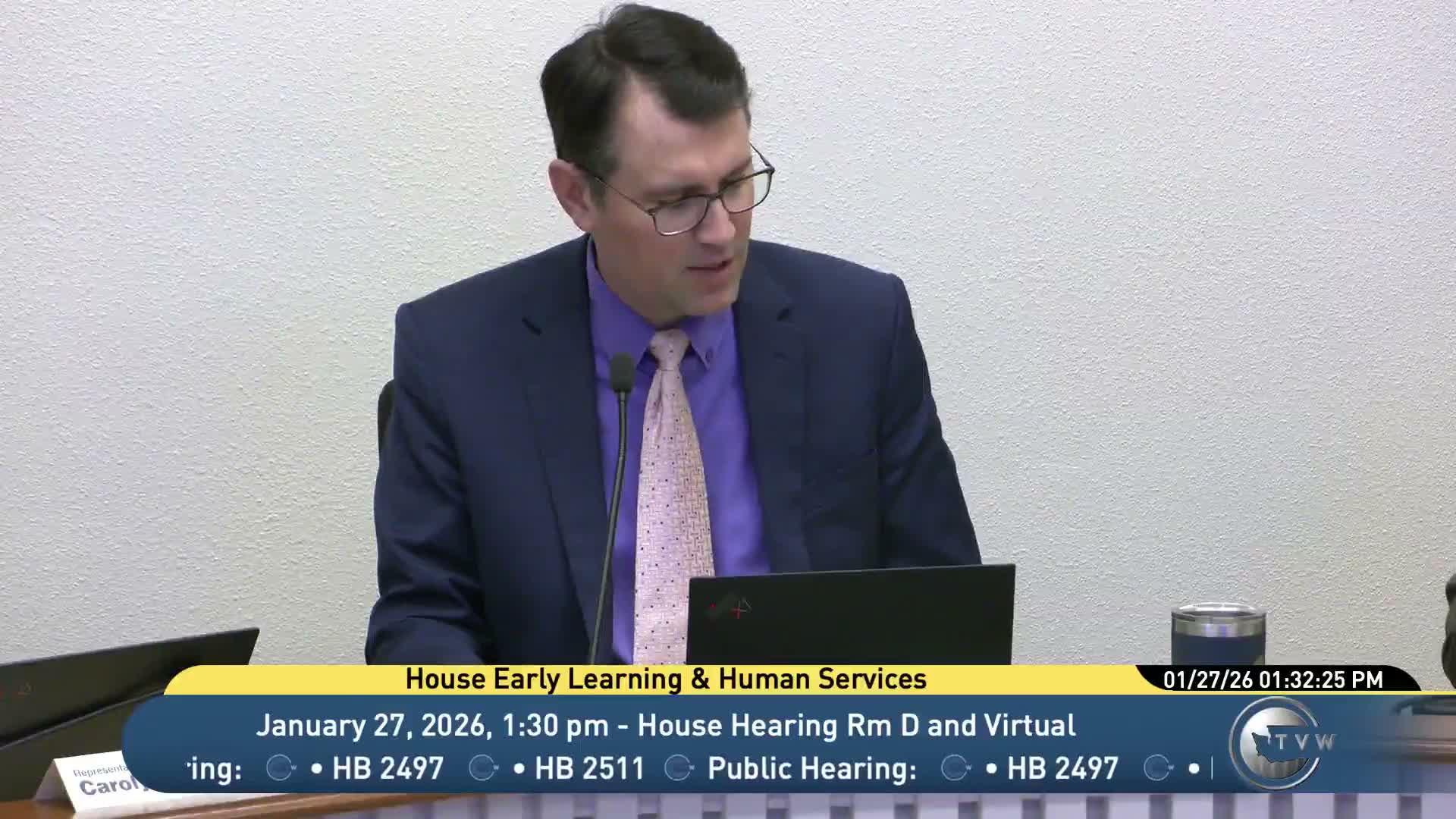
Summary
Supporters including foster and kinship caregivers say HB 2511 would let caseworkers and courts act earlier to prevent fatalities; legal advocates and defenders warn the definition could conflict with existing law and expand removals without funding for services. DCYF says courts apply the current standard inconsistently and offers to work with the sponsor on refinements.
Representative Tom Dent introduced House Bill 25-11 to the Early Learning and Human Services Committee as an attempt to provide a statutory definition of “imminent physical harm” used to authorize removal or shelter-care actions in child-welfare cases. Committee counsel Luke Wickham described the measure as specifying that imminent physical harm exists when there is a substantial risk of serious harm arising from home conditions, caregiver conduct or omission, or other circumstances reasonably likely to cause significant developmental, psychological or physical injury.
Supporters included current and former foster and kinship caregivers and frontline workers who cited recent child fatalities and near-fatalities. Allison Rogers, a Washington Federation of State Employees member and child-welfare worker, said the status quo is “unacceptable” and cited an estimate that 92 children faced fatalities or near fatalities last year; she urged lawmakers to “choose to pass legislation that will meaningfully address a clear problem in the law.” Rep. Dent said his experience as a foster parent and contact with caseworkers motivated the bill so staff would have clearer legal tools.
Opponents, including Legal Counsel for Youth and Children and representatives of public defense programs, argued the bill is legally unsound and risks undermining protections in existing statutes. Esani Chung of LCYC said the proposed definition “defies the principles of statutory construction” and warned it deviates from the plain meaning of imminent physical harm. Marcy Como of the Office of Public Defense said the bill could conflict with language in current shelter-care statutes—pointing to text that states substance use alone does not automatically constitute imminent physical harm—and referenced the Indian Child Welfare Act as a governing standard to consider.
Several witnesses described specific cases in which they said the current standard prevented timely intervention. Adrian McKinley and Christian Ray Verasales recounted kinship-care cases involving medical neglect and alleged unaddressed abuse. Daryl Cochran, representing the Washington State Association for Justice, countered that the 2021 reforms aimed to ensure removals occur only when imminence and physical harm are present and urged caution against rolling back those safeguards.
Department of Children, Youth and Families representative Julie Watts said DCYF shares the bill’s goal of protecting children and described inconsistent application of the imminent-harm standard across different courts. Watts said a clearer, more consistent definition could help caseworkers and judges but signaled the agency has concerns about specific language and offered to work with the sponsor to refine drafting.
Committee members asked about data and sources. Witnesses and staff cited a rise in opioid-related incidents and critical-incident reports; DCYF and several medical and advocacy witnesses urged pairing any statutory changes with investments in services and training. Several legal witnesses warned that the bill’s enumerated factors (emotional harm, chronic unsafe conditions, caregiver impairment due to substance use) would themselves require careful definition to avoid new inconsistencies.
The hearing produced extensive testimony for and against the measure; no committee vote occurred during the session. The committee closed the hearing after hearing public comment and staff responses, and members signaled interest in further briefing and drafting work to reconcile child-safety goals with statutory coherence and implementation capacity.