
Committee hears unanimous clinician support for banning insurer anesthesia time caps
Get AI-powered insights, summaries, and transcripts
Subscribe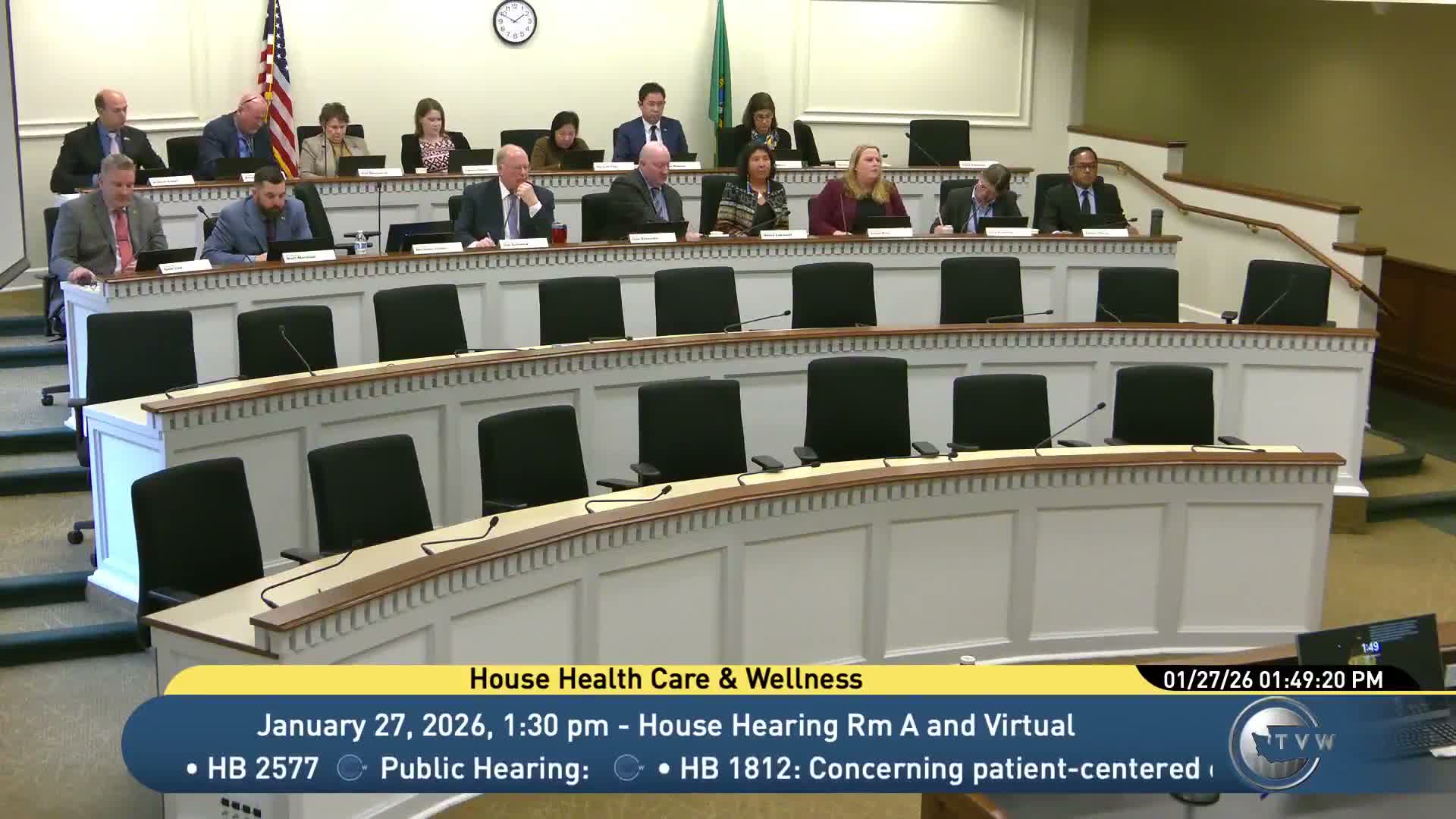
Summary
Sponsors and clinicians urged passage of a bill that would prohibit insurers and public plans from denying or capping anesthesia reimbursement on the basis of arbitrary time limits; anesthesiologists and nurse anesthetists warned caps endanger patient safety, while hospitals may request clarifying language.
Olympia — On Jan. 27 the House Health Care and Wellness Committee took testimony on a proposed substitute (H2936) to House Bill 1812 that would prohibit health carriers, public employee plans and Medicaid managed care organizations from enforcing anesthesia time limits or capping anesthesia reimbursement based on base or time units.
Staff described the substitute as prohibiting plans from establishing anesthesia time limits for payment, defining anesthesia time to begin when the provider prepares the patient and to end when the provider no longer delivers anesthesia services, and authorizing the insurance commissioner to pursue enforcement actions for repeated violations.
Sponsor Representative Alicia Ruehl framed the bill succinctly: "Insurance companies should not be practicing medicine," saying patient safety requires anesthesia to continue when complications arise and reimbursement must be based on medical necessity, not an algorithm.
Multiple anesthesia professionals testified in favor. Kelly Camp, president of the Washington Association of Nurse Anesthesiology, said anesthesia is ‘‘time based, patient specific, and often very unpredictable’’ and that artificial time caps shift financial risk to providers and patients. Dee Binder, vice president of the association and a Snohomish County hospital commissioner, warned that time limits ‘‘create dangerous pressure to rush care’’ and urged the committee to protect reimbursement through the end of a case: "You can't put a stopwatch on safety. You can't put a stopwatch on anesthesia."
Amy Brackenberry, an anesthesiologist, noted the bill is a preemptive response to insurance actions in other states and recommended a small definitional change to protect use of physical status modifiers; she referenced current CMS guidance that reimburses anesthesia in 15‑minute increments as the existing standard.
Committee members asked clarifying questions; no vote was recorded during the hearing. The testimony reflected strong clinical consensus on patient safety and rural hospital viability tied to anesthesia reimbursement practices.