Get Full Government Meeting Transcripts, Videos, & Alerts Forever!
Get email alerts on the Animal Testing Alternatives topic
No spam. Unsubscribe anytime.
Panel hears bill to require validated non‑animal test methods in drug development
Summary
Supporters told the Consumer Protection and Business Committee HB 2542 would require use of validated non‑animal test methods in drug development when available; industry witnesses urged care to avoid hindering research where alternatives are not yet adequate. The committee heard broad public support and staff briefing on federal FDA developments.
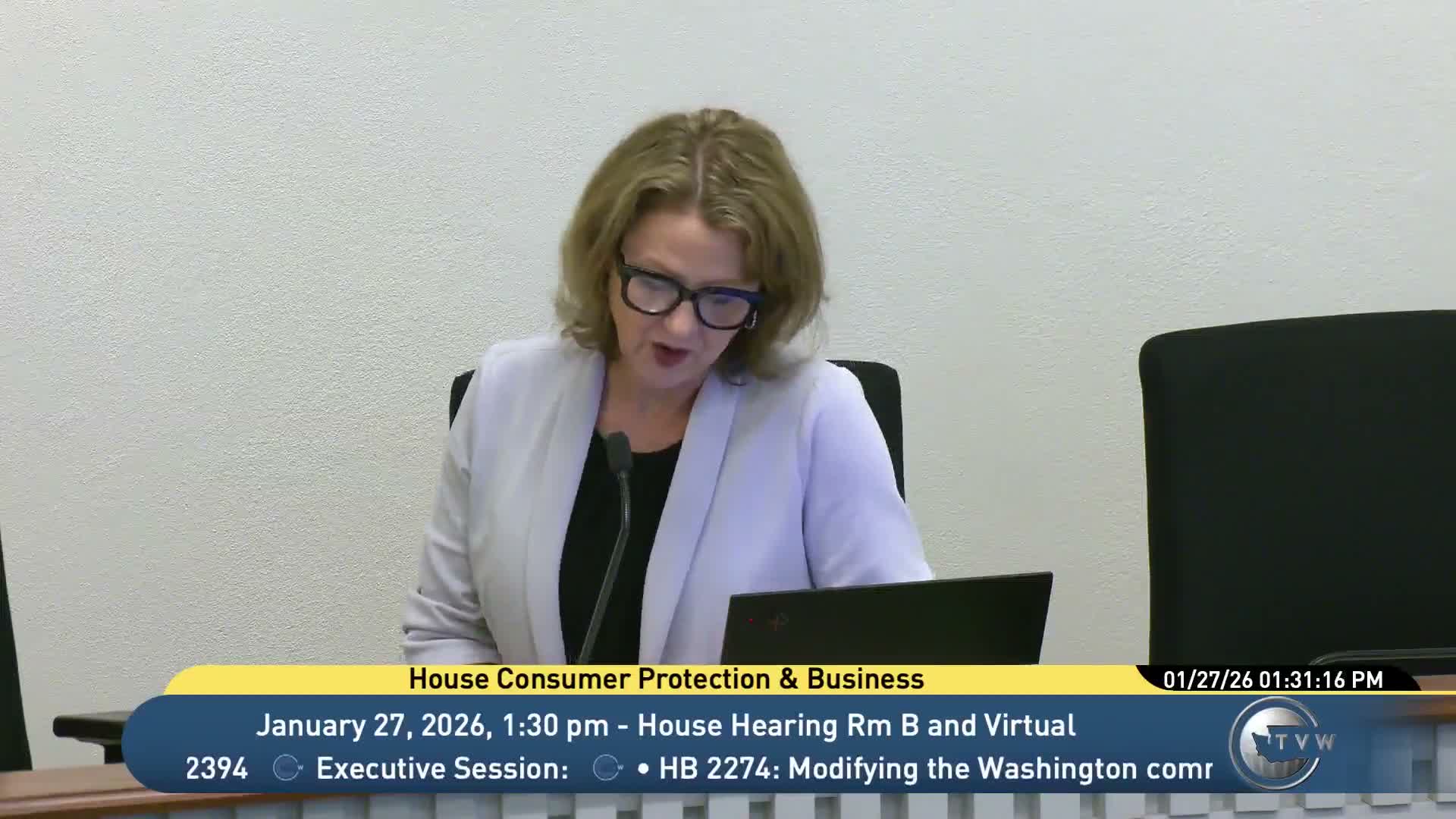
The Consumer Protection and Business Committee heard testimony Jan. 27 on House Bill 2542, which would prohibit use of animal test methods in drug development when a validated, non‑animal alternative that provides information of equivalent or better scientific quality is available.
Megan Mulvihill, staff to the committee, told members that the bill defines an alternative test method as one that “provides information of equivalent or better scientific quality and relevance” and is identified by a validation body and adopted by the relevant federal agency. She noted the 2022 federal FDA Modernization Act removed the mandatory animal‑testing requirement for new drug development and that the FDA announced plans in 2025 to phase out some animal testing.
Prime sponsor Representative Mia Gregersen (33rd Legislative District) framed the bill as the next step following cosmetic testing reforms and federal changes, saying the measure seeks to “move us towards a future that maximizes the ability to treat animals more humanely when possible.” She said she was open to technical amendments and to discussions with staff and advocates.
More than a dozen members of the public, including students, animal‑welfare advocates and residents, urged passage. Wendy Linton of Seattle said HB 2542 would “protect our fellow residents and animals” and cited studies showing high failure rates for drugs that succeed in animal trials. Marci Bowers of the Statewide Poverty Action Network and other witnesses urged the committee to adopt the bill and suggested amendments to strengthen its reach.
Industry witnesses raised caution. Primo Castro with the Biotechnology Innovation Organization said alternatives such as in vitro and in silico techniques provide valuable information but “cannot capture the integrated whole‑body responses needed to assess systemic effects,” and that the FDA has not finalized rules for drug approval based solely on alternative methods. He asked the committee to consider amendments that preserve patient‑safety pathways while promoting validated alternatives.
Supporters and industry said they had exchanged amendment ideas; some witnesses provided written suggestions to refine definitions and to clarify the bill’s interaction with federal regulatory standards. The hearing record closed after public testimony; the committee did not take a vote on the bill at this session.
The committee will decide next steps in a future meeting; staff offered to circulate technical bill history and related federal rulemaking materials on request.