Get Full Government Meeting Transcripts, Videos, & Alerts Forever!
Get email alerts on the Tort Reform topic
No spam. Unsubscribe anytime.
Senate Committee Hears Fierce Debate Over Mandatory Arbitration for State Tort Claims
Summary
The Senate Law & Justice Committee heard hours of testimony on SB 6,239, which would require civil arbitration for tort claims against Washington and its subdivisions before trial. Local governments urged relief from rising insurance costs; trial lawyers, survivors and civil-rights groups warned arbitration would reduce transparency and erect barriers to justice.
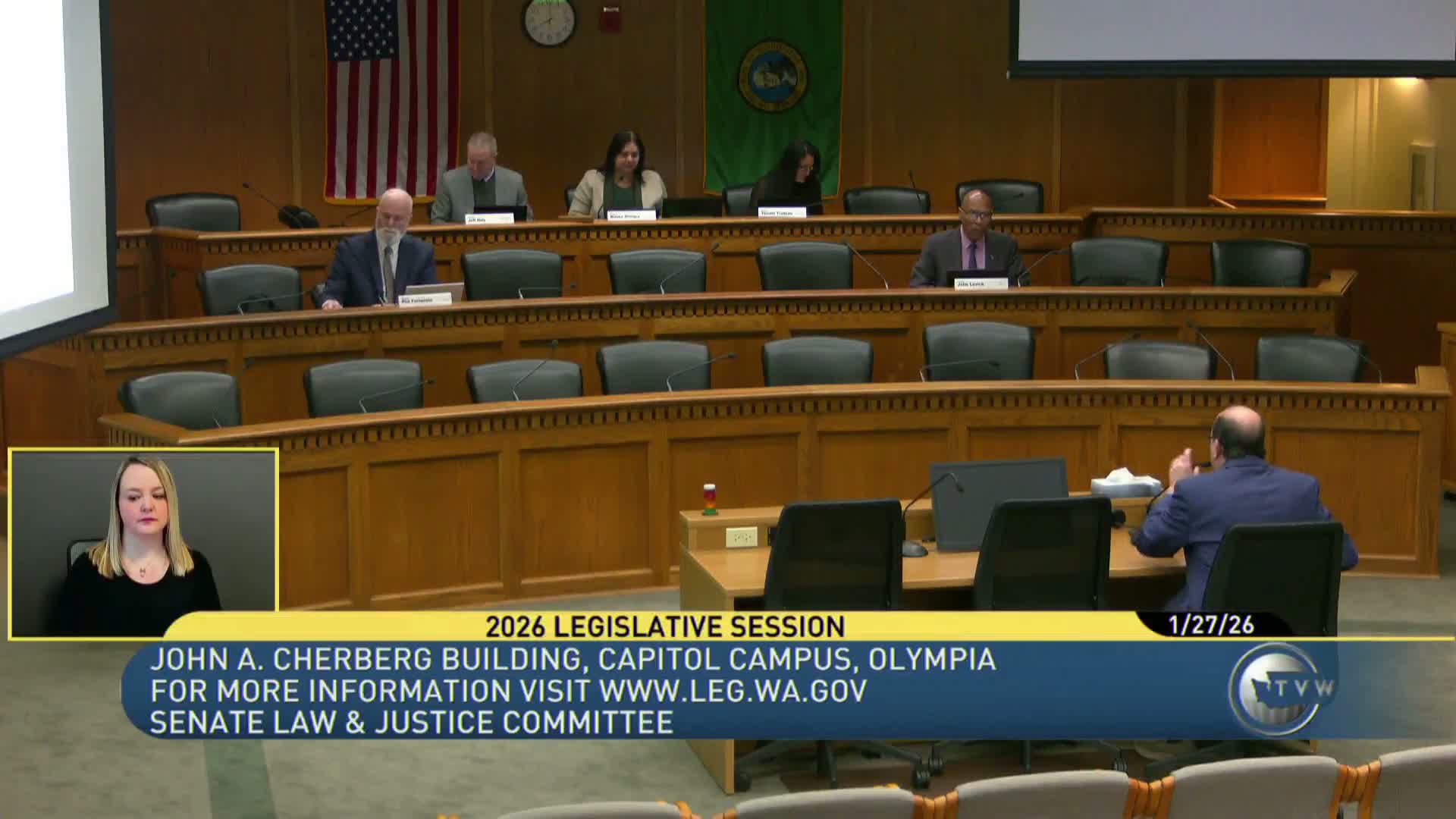
The Washington State Senate Law and Justice Committee on Jan. 27 heard extensive public testimony on Senate Bill 6,239, a proposal to require civil arbitration for tort claims against the state and local subdivisions before cases proceed to trial.
Tim Ford, committee staff counsel, told the committee that current practice requires claimants to submit tort claims to the Office of Risk Management, wait 60 days and then may file suit. ‘‘When someone has a tort claim against the state, they must first submit the claim to the office of risk management in the department of enterprise services and then they have to wait for 60 days,’’ he said. The bill would make those claims subject to arbitration at any dollar amount prior to trial and preserve a trial de novo and jury if a party appeals.
Sen. Tara Dhingra, the bill’s prime sponsor, framed SB 6,239 as a response to mounting liability exposure that she said is straining state and local budgets. ‘‘Washington is an outlier in the country in terms of how much liability exposure it has when it comes to actions of government,’’ she said, and described the bill as an effort to create an early-resolution system while preserving jury rights and victims’ damages.
Local officials and members of county associations urged passage. Pierce County Executive Ryan Mello said his county has received ‘‘140 claims totaling over $320,000,000’’ and has paid ‘‘just over $9,000,000,’’ warning that unchecked liabilities ‘‘would likely cut Pierce County core constitutional services such as elections, criminal justice services’’ and could jeopardize service delivery.
County and city officials, risk pools and school-district representatives said rising premiums and assessments are forcing difficult budget choices. Several speakers urged the committee to keep the bill mandatory and broad to maximize potential cost relief, while noting the bill is an incremental step that may not solve every root cause.
Opponents—from the Washington State Association for Justice, trial attorneys, survivor advocates and civil legal-aid groups—pressed that arbitration would reduce transparency and limit public accountability for systemic failures. Kelly Carson, representing the Washington State Association for Justice, argued the measure ‘‘would have any single civil claim of any nature against the government go through arbitration,’’ including vehicle strikes, employment and contract disputes, potentially creating a barrier to justice.
Survivors who testified described the personal consequences of institutional abuse and why they sought public court proceedings. ‘‘It was more like a POW camp,’’ survivor Chris Norwood said when describing an institution he sued in public court; he added that public trials enabled him to ‘‘hold the system accountable.’’
Trial lawyers and press advocates warned that open court proceedings drive reforms. Daryl Cochran said the current sovereign-immunity waiver ‘‘has increased citizen control of government accountability’’ and cautioned that an arbitrated process ‘‘could incentivize mass filings’’ if not carefully designed.
School-risk and provider representatives said the state’s liability rules and court rulings have driven up exposure and that arbitration could help stabilize premiums, but some asked to be included as stakeholders in future drafting. Tina Eck, general counsel for the Washington Schools Risk Management Pool, urged that the proposal be kept broad for effectiveness and that schools be part of future conversations.
The hearing record shows a sustained divide: local officials and insurers seeking fiscal relief versus survivors, civil-rights and criminal-justice advocates warning of lost transparency and access to justice. Sen. Dhingra said she expected amendments before the committee’s executive session and the bill’s sponsors signaled further negotiations.
The committee closed the public hearing on SB 6,239 after hours of testimony and did not take a formal vote during this session. Any amendments, fiscal-note details and committee recommendations remain to be developed in follow-up work sessions.