Get Full Government Meeting Transcripts, Videos, & Alerts Forever!
Get email alerts on the Hb 2175 topic
No spam. Unsubscribe anytime.
Bill would exempt nonprofits that give away durable medical equipment from sales tax
Summary
House Bill 2175 would exempt free durable medical equipment (DME) providers — licensed, tax‑exempt nonprofits that supply wheelchairs, walkers, hospital beds and similar items — from retail sales and use tax on items necessary to provide care; sponsor Rep. Mark Clicker and a long‑time nonprofit operator urged passage, while staff presented a small fiscal impact estimate.
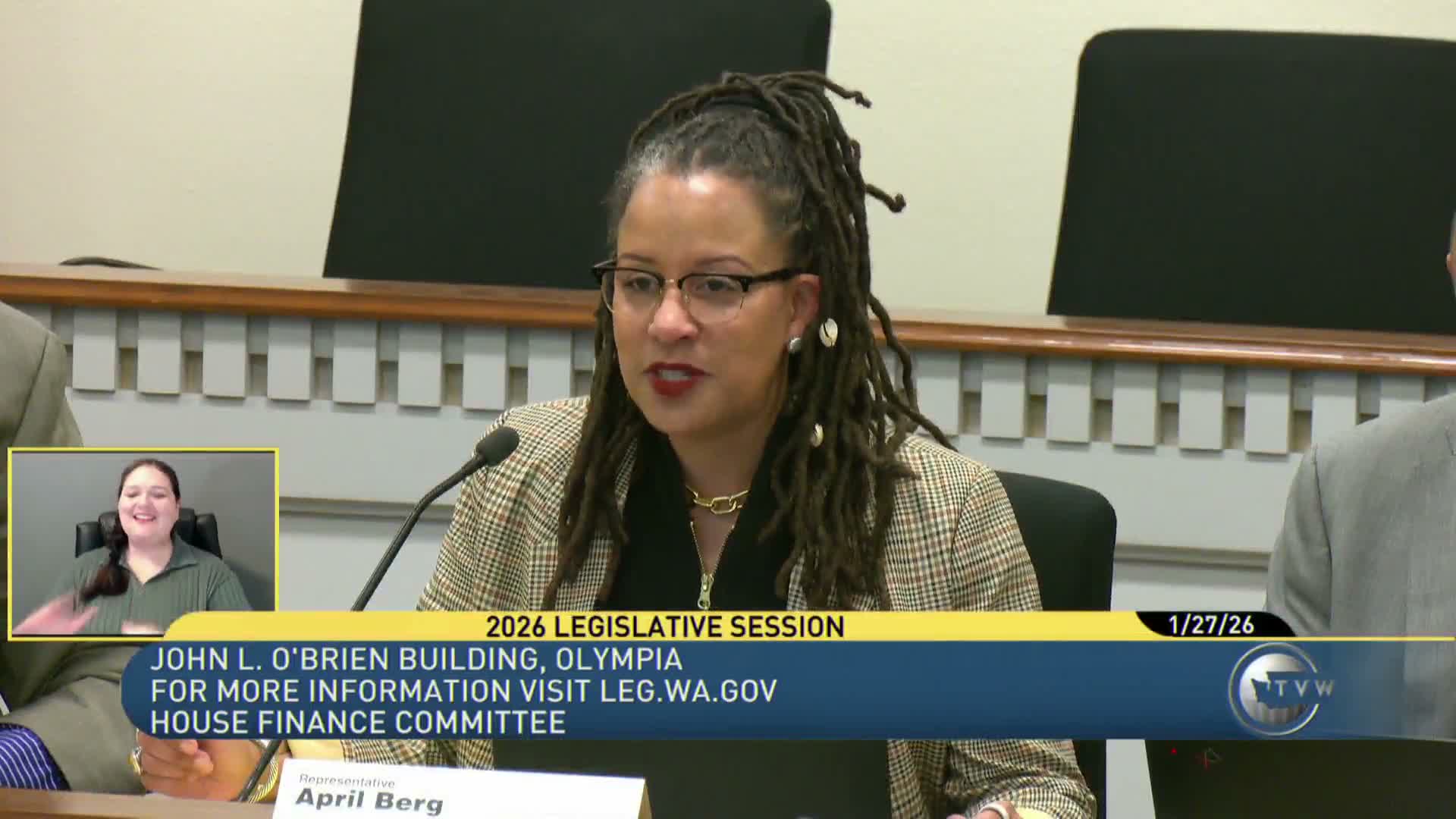
House Finance Committee members heard a briefing Jan. 27 on House Bill 2175, which would exempt providers that deliver durable medical equipment free of charge from retail sales and use tax on items reasonably necessary for operation.
Christina King, staff to the committee, told members the bill narrows the tax exemption to “items reasonably necessary for the operation of and provision of health care by free durable medical equipment providers” and that the Department of Revenue (DOR) estimates the change affects about 700 taxpayers. King said a fiscal note estimates a decrease to the state general fund of roughly $7,000 in the current biennium and about $33,000 in the 2027–29 biennium, and local revenue decreases in the low thousands; DOR staff also estimated one‑time administrative costs to implement changes.
Rep. Mark Clicker, the prime sponsor, said the bill would help small charitable organizations that collect, repair and donate equipment such as wheelchairs, scooters, walkers and hospital beds to people who cannot afford them. “These organizations…sometimes have to buy [equipment], and they shouldn’t have to pass that cost on to people who can’t afford it,” Clicker said.
Jerry Rhodes, founder and volunteer CEO of a nonprofit DME provider, testified in support and described nearly three decades of service. Rhodes said his organization has repaired and issued thousands of items — “over 2,600 electrical wheelchairs and scooters and even more hospital beds” — and estimated the nonprofit’s service value at about $4,000,000. He urged the committee to pass the bill to reduce costs for providers who serve clients at no charge.
There were no formal amendments or motions recorded during the hearing. The prime sponsor and staff answered committee members’ procedural questions; no opposing testimony was offered and the chair closed the hearing.