
Bill would give Washington housing agency new enforcement tools after audit finds broken 'rent-to-own' promises
Get AI-powered insights, summaries, and transcripts
Sign Up Free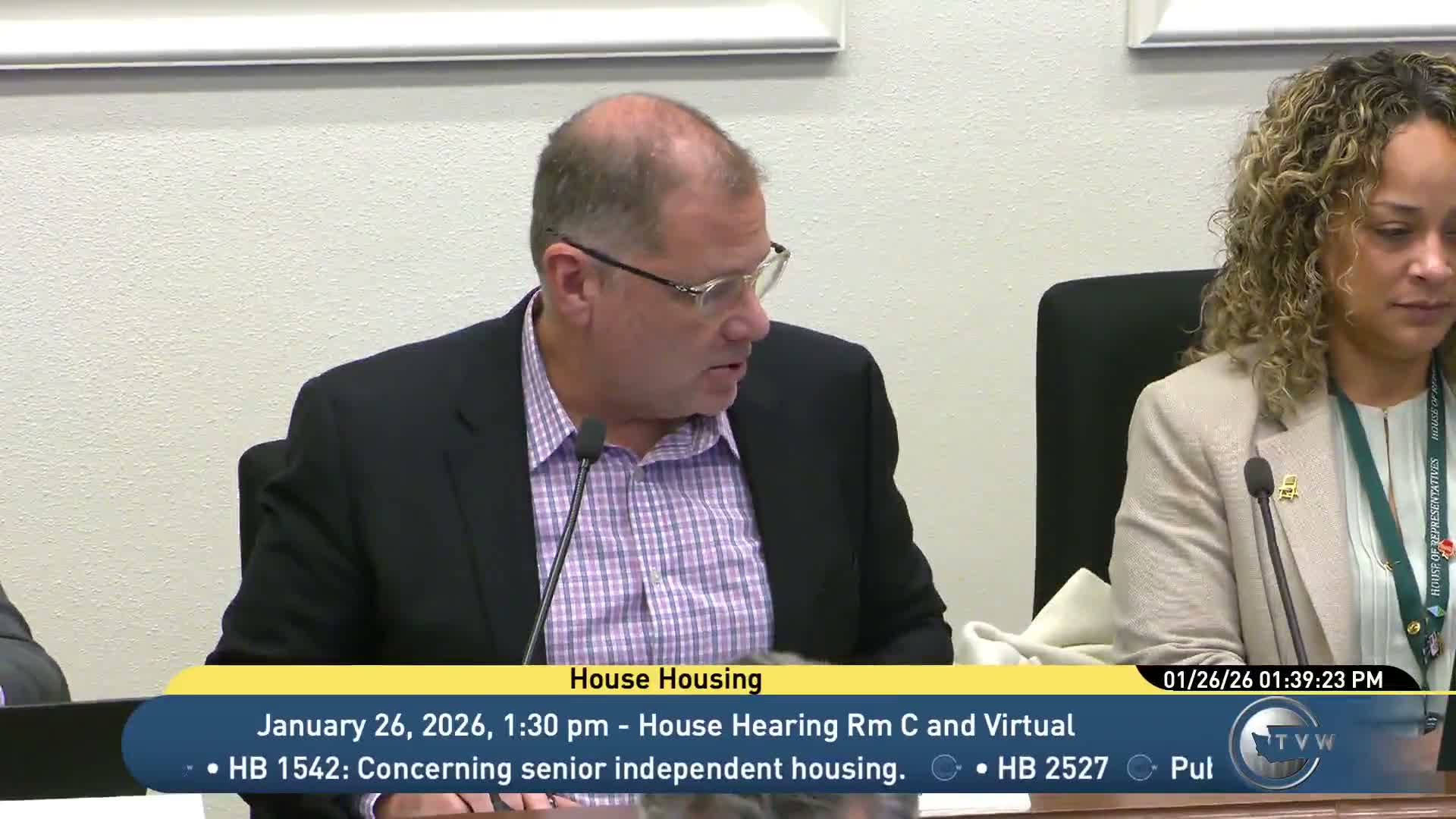
Summary
HB 2527 would require developers using federal low-income housing tax credits to support eventual tenant ownership (ETO) plans, expand Housing Finance Commission enforcement (including possible debarment), and mandate public reporting; advocates say the bill addresses audit findings that more than 500 tenant-buyers were not placed on a path to homeownership, while the Housing Finance Commission urges collaborative fixes to avoid unintended harm to tribal housing programs.
A Washington bill that would strengthen enforcement of 'eventual tenant ownership' commitments under federal low-income housing tax credits was heard Jan. 26 by the House Housing Committee.
Representative Jesse Pollet, prime sponsor of HB 2527, told the committee the measure responds to an audit and community reports showing tenants in tax-credit projects were promised the opportunity to buy their homes after 15 years but frequently never received deeds or keys. "We estimate, well over — the records show, over 450 families," Pollet said, adding the state auditor’s work and subsequent testimony point to systemic monitoring failures.
Audits cited by testifiers put the figure even higher. Gabe Galanda, an indigenous rights lawyer and housing advocate, testified that the state auditor’s performance audit found "over 500 families" who were promised homeownership through the LIHTC program had not received deeds or keys and that as of the audit date "not a single homeowner was on a trajectory to become a homeowner." He urged lawmakers to give the Washington State Housing Finance Commission (WSHFC) statutory tools to hold developers accountable.
Under current practice, developers awarded federal tax credits typically sell those credits to investors who provide construction capital; ownership and transfer plans vary across projects. Jim Morishima, committee staff, summarized HB 2527 as imposing duties on developers to establish reserve or escrow accounts, inform tenants of rights and responsibilities, post program progress reports publicly, and allow the Housing Finance Commission to investigate and enforce compliance. Penalties in the bill include temporary debarment from commission programs for one to five years, and for willful violations a two- to five-year prohibition from participating in commission programs; developers could appeal enforcement actions to the Office of Administrative Hearings.
WSHFC’s executive director, Steve Walker, and multifamily programs lead Lisa Vatsky said the commission supports the bill’s goals but cautioned the committee against punitive language they said could undermine ongoing collaborative work with tribal housing authorities. "Tribal housing authorities are the owners of 17 of our 18 ETO projects," Walker said, and the commission in 2024 adopted strengthened policies and procedures to address monitoring gaps. Walker warned that creating statutory, retroactive punitive measures could hamper progress and urged continued engagement with tribes and native communities.
Committee members pressed WSHFC on specific questions: whether deeds or keys were guaranteed at year 15 (WSHFC said practices vary and that not every ETO project was designed for keys to be turned over automatically at year 15), how many projects had used ETO (18 projects have the provision; the commission noted about 1,300 total LIHTC projects statewide), and examples of successful transfers (the Spokane Indian Housing Authority transferred 17 units, the commission said). WSHFC also said monitoring obligations included five-year check-ins that were not consistently completed in the past, contributing to the gap identified by the auditor.
Sponsors and advocates argued that relying on federal enforcement or IRS complaints has not produced results for affected tenants. Pollet said the bill is intended to create state-level remedies that give the commission leverage over developers who fail to implement ETO plans. Walker and Vatsky said many issues stem from complex, project-specific partnership agreements (investor, developer, tribal sponsor) and that the commission's relationship is with sponsoring tribal entities rather than outside investors; they warned the bill should not inadvertently penalize tribal owners or disrupt projects on sovereign land.
The hearing closed with the chair noting the possibility of a future work session to refine statutory language and potential amendments. No committee vote occurred on HB 2527 during the Jan. 26 hearing.