Committee Weighs Proposal to Replace Property Tax on Large Renewables With New Excise Tax
Loading...
Summary
House Bill 1960 would exempt personal property used exclusively for qualified renewable energy facilities from property tax beginning 2028 and create state and local renewable excise taxes with specified per-megawatt rates and a local investment distribution program to support counties and tribal capacity grants.
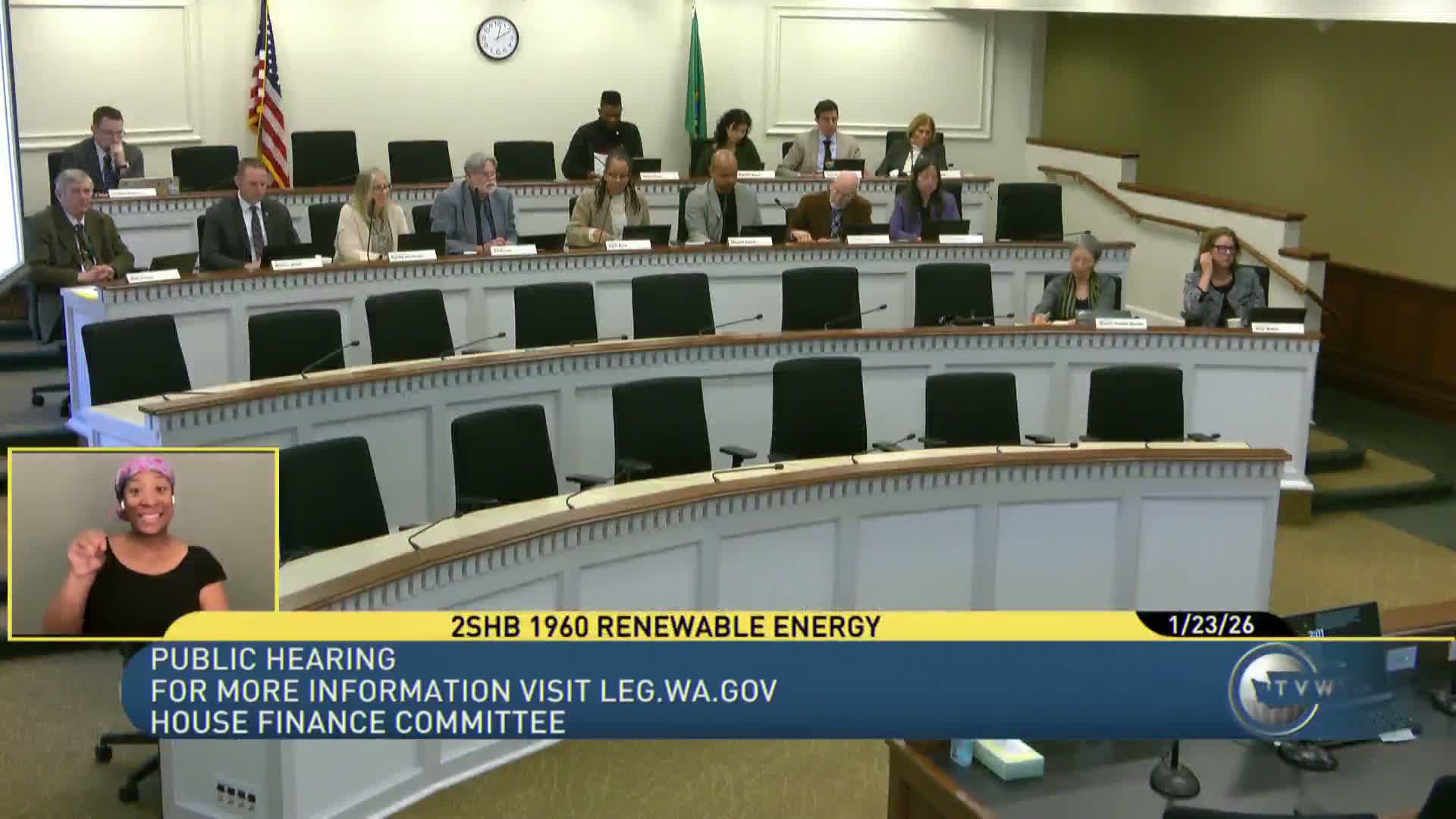
Lawmakers and stakeholders spent the Jan. 23 House Finance hearing debating House Bill 1960, a multi-part substitute that would remove certain renewable energy equipment from property-tax levy growth calculations and replace that revenue with a state renewable excise tax and optional local rates.
Tracy Taylor, staff to the committee, said the bill exempts personal property used exclusively for qualified renewable energy facilities that become operational or are repowered on or after Jan. 1, 2028, and defines a qualified facility as having nameplate capacity of at least 10 megawatts. Taylor listed the bill’s per-megawatt base rates: for solar, the state rate is "$969 per year per megawatt" and the local rate "$2,905 per megawatt"; for wind, the state rate is "$1,286 per year per megawatt" and local "$3,857 per megawatt"; for battery electric storage, the state rate is "$156 per megawatt" and the local rate "$467 per megawatt." Taylor also summarized opt-in rules for projects under construction, administrative requirements, and a directive for DOR and JLARC to review rates and report to the legislature by Oct. 31, 2031.
Representative Bramhall, the bill’s sponsor in the hearing, framed the change as making hosting communities "see a lasting economic benefit" and described the policy goal as leveling tax payments over a facility’s life so other taxpayers are not left with a later tax spike. "I sometimes liken this effect to a sugar high followed by a crash," the sponsor said. The substitute includes a local investment distribution program to provide grants to counties and a tribal capacity grant program administered by Ecology.
Supporters included county officials and statewide associations who said the current property-tax rules produce an unintended cost shift to local taxpayers; the Washington State Association of Counties and local assessors described the bill as a collaborative solution though they requested changes to rates, timing and definitions (in particular, the definition of "repowering"). Utilities and developers expressed concern that rates may be too high and that centrally assessed entities need distinct treatment; stakeholders urged continued negotiation. Several county treasurers requested clearer timing of fund flows to align with tax dates so counties can meet debt obligations.
The committee closed the hearing on HB 1960 after extensive testimony and indicated further stakeholder work and technical drafting would continue.