
Senate committee hears broad review of dual-credit programs as ERDC plans causal study
Get AI-powered insights, summaries, and transcripts
Subscribe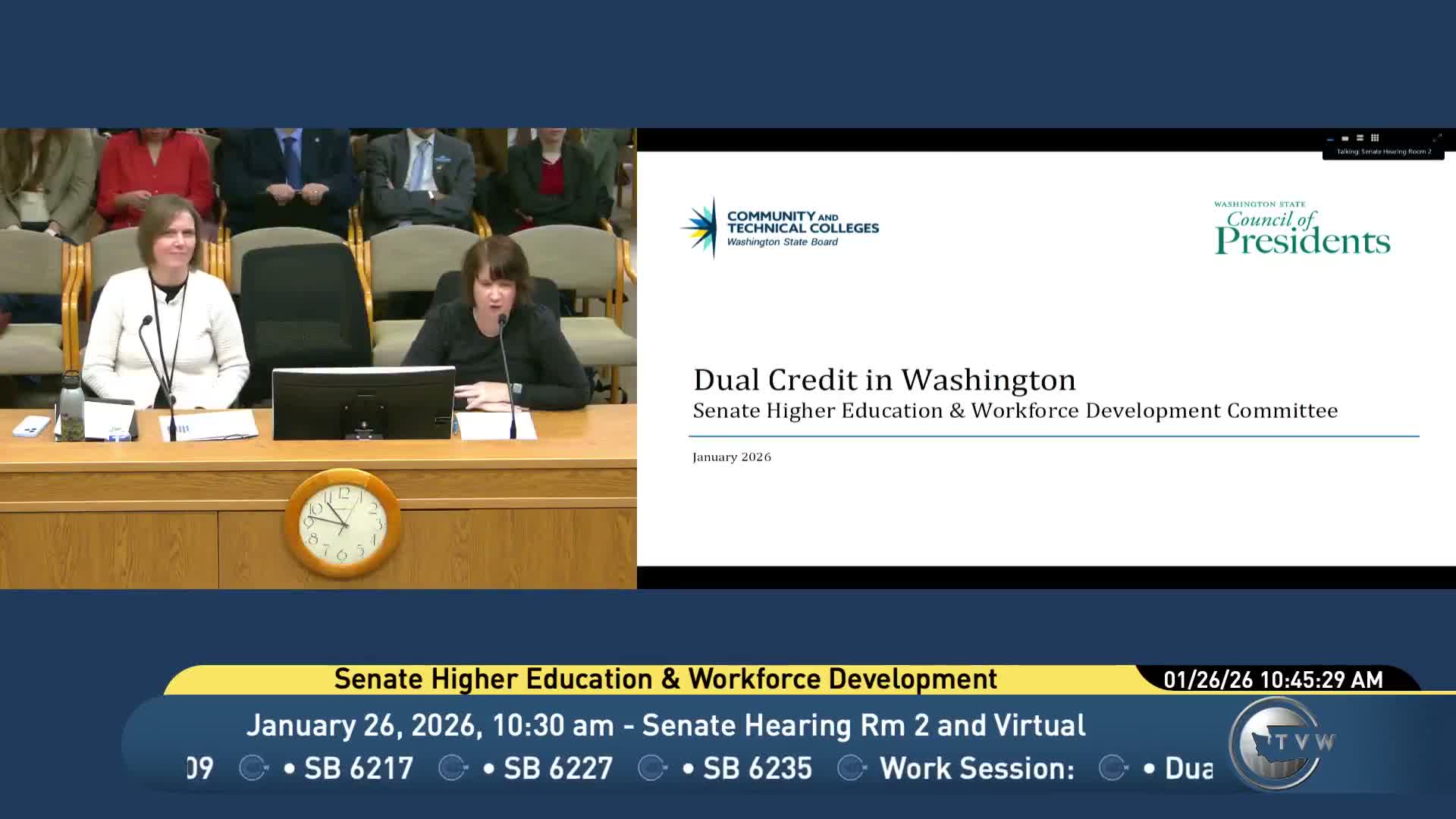
Summary
Presenters from the Council of Presidents, State Board for Community and Technical Colleges and ERDC told the Senate Higher Education Committee that dual credit participation is widespread in Washington and linked to higher postsecondary enrollment and credential attainment, while noting gaps in funding, equity, advising, and data.
The Washington Senate Higher Education and Workforce Development Committee heard a detailed work session on dual credit programs from university and college system leaders and the state’s Education Research and Data Center (ERDC). Presenters said participation is high, outcomes can be positive, and persistent data and funding gaps limit policymakers’ ability to act.
Julie Garver, director of policy and academic affairs for the Council of Presidents, told the committee that when the state measures dual credit participation "90% of students in the class of 2024 enrolled in a dual credit course," and that students who take dual credit enroll in postsecondary education at higher rates and have higher credential completion rates in six years than those who do not. "College credit earned through a dual credit program does transfer to Washington’s public community and technical colleges and universities," she said, noting statutory transfer rules for AP, IB and Cambridge credits.
Jamie Troggett, director of student services in K–12 alignment at the State Board for Community and Technical Colleges, emphasized growth in Running Start and summer access, reporting a headcount of 35,914 students for fall 2025 and a 426% increase in summer Running Start participation after state expansion. She said student success rates in Running Start remain high — "89 to 91 percent" earning C or better — and that summer retention into fall exceeds 80 percent.
ERDC senior research scientist Danny Fumia outlined the agency’s data work and analytic plans, including a published dashboard and an upcoming larger research report on school-level characteristics that affect dual-credit availability. Fumia said ERDC will pursue a 2027 study aiming to estimate the causal effects of dual credit on postsecondary enrollment and persistence, but that this project is contingent on grant funding. He cautioned that some findings so far are descriptive: "Not saying that it's causal at this point," he said about initial analyses.
Committee members pressed presenters on equity, advising, funding, and whether dual-credit participation predicts success at selective institutions. Garver and Troggett said institutions are mapping equivalencies and building advising capacity, while acknowledging that funding, transcripting inconsistencies and local capacity constraints remain barriers, especially for CTE and high-school-led programs. Troggett noted a Gates/JFF grant and a College and High School Alliance project aimed at statewide coordination and equity.
ERDC and system leaders outlined next steps: continued dashboard updates (annual legislative report and dashboard published by Sept. 1), targeted research briefs, and a longer causal study if funding is secured. The committee did not take action; members asked for follow-up materials on funding models and the UW findings referenced by a member.
The committee moved from the work session into the scheduled public hearings on multiple bills.