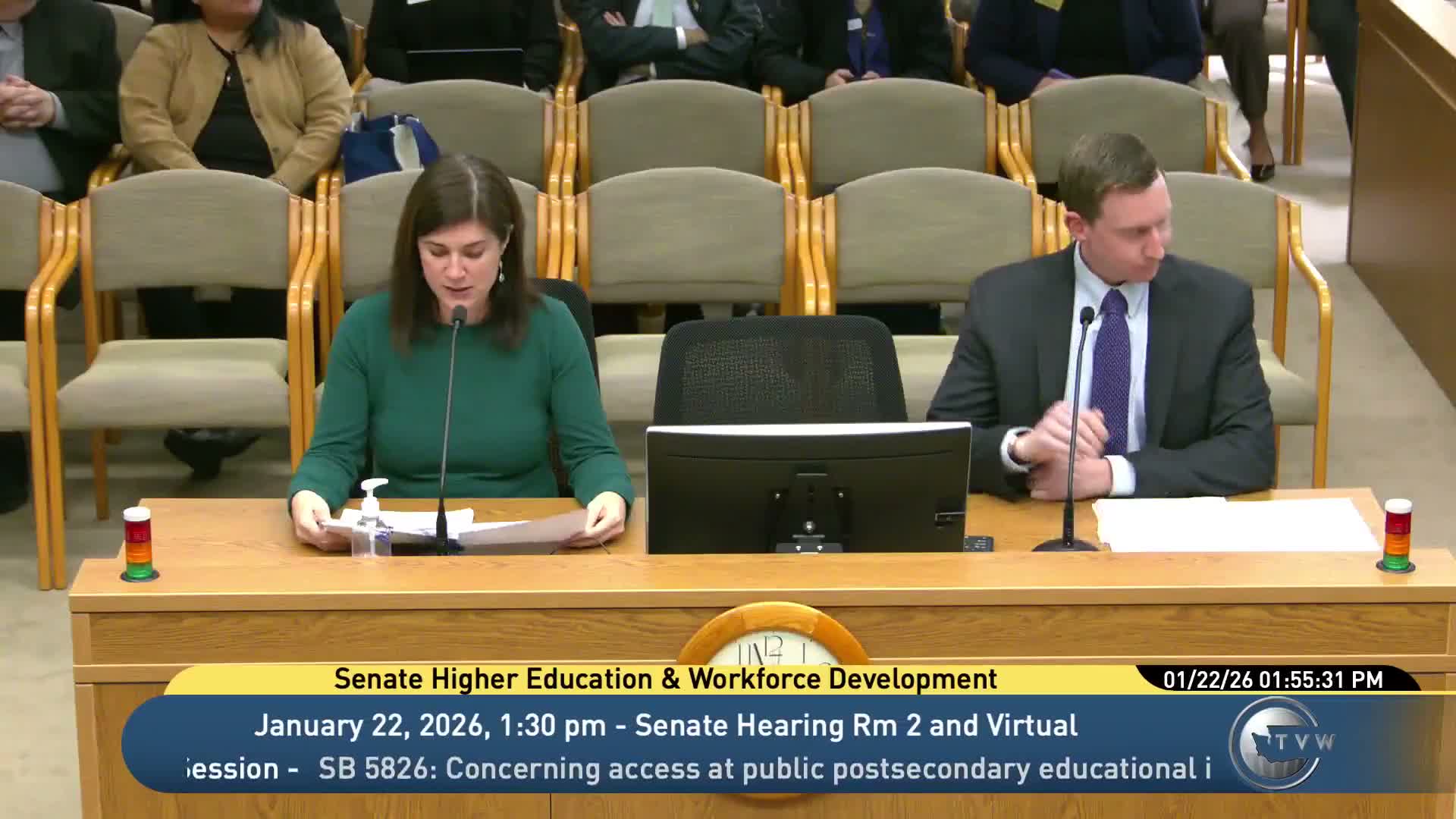
Senate Higher Education committee advances eight bills, sends them to Ways and Means
Loading...
Summary
In executive session the Senate Higher Education and Workforce Development Committee moved eight bills (including SB 5826 on medication abortion access at public campuses and SB 5963 affecting Passport to Careers funding) to the Ways and Means Committee; most passed on voice votes and were reported 'subject to signatures.'
The Senate Higher Education and Workforce Development Committee moved eight bills to the Ways and Means Committee during an executive session held after a Passport to Careers presentation.
Staff briefed the committee on the bills before action. Among them: Senate Bill 5826, which staff said "requires public institutions of higher education to offer access to medication abortion through certain available methods" and requires training or referral procedures where institutions lack student health centers; Senate Bill 5963, which staff said "directs WASAC to deposit all funds for Passport to Careers into the state financial aid account" and amends financial‑need definitions for Passport eligibility; and Senate Bill 6082, which would direct JLARC to audit state financial aid fraud using existing resources and report to the Legislature by December 2027.
A senator moved each bill receive a 'due pass' recommendation and be sent to the Ways and Means Committee. The committee handled the bills largely by voice vote; staff noted fiscal notes are available for most bills in the committee packet and one bill has a partial fiscal note. For SB 5826 one senator objected, saying the bill could impose administrative burdens and costs on institutions; the committee nevertheless moved the bill forward and recorded that it "has passed subject to signatures." Other bills were similarly moved forward on voice votes and recorded as passed "subject to signatures."
The committee did not enter public debate on amendments during the session; several bills had been heard previously (committee staff cited hearings on January 15 and 19 for multiple items). The committee closed the executive session, asked members to sign attendance sheets, and adjourned.