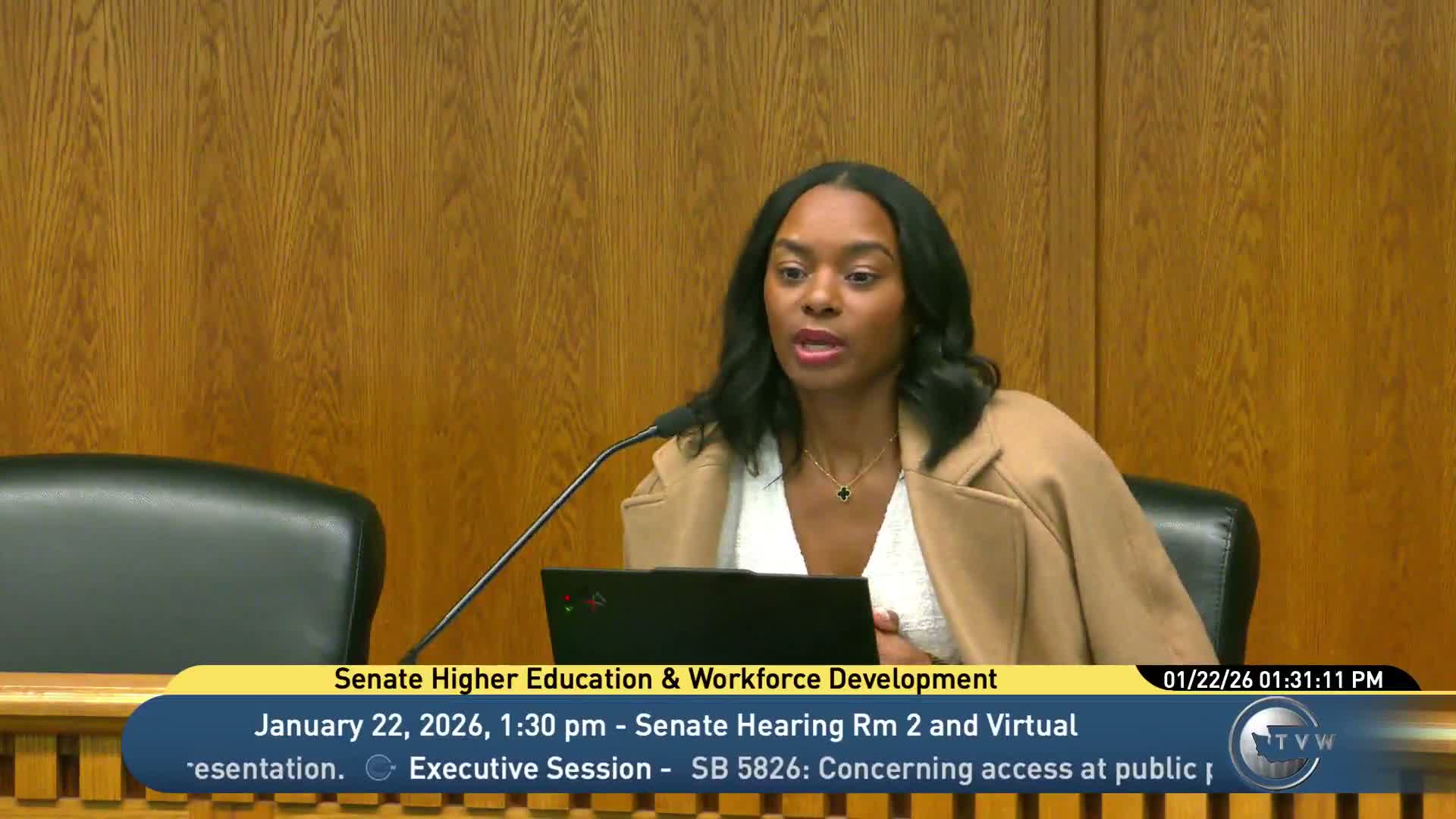
Washington Student Achievement Council tells Senate committee Passport to Careers serves nearly 2,000 but funding hasn’t kept pace
Loading...
Summary
Washington Student Achievement Council officials told the Senate Higher Education and Workforce Development Committee that the Passport to Careers program serves youth from foster care or unaccompanied homelessness, produces higher graduation outcomes (31% at eight years) but faces funding shortfalls that have reduced awards from $5,000 to $2,000 in 2025–26.
Joel Anderson, associate director of legislative and external affairs at the Washington Student Achievement Council, told the Senate Higher Education and Workforce Development Committee that the Passport to Careers program is designed for youth who experienced foster care at age 13 or later or who experienced unaccompanied homelessness in the academic year before college enrollment. Anderson said the program will serve almost 2,000 students in the 2025–26 academic year and that the maximum award has been reduced to $2,000 for the current year, with an average award of about $1,900.
"We are the only state, to our knowledge, with data‑sharing agreements to identify these students automatically and enroll them in this program," Anderson said, describing the program’s state‑funded scholarship and campus support model and a public‑private partnership with the College Success Foundation to provide technical assistance and training.
Don Cipriano McCafferty, assistant director of student financial assistance at the council, told senators that Passport combines an award with flexible campus funding to address basic needs and academic supports. "Most frequently, institutions report students needing assistance with basic needs, such as food, housing, or other emergency aid," McCafferty said, adding that more than 60% of Passport students work more than 20 hours a week.
The presenters cited program outcomes and participation trends. Anderson said a long‑term evaluation found 31% of participants graduate with a degree or credential within eight years of enrollment; the presenters contrasted that figure with lower rates reported for comparable groups. McCafferty said survey data shows 84% of Passport students reported the program made them more likely to enroll or stay enrolled. He also provided demographic detail: "95.2 percent of Passport students are single without children," based on 2023–24 data, he said.
Senators questioned program distribution and supports. Anderson said roughly 43% of Passport students in 2024–25 were at community and technical colleges, and he offered to provide a written breakdown by institution. Senators also asked how campus navigators and advisors are funded; staff explained arrangements vary by campus. WASAC historically provided a per‑student institutional payment (previously $500 per student per quarter), but Anderson said program growth has outpaced appropriations and forced policy choices: reduce support funding, cap enrollment, or lower individual awards. The council and campus advisers prioritized preserving flexible campus supports even as scholarship amounts were reduced.
Committee members pressed how students are identified for Passport; McCafferty said WASAC works with the Department of Children, Youth & Families and the Office of Superintendent of Public Instruction and receives McKinney‑Vento liaison data so eligible students are flagged during financial aid processing rather than requiring a separate application.
The presenters closed by emphasizing the program’s role in access and persistence, with Anderson noting Passport is seen as a national model for automatic identification and state‑funded supports for young people from foster care or unaccompanied homelessness. The committee asked for follow‑up reports on statewide graduation comparisons and the institutional distribution of Passport students. No committee action on Passport funding occurred at the meeting; the committee moved into an executive session to consider unrelated bills.