
NCSL briefs House committee on replacing shrinking gas-tax revenue with EV fees, mileage charges and new user levies
Get AI-powered insights, summaries, and transcripts
Subscribe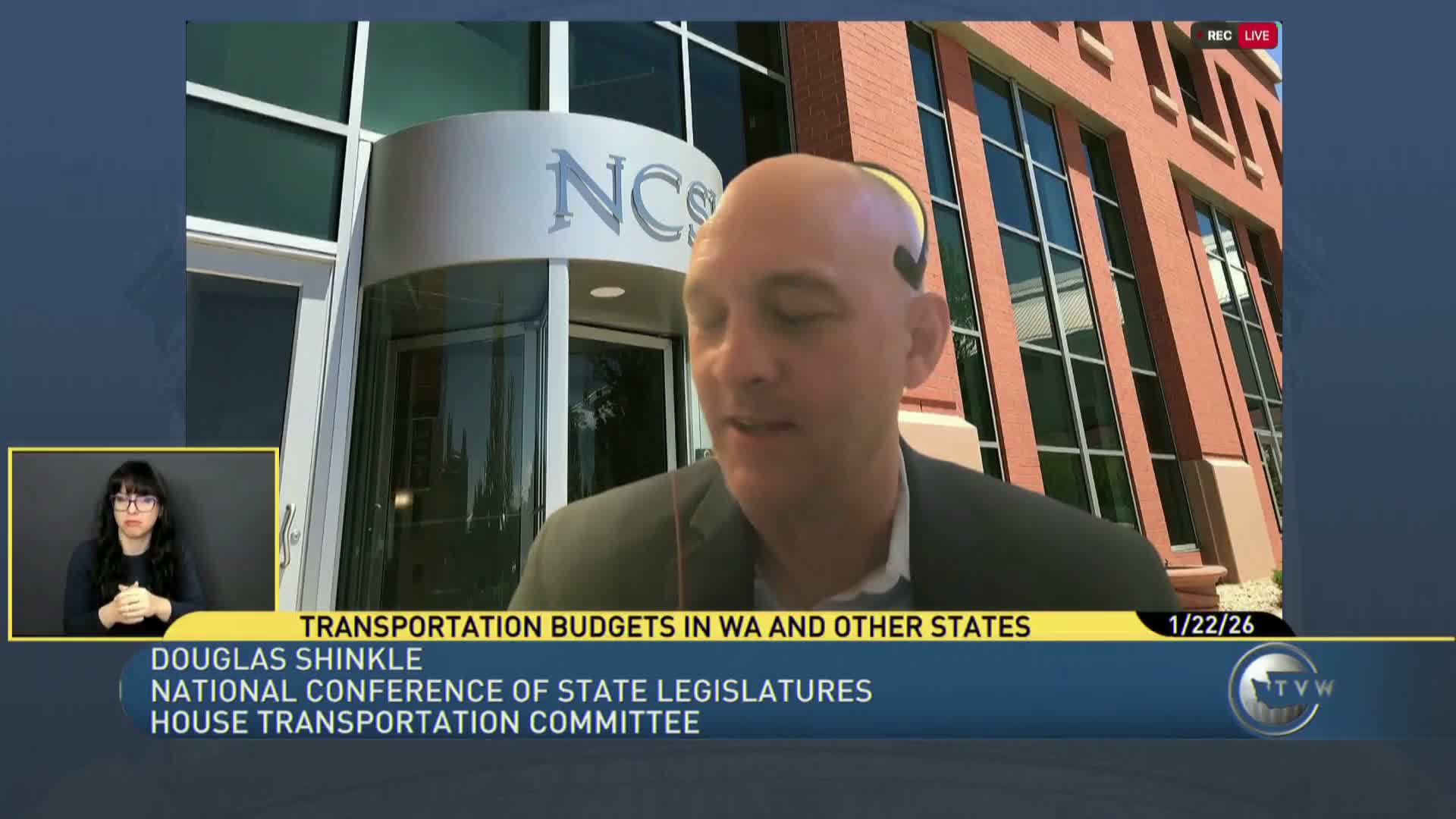
Summary
National Conference of State Legislators presenters told the House Transportation Committee that states are experimenting with electric-vehicle registration fees, per-kilowatt charging fees, TNC surcharges, retail-delivery levies and voluntary mileage-based road-usage charges as motor-fuel tax revenue declines.
Doug Schenkel of the National Conference of State Legislators told the House Transportation Committee on Jan. 22 that motor-fuel taxes "are traditionally the largest source of revenue for states to fund the operation and maintenance of their transportation systems," but that revenue and purchasing power have declined in recent years.
Sch enkel and his colleague Lexi Ilio outlined a range of user-fee and non-user-fee options states are using or testing to make up the gap. They said many states have adopted higher annual registration fees for electric vehicles and hybrids; 41 states and the District of Columbia now levy higher EV registration fees, with amounts ranging roughly from $50 to $290, while hybrid surcharges are generally lower.
The presenters described mileage-based road-usage charge programs (RUCs) as an alternative to fuel taxes. Schenkel summarized the landscape: four states operate voluntary RUC pilots (Oregon, Utah, Virginia and Hawaii), with varied reporting methods, mileage rates typically between about 1¢ and 2.5¢ per mile, and different enrollment incentives. He said Oregon’s program has been the longest running, and Hawaii plans to expand enrollment through odometer checks tied to annual vehicle inspections.
Ilio reviewed other revenue tools: transportation-network-company (TNC) fees (13 states and D.C. levy them at the state level), retail delivery fees (currently enacted in two states), and per-kilowatt-hour levies on nonresidential EV charging (11 states). She gave revenue examples — Massachusetts collected roughly $90 million between 2017 and 2023 on a 20¢ per-ride fee, and Utah recorded about $1.3 million in its first full year of nonresidential EV charging fees.
On implementation, the presenters warned of trade-offs: RUC pilots are administratively complex and face privacy and cross‑border accuracy questions; electricity-based fees require utility coordination; and delivery fees and TNC surcharges vary in what they dedicate to transportation. Schenkel said he could follow up with enrollment percentages and state-specific implementation cost data if the committee wanted more detailed numbers.
The presentation closed with committee questions about Virginia’s highway-use fee and whether any state has reduced fuel-tax rates when adopting RUCs; Schenkel said he was not aware of states broadly rolling back fuel taxes concurrent with RUC adoption.
Next steps: presenters offered to provide follow-up data on voluntary-enrollment rates and program implementation costs at members’ requests.