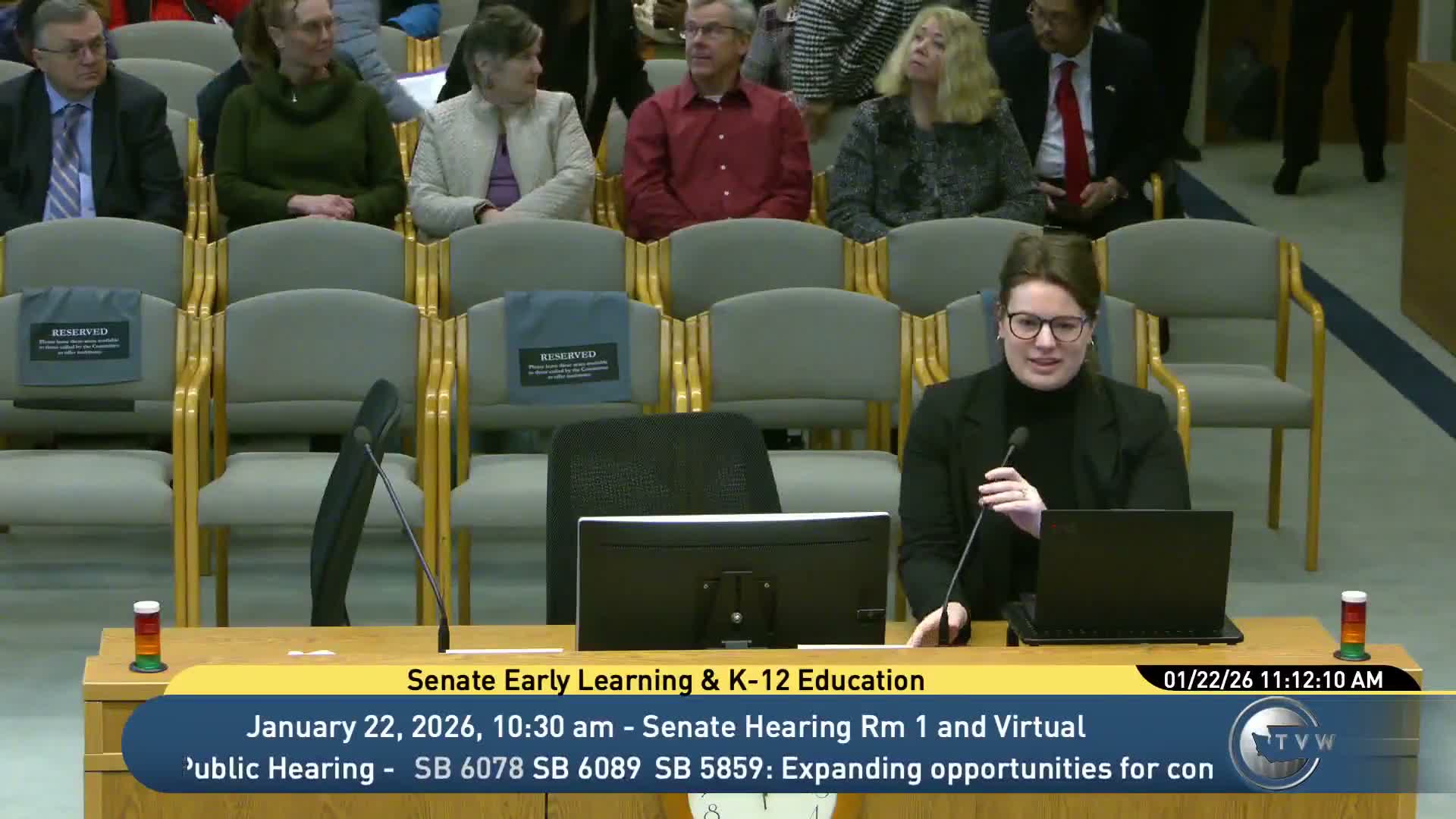
Committee hears testimony on adding competency‑based assessments to graduation pathways
Loading...
Summary
SB 58 59 would add competency‑based assessments to two graduation pathways so students could meet requirements via competency assessments. Supporters — including Pearson (Edexcel) and students — said the change increases flexibility; SBE and district leaders urged coordination with the State Board’s future‑ready review and cautioned about timing and rulemaking burdens.
Senate Bill 58 59 (referred to in testimony as SB 5859) would add competency‑based assessments to two Washington graduation pathways: the high school transition course and the AP/IB/Cambridge transition pathway. The bill directs the State Board of Education to establish by rule which advanced courses and competency‑based assessments meet the standard under those pathways.
Pearson representatives asked the committee to specifically recognize Pearson Edexcel so the State Board may evaluate the international pathway alongside AP, IB and Cambridge. Nora Palatao Burns (Pearson) said statutory recognition would allow SBE review “with no presumption of approval and no added burden” unless the board determines it merits consideration. Paul Kelly and Duncan Hampshire (Pearson) described Edexcel’s modular exams, global recognition and supports for diverse learners.
Student testimony underlined how competency options can preserve a student’s pathway after life events. Viet Kelman, a high school senior, described a peer who lost eligibility for an IB class after a medical leave and said competency assessments would let students demonstrate prior knowledge to remain on track.
School and state board witnesses supported expanded opportunities but urged caution. Ross Thompson (Association of Washington School Principals) and Randy Spalding (State Board of Education) said the State Board is conducting a comprehensive 'future ready' review and recommended aligning any statutory changes with that work to avoid duplicated effort or additional staff burdens; Spalding noted the bill does not specify assessments and SBE would need to set criteria.
Staff provided a fiscal estimate during testimony of $207,000 in the current biennium and $6,000 in future biennia for implementing related rule changes. The committee closed the public hearing after mixed proponent testimony and agency cautions.