Get Full Government Meeting Transcripts, Videos, & Alerts Forever!
Get email alerts on the Tourism Funding topic
No spam. Unsubscribe anytime.
Industry Leaders Push Self‑Funding Model for State Tourism; Proposal Would Let Businesses Ratify Assessments
Summary
SB 6,061 would authorize the Washington Tourism Marketing Authority to establish an industry‑led tourism assessment by rule, subject to ratification by participating businesses. Industry panels and State of Washington Tourism argued the model could generate $25 million annually and an estimated $14.6 billion in visitor spending over a decade; questions focused on thresholds, local taxes, and governance.
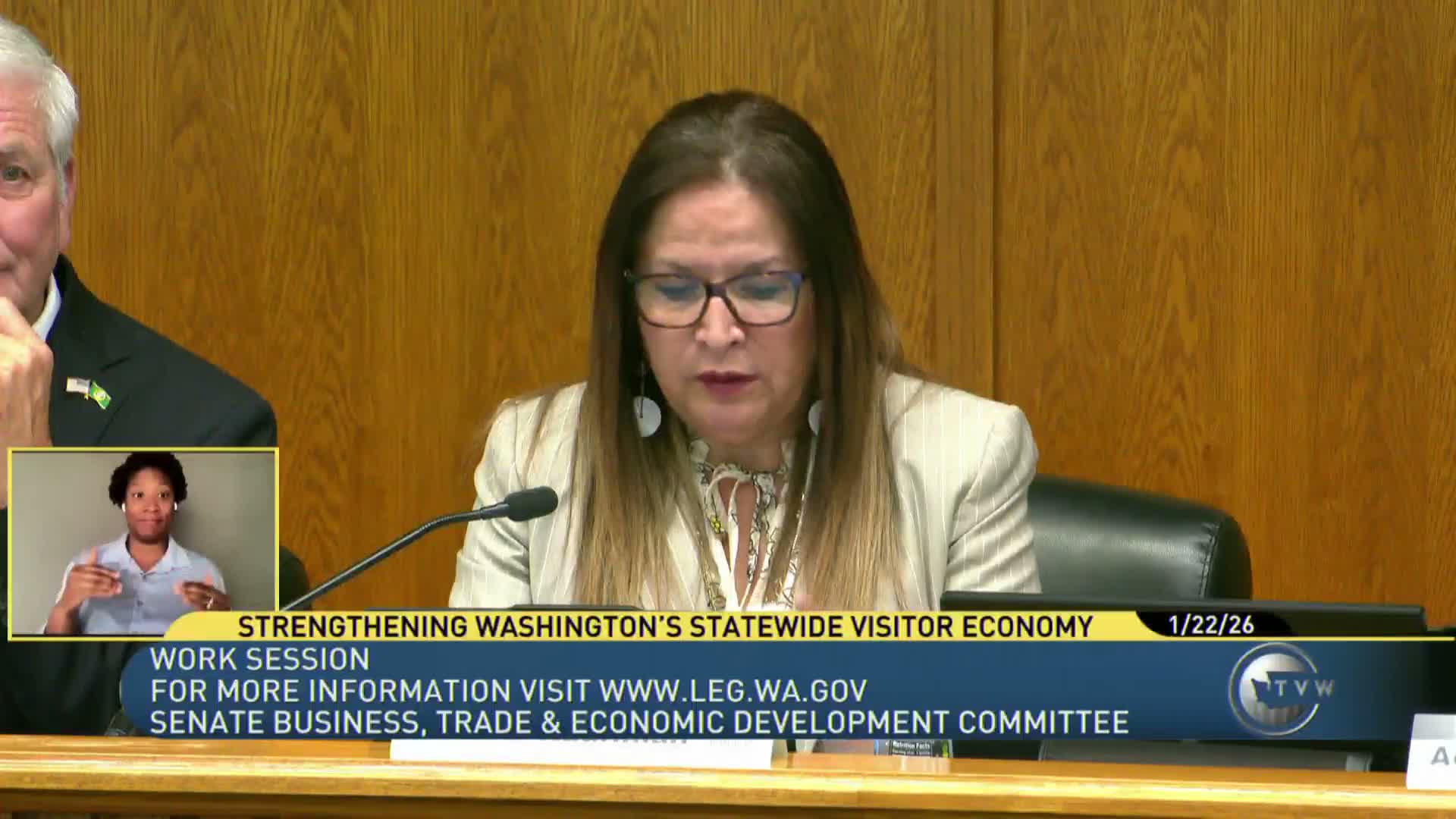
Senate Bill 6,061, presented to the committee Jan. 22, would authorize the Washington Tourism Marketing Authority (WTMA) to set up a tourism self‑support assessment program by rule, subject to ratification by covered tourism businesses. The assessment would be calculated as a percentage of gross revenue and collected annually; the bill creates a ratepayer oversight board to design program details and a separate tourism assessment account for receipts.
David Blanford, CEO of State of Washington Tourism, described long‑running efforts to rebuild and sustain statewide tourism since the agency’s 2011 closure and urged a self‑funding industry assessment to create predictable, competitive funding. He said such a program could be structured to yield $25 million annually and estimated a potential $14.6 billion increase in visitor spending over a decade if implemented at scale.
Industry speakers — including Chris Stone (Washington State Wine Commission), Andy Olson (Columbia Hospitality), Annie McGrath (State of Washington Tourism), Josh McDonald (Washington Wine Institute), Dan Olson (Washington Brewers Guild), and Anthony Anton (Washington Hospitality Association) — testified in strong support, citing assessment models in other states (notably California) and commodity commission analogues. They said industry governance, ratification by affected businesses, and threshold rules during rulemaking would avoid imposing small businesses.
Committee members asked how assessments would interact with existing local lodging taxes and whether short‑term events (e.g., FIFA World Cup) were included in the $14.6 billion projection; presenters said the projection covers the next decade and does not single out individual events, and that the assessment is intended to complement, not replace, local lodging taxes. Presenters described rulemaking to set specific industry thresholds (for restaurants, a $5 million gross receipts threshold was discussed) and an opt‑in/ratification step so assessments would apply only to those business categories the industry ratifies.
Public testimony included broad industry support and some opposition on narrow points (e.g., one commenter questioned inclusion of unrelated sectors in draft language). The committee closed public testimony with participants indicating some friendly amendments were anticipated to refine governance, geographic representation, and eligible sectors. No committee vote was taken at the hearing.