Get Full Government Meeting Transcripts, Videos, & Alerts Forever!
Get email alerts on the Higher Education Funding topic
No spam. Unsubscribe anytime.
Committee Hears Large Proposal to Uncap Advanced Computing Surcharge to Fund College Grants and Lower Tuition
Summary
House Bill 2098 would remove the $75 million cap on the advanced computing surcharge, generating estimated revenue proponents say could fully fund expanded Washington College Grants and temporarily reduce resident tuition; testimony revealed deep divisions among universities, business groups, students and advocates about fiscal impacts and accountability.
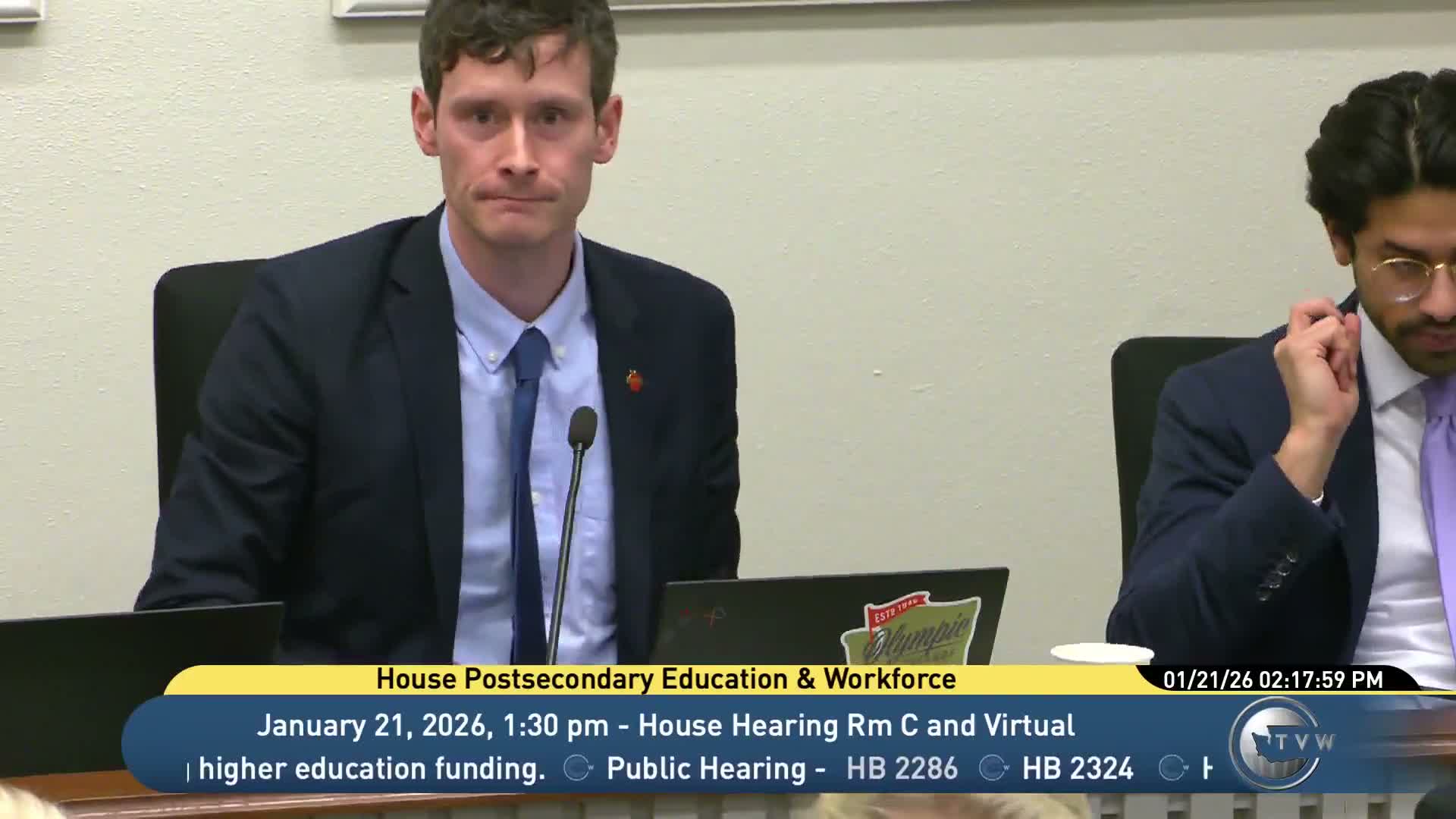
The committee heard House Bill 2098, a major higher‑education funding proposal that would eliminate the $75,000,000 cap on the advanced computing surcharge and redirect additional revenue to expand the Washington College Grant and reduce resident undergraduate tuition.
Saranda Ross explained the bill’s structure: it would remove the cap on the surcharge applied to advanced computing businesses with more than $25 billion in worldwide revenues, increase the income cap for maximum Washington College Grant awards to 100% of state median family income, and reduce resident undergraduate tuition by 10% for three academic years before restoring the current statutory formula.
Representative Julie Reid (36th District), sponsor, argued the bill asks the largest corporations to pay the tax on the same basis as smaller firms and estimated roughly $2 billion in additional revenue over four years to backfill grants and tuition reductions, framing the measure as an investment in workforce development and affordability. Student witnesses and community groups emphasized affordability, equity and the need to protect existing grant programs.
Opposition testimony came from university representatives and business groups. Chris Mulick (WSU) and Morgan Hickle (University of Washington) warned that uncapping the surcharge and raising rates could impose catastrophic costs on businesses and leave universities with budget shortfalls if lost tuition revenue were not backfilled by state appropriations. Emily Whitman and Neil Stregi questioned transparency about which firms pay the surcharge and criticized past supplanting of WEA funds for other purposes.
Witnesses also debated prior budget decisions: some panelists noted the WEA account has grown and that last year $400 million of WEA revenues were used in the budget process. Committee members asked detailed questions about cap mechanics, who pays the surcharge, supplanting language and whether the bill would guarantee non‑supplanting of higher‑education funding.
The committee heard many short (90‑second) panels from students, faculty, business groups, think tanks and advocates. Testimony was sharply divided: supporters urged expanded grant eligibility and lower tuition to increase enrollment and workforce supply; opponents warned of institutional budget risk, lack of transparency, and potential economic impacts on companies subject to the surcharge. The public hearing closed with sponsor and staff reminders about amendment deadlines.