
Secretary of State seeks modest FY27 increase as analysts flag charity delinquencies and praise ELF upgrade
Get AI-powered insights, summaries, and transcripts
Subscribe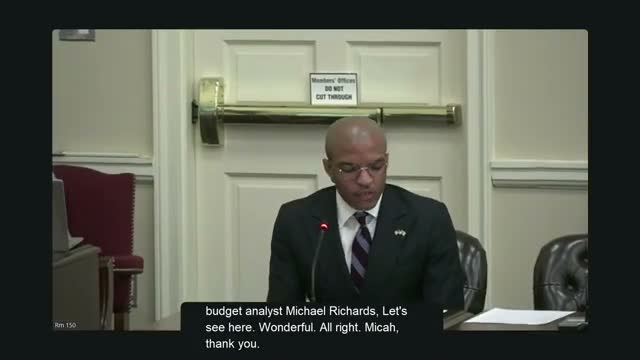
Summary
DLS asked the Secretary of State to explain a rise in delinquent charities even as contacts and resolved cases fell; the agency and analyst also highlighted a recently modernized electronic filing system (ELF) and the continued use of VOCA funding for the Address Confidentiality Program.
The Secretary of State’s office asked the Appropriations subcommittee on Wednesday to approve a modest FY2027 increase to support personnel and operations while defending the agency’s new technology and enforcement approach. Department of Legislative Services analyst Micah Richards told the panel the fiscal 2027 allowance rises about 5.6% to $6.1 million, with personnel accounting for the largest single increase.
Why it matters: The DLS analyst raised an unusual data pattern — an 8% rise in delinquent charities in fiscal 2025 while the number of contacts and resolved delinquent cases fell — and asked the agency to explain the trend. That discrepancy bears on the state’s ability to enforce nonprofit reporting rules and to protect donors and beneficiaries.
DLS presented the numbers and recommended the secretary discuss causes. “The fiscal 27 budget increases by 5.6% to $6,100,000,” Richards said during his presentation. He noted the administrative headquarters comprises the majority of the budget and that the largest spending increase is for personnel.
Agency response and causes: Susan Lee, Secretary of State, introduced agency staff and emphasized the office’s limited net cost to the state — roughly $2 million after fee revenues — and its broad responsibilities that include the Address Confidentiality Program (ACP), charities enforcement, state documents, and international affairs. She said the office supports 29 regular full‑time employees and several contract roles.
Mike Schlein, director of charities and legal services for the office, told the committee the delinquency rise reflects a more accurate point‑in‑time count and a persistent cohort of long‑standing delinquents. He said automated notices for newly delinquent organizations have reduced the need for manual outreach, which in turn lowered contact counts even though the total delinquency tally rose. Schlein noted that a recently enacted registration cancellation statute gives the agency a tool to clear long‑standing delinquents in coming years.
On technology, the agency credited a modernization of ELF, the electronic filing system, with improving public access to the Code of Maryland Regulations and the Maryland Register. Agency staff described implementing off‑the‑shelf tools such as Formstack to capture applicant data once and reduce paper processing. “We are using the best technology, the newest one that we can possibly get,” Lee said, thanking staff and external partners.
Program details and grants: DLS’s presentation also reviewed the Maryland Safe at Home (ACP) program, funded through the Victims of Crime Act (VOCA). Richards noted the secretary used about $180,000 of VOCA funds in FY25 for program salaries and outreach, and that the board of public works approved an FY26 VOCA grant of roughly $154,000 for the same purposes.
What’s next: DLS asked the agency to explain the higher delinquency count and the drop in contacts and resolved delinquencies. Agency officials said they will provide follow‑up details and expect the registration cancellation tool to reduce long‑standing delinquencies over the next one to two years.