Get Full Government Meeting Transcripts, Videos, & Alerts Forever!
Get email alerts on the Electric Transmission Policy topic
No spam. Unsubscribe anytime.
Committee hears broad support and cautions for state transmission authority, with calls for financing and permitting fixes
Summary
SB 5466 would create a Washington Electric Transmission Authority and a categorical SEPA exemption for reconductoring; supporters called the authority a needed tool to unlock projects and reliability, while some utilities and consumer groups urged clearer permitting solutions and cautioned about state ownership and fiscal risk.
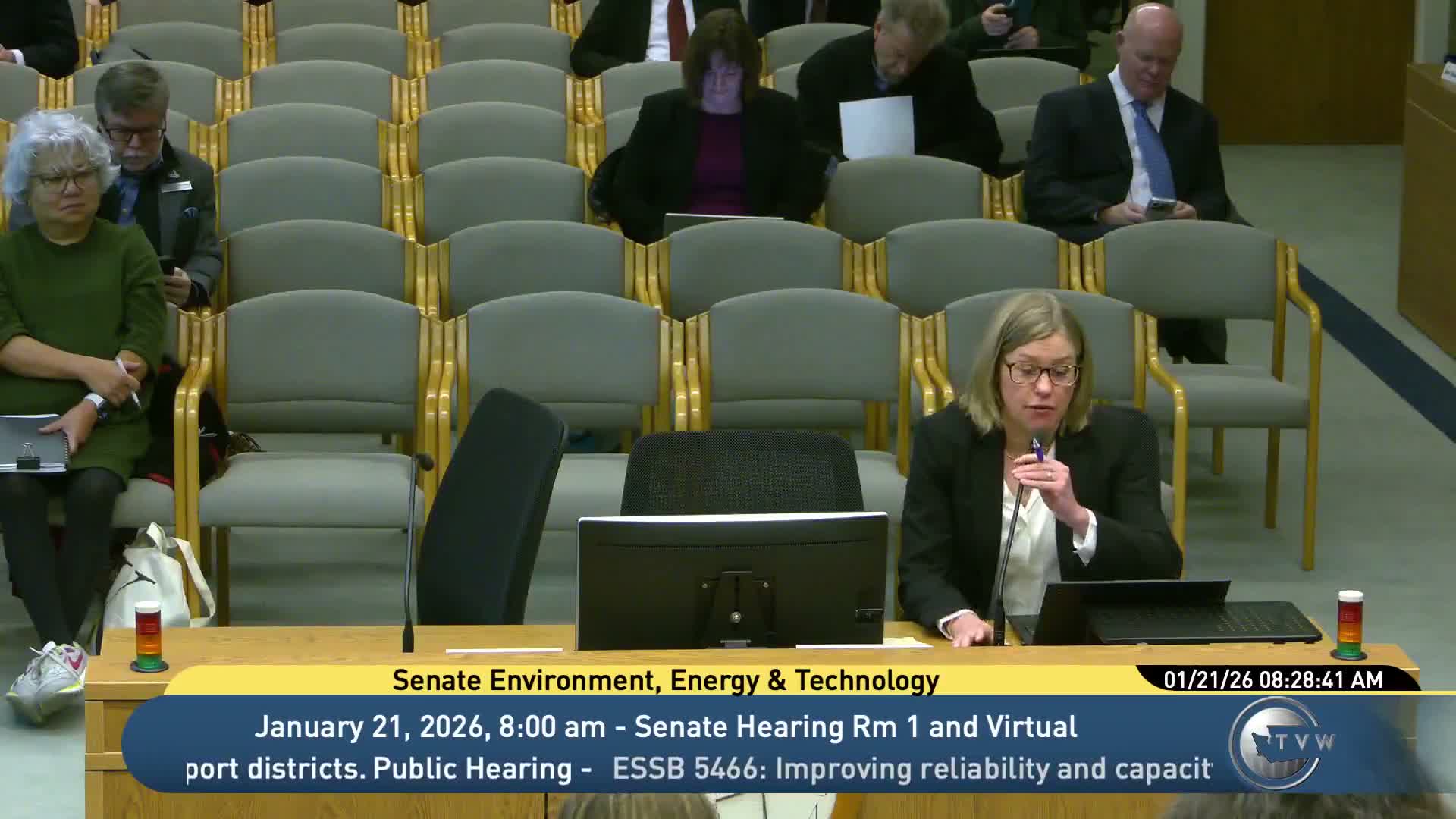
Staff briefed the committee that Senate Bill 5466 (second substitute) establishes a Washington Electric Transmission Authority (WITA) to plan, facilitate and, as a last resort, build transmission projects. Kim Cushing told the committee the authority would have powers including rulemaking, contracting, limited ownership of transmission equipment, selection of qualified builders, condemnation authority where necessary, and a 10‑member board to be appointed by Jan. 1, 2027. The bill also proposes a categorical SEPA exemption for certain reconductoring and upgrade projects over 115 kV with tribal and Department of Archaeology and Historic Preservation consultation requirements.
Witnesses broadly supported more transmission capacity while offering technical suggestions. Angus Duncan of the Natural Resources Defense Council supported the authority and urged early community and tribal engagement, and he referenced the regional Westech transmission plan. Maya Gillette of The Nature Conservancy and Emily Moore of Sightline Institute supported the bill and recommended adding public‑financing or bonding authority to lower financing costs for ratepayers. Nicholas Garcia of the Washington Public Utility District Association and other utility speakers praised reconductoring and the categorical exemption but cautioned that permitting remains the main hurdle and suggested stronger alignment with the Westech planning process.
Labor and construction stakeholders emphasized jobs and workforce standards. Matthew Heffner (certified electrical workers) and Jason Hudson (IBEW Local 77) said reconductoring and transmission upgrades would create local jobs and urged inclusion of financing authority and practical pathways for the categorical exemption. Renewable developers and industry groups (Spencer Gray, SEG 905) supported the partner‑first approach and urged bonding or financing authority.
Opponents and cautious stakeholders asked for more clarity. The Alliance of Western Energy Consumers (Brandon Huskaper) warned about ratepayer exposure and asked to limit state ownership of infrastructure. Some business groups and utilities urged sharper focus on permitting fixes rather than creating a state owner of assets.
No committee vote was taken; sponsors and staff said more policy work remains, including drafting financing language and clarifying the exemption process. The committee closed the hearing on SB 5466 and later resumed SB 5652 testimony.