Get Full Government Meeting Transcripts, Videos, & Alerts Forever!
Get email alerts on the Wildfire Fund topic
No spam. Unsubscribe anytime.
Washington committee hears competing views on proposed wildfire prevention fund
Summary
Lawmakers heard hours of testimony on House Bill 22 75, which would create a State Wildfire Prevention and Protection Fund and a 15‑member council to administer contributions and claims; survivors urged compensation, while utilities and cooperatives warned of retroactive charges and ratepayer risk.
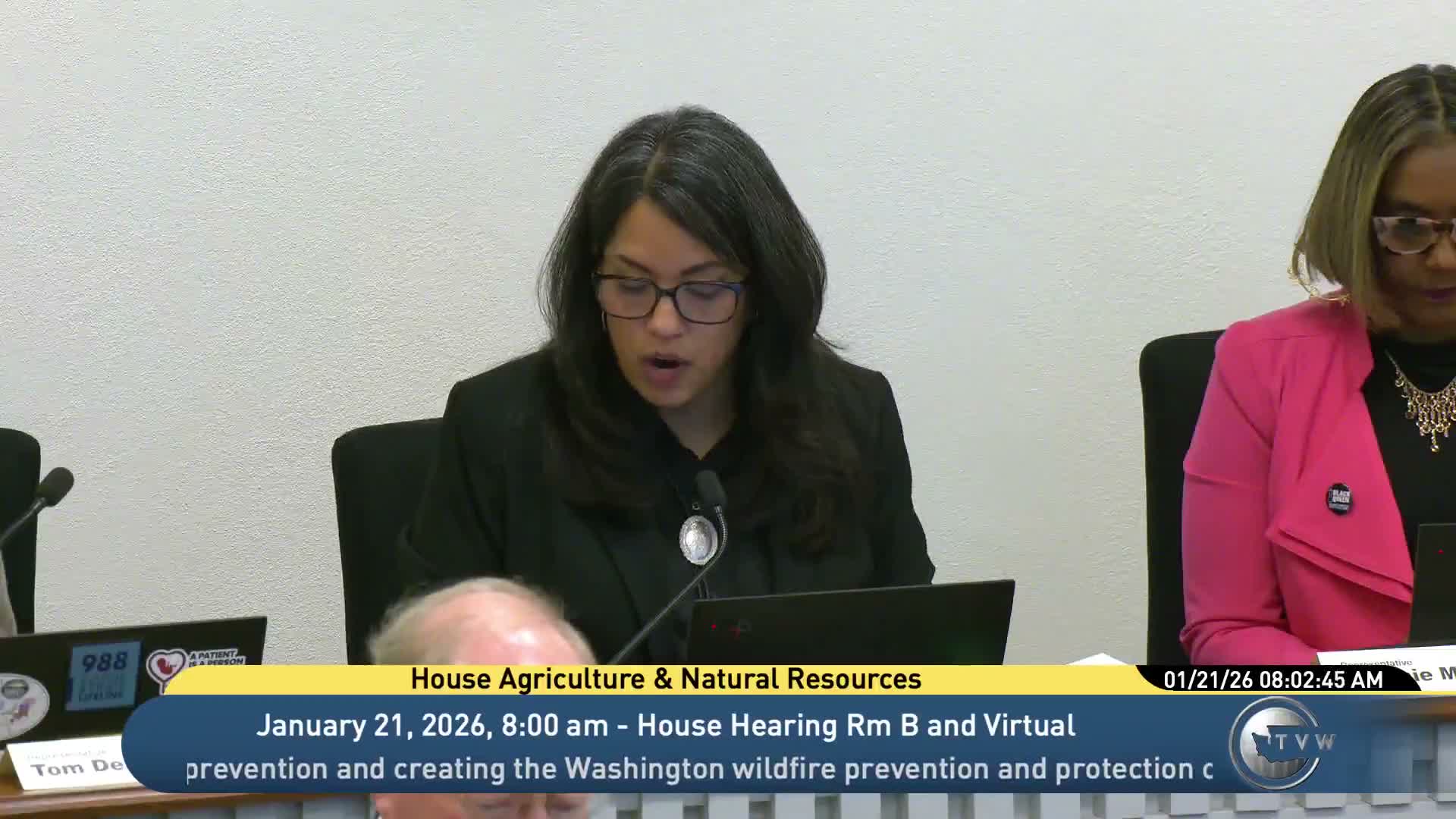
The House Agriculture and Natural Resources Committee opened a public hearing on Jan. 21 for House Bill 22 75, which would create a Wildfire Prevention and Protection Fund to reimburse electric utilities for third‑party wildfire damages and establish a 15‑member council to set contributions and damage thresholds.
Lily Smith, staff to the committee, told members the proposal would require investor‑owned utilities to participate and make participation optional for consumer‑owned utilities, would pay claims for wildfires caused by a utility’s negligence after July 1, 2021, and would allow utilities to recover contributions through customer surcharges. Smith said the council would set one‑time and annual contribution levels and hire an administrator to manage the fund and approve claims.
The bill’s prime sponsor, Representative Christine Reeves, framed the measure as part of a comprehensive wildfire strategy and said the fund is meant both to provide compensation to victims and to create a stable revenue stream that can support mitigation. “We wanna actually drive down your rates, and we wanna make sure that your rates are being transparently shared with you,” Reeves said.
Survivors who testified urged lawmakers to provide more dependable help than they received after recent fires. Melissa Hunter, who described losing five homes in the Medical Lake fire, said the financial and health consequences have been long lasting and called a state fund “helpful to recover people.” Ali Zackeraydes, who lost a home and business tools in the Grama fire, said community relief funds distributed donations unevenly and that a statutory fund could protect uninsured or underinsured residents.
Industry, utility and local government witnesses said the bill as drafted raises unanswered questions about affordability, solvency and fairness. Kelly Scott of Chelan PUD said the cooperative spends roughly $10.3 million a year on mitigation and warned liability and fund solvency are “inseparable.” Sherry Nelson of the Washington Rural Electric Cooperative Association said the proposal “imposes high cost on rural Washington’s electric co‑ops without solving the root problem.”
Puget Sound Energy senior vice president Matt Storwalt urged lawmakers to consider broader, economy‑wide solutions and warned that retrospective charges for events dating back to 2021 could saddle current ratepayers with large bills. “It is bad public policy to make customers of my utility … pay billions of dollars,” Storwalt said.
Several witnesses compared Washington’s proposal to California’s model. Attorney Gerald Singleton, who represented fire victims in California litigation, said California’s wildfire fund is not insolvent, citing a fund balance he said was approximately $13 billion and a replenishment mechanism of about $1 billion per year, with surcharges of roughly $2–$3 per month for ratepayers. He argued the California model helped avoid utility bankruptcies and protected victims’ access to recovery.
State agencies and forest owners urged clarifications and stronger prevention measures. George Geisler, Washington State Forester, said the Department of Natural Resources supports the bill in principle but requested language clarifying account administration and the council’s administration. Speakers representing forest landowners and firefighting practitioners urged that any council include on‑the‑ground wildfire management expertise and that mitigation be prioritized.
Committee members pressed sponsors on retroactivity, the mechanisms for setting contribution levels, and whether fund investment earnings would be dedicated to mitigation. The sponsor and staff said the bill’s retroactive date (July 1, 2021) reflects the timing of recent catastrophic events and argued both compensation and prevention are needed.
The committee did not take a vote on House Bill 22 75 during the public hearing. Chair Reeves closed the hearing after reading the record of those signed in to testify; Vice Chair Morgan reported 30 pro, 774 con and 2 other written submissions. The committee recessed for caucus and moved to an executive session on separate legislation.
What’s next: the bill remains under committee consideration; the committee requested follow‑up clarifications on administration, thresholds, and the fund’s solvency mechanics before advancing the measure.