Get Full Government Meeting Transcripts, Videos, & Alerts Forever!
Get email alerts on the HB 2,489 topic
No spam. Unsubscribe anytime.
House committee weighs bill to limit criminalization of survival activities on public property
Summary
House Bill 2,489 would bar local governments from enforcing laws that criminalize life‑sustaining activities on public property unless adequate alternative shelter space was available at the time and place of enforcement; advocates said the measure prevents harmful displacement while police and cities warned the statutory standard is operationally infeasible as written.
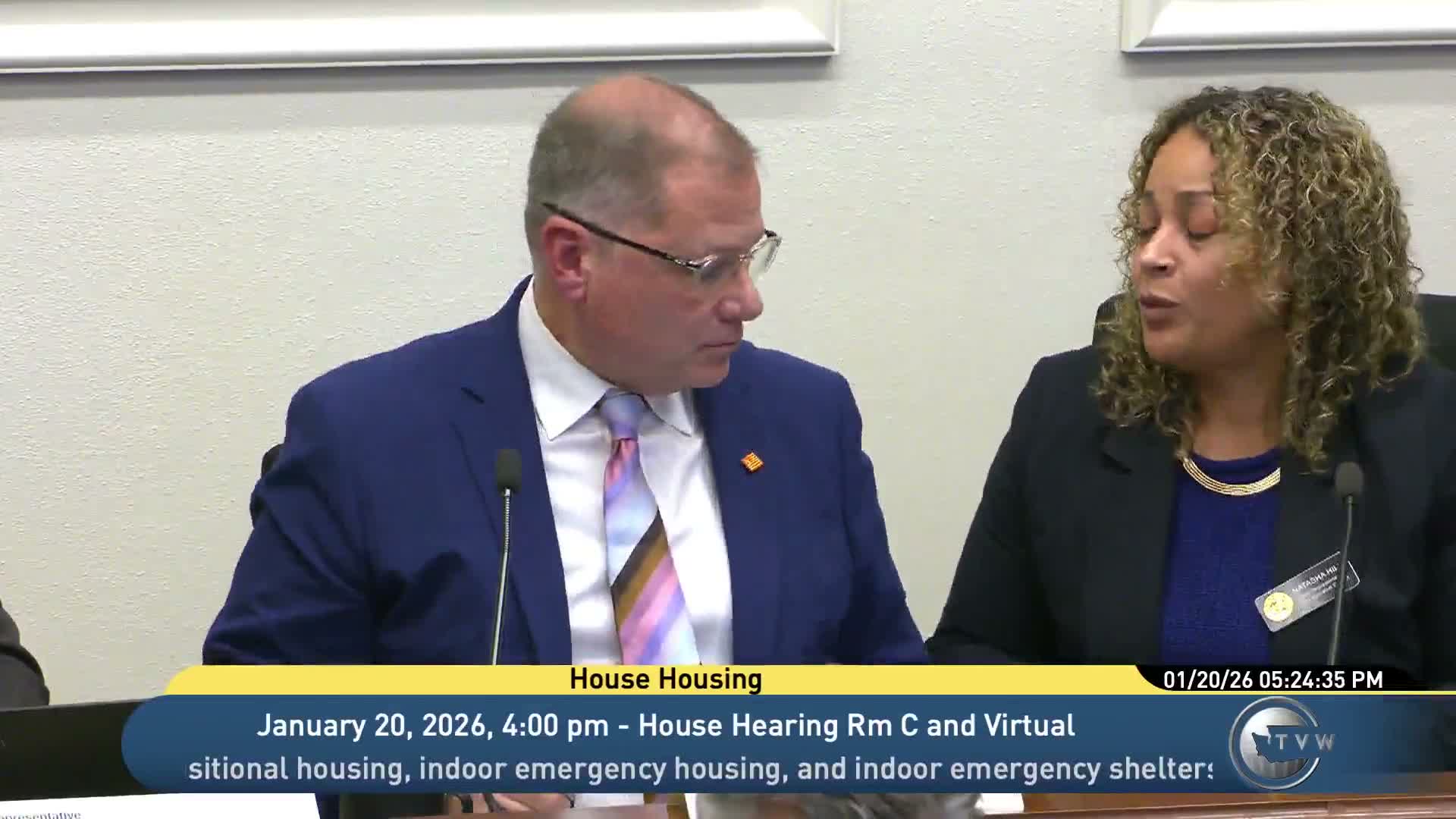
The House Housing Committee on Jan. 20 heard extensive testimony for and against House Bill 2,489, a proposal that would restrict enforcement of local laws against camping, sitting, lying or sleeping on public property when no adequate alternative shelter is available.
"The system should not punish someone for survival conduct unless there is a real alternative available," Jasmine Clark of the ACLU of Washington told the committee, summarizing the organization's mapping project that shows a fragmented patchwork of anti‑camping ordinances across the state and enforcement practices that often displace people without housing them.
Staff described the bill as providing a lengthy definition of "adequate alternative shelter space" — including legal and physical accessibility, no‑cost ongoing availability, accommodation for disabilities, pets and support persons, and limits on requiring more than one check‑in per 24‑hour period. The bill also creates a private cause of action for injunctive or declaratory relief and allows prevailing plaintiffs reasonable attorney fees.
Service providers and people with lived experience described low‑barrier shelter programs that accept pets, couples and people with criminal histories, and said such options are critical to bring people indoors and stabilize lives. "Once housed, people stabilize...and today, she has her son back," said Meg Martin of Interfaith Works, recounting a client who entered shelter, later moved to permanent supportive housing and reunited with family.
Opponents included law enforcement and multiple city attorneys who said the bill, as drafted, would force officers to make complex, individualized determinations in real time about whether available shelter met the bill’s rigorous standards. "This bill creates operational problems that will undermine both public safety and effective homeless services across Washington," Chief Daryl Lowe (Redmond Police) said, arguing that the statute’s prescriptive definition of "adequate" would be unmet by most current shelter systems and could invite litigation.
City officials urged narrower language or carve‑outs for sensitive public spaces (parks, levees, water infrastructure) and asked the legislature for additional funding or oversight if preemption of local enforcement is intended. Supporters and many providers countered that current enforcement practices simply move people across jurisdictional lines and that aligning enforcement with actual shelter availability will reduce churn and lower public costs over time.
Committee members asked for data, examples of administrable standards, and offered to accept written amendments. No committee vote or floor action occurred during the Jan. 20 hearing.