Get Full Government Meeting Transcripts, Videos, & Alerts Forever!
Get email alerts on the HB 2,266 topic
No spam. Unsubscribe anytime.
Washington committee hears mixed views on HB 2,266, a bill to expand step housing access
Summary
Supporters told the House Housing Committee HB 2,266 would remove local barriers and speed delivery of shelters and permanent supportive housing; city officials warned the bill as drafted would strip critical operational tools and create safety and funding issues. Committee held broad testimony and asked for draft amendment language.
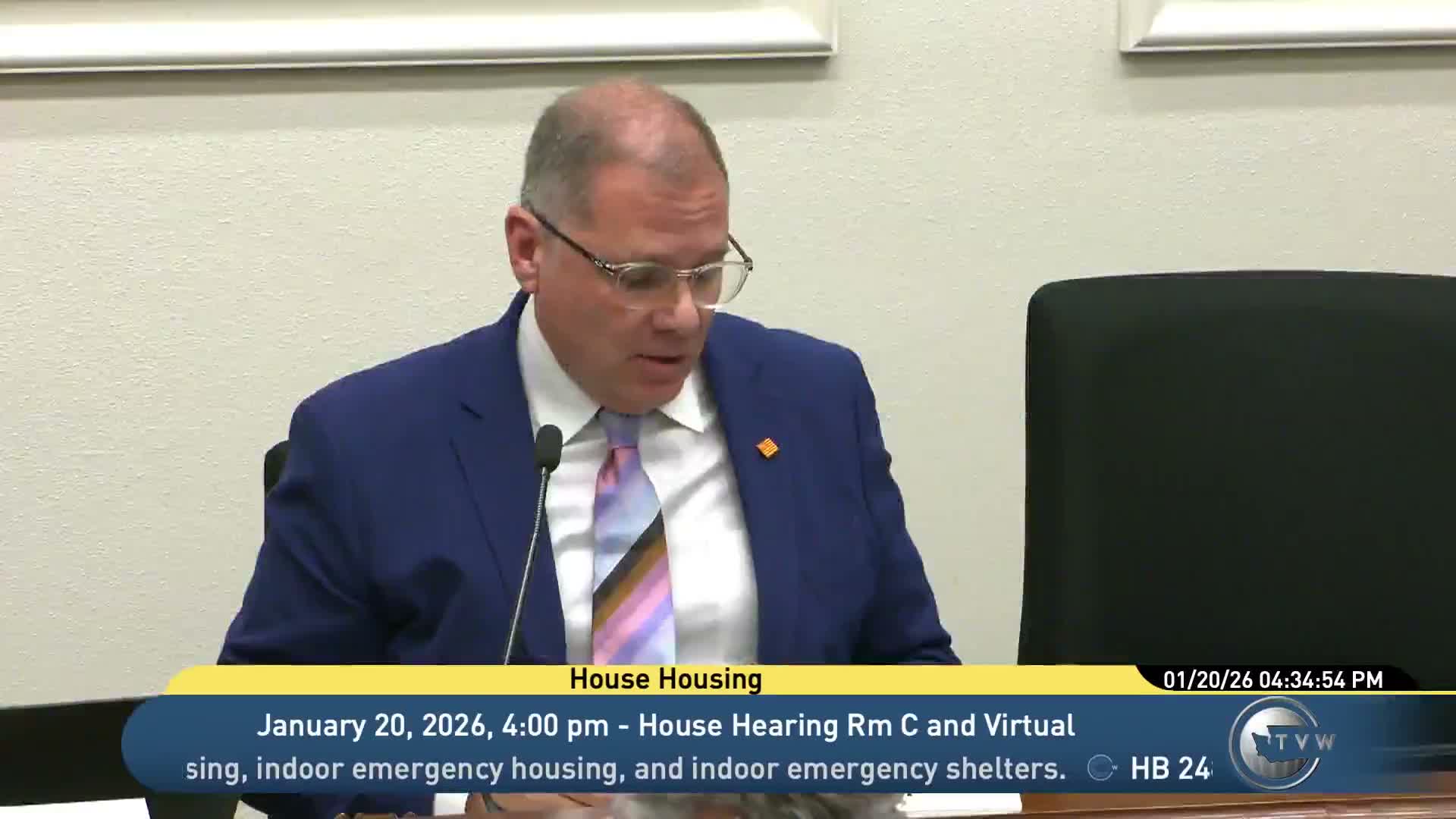
Supporters of House Bill 2,266 told the Washington House Housing Committee on Jan. 20 that the bill is necessary to stop local barriers from delaying or blocking step housing projects.
"We do not have enough deeply affordable housing for the amount of people who need it, and we are not building fast enough," said Sarah Dickmeyer of Plymouth Housing, which she said operates nearly 1,500 permanent supportive housing units. Dickmeyer testified that hidden discretionary approvals, duplicative permitting and late‑stage changes had delayed projects and sometimes prevented financing from being used.
Jim Morishima, staff to the committee, summarized the bill as requiring cities and counties to allow step housing in any non‑industrial area and to apply the same standards to step housing that apply to other permitted residential uses, with limited exceptions such as setbacks and stormwater rules. Morishima said the bill emphasizes administrative permitting for step uses and removes last year’s waiver, dispute resolution, and withholding‑funds enforcement provisions.
Commerce staff described how state and federal funding interact with local permitting. Ted Kelleher, interim co‑assistant director for housing at the Department of Commerce, said Washington relies on the Continuum of Care process that had typically provided about $120,000,000 per year in operating funds for existing projects statewide, and warned that an abrupt HUD NOFO in November risked leaving projects without timely renewal. Kelleher credited the Washington attorney general’s multistate litigation with forcing HUD to begin a renewal process but cautioned that funding awards remain contingent on final court rulings.
Cities and local officials urged targeted changes. Carol Helland, planning director for Redmond, said Redmond supported expanding access to permanent supportive and transitional housing but that removing the ability to require operational agreements would undercut projects in which the city has invested — she cited a $5,000,000 parcel and a $3,200,000 general‑fund subsidy provided to a Plymouth project. Michael Lillequist of Bellingham and Ben Wick of Spokane Valley urged the committee to preserve limited local authority to require safety plans, on‑site supervision, and reasonable spacing to avoid unintended concentrations of shelters.
Several witnesses proposed narrower drafting that would distinguish step housing types (permanent supportive housing versus emergency shelters) and would allow cities to require operating plans when they contribute funding or land. Dave Anderson of the Department of Commerce described existing state tools — a model ordinance, user guide, best practices, and a dispute resolution program developed after 2019 legislation — and said Commerce has been doing one‑on‑one work with local governments to implement the law.
Supporters argued statewide consistency is necessary to ensure projects that have been funded and planned can proceed. "When funding is already secured and providers are ready to help the people who are homeless and disabled in our communities, delaying these projects means turning away resources that could immediately benefit the entire community," said Jen Henderson of Disability Rights Washington, who framed parts of the bill as civil‑rights protections tied to the Americans with Disabilities Act and the Federal Fair Housing Act.
The committee did not take action on the bill; members asked municipalities and stakeholders to submit proposed amendments and administrative‑review language. The public hearing on HB 2,266 closed after multiple panels of testimony and follow‑up offers to provide draft bill language.